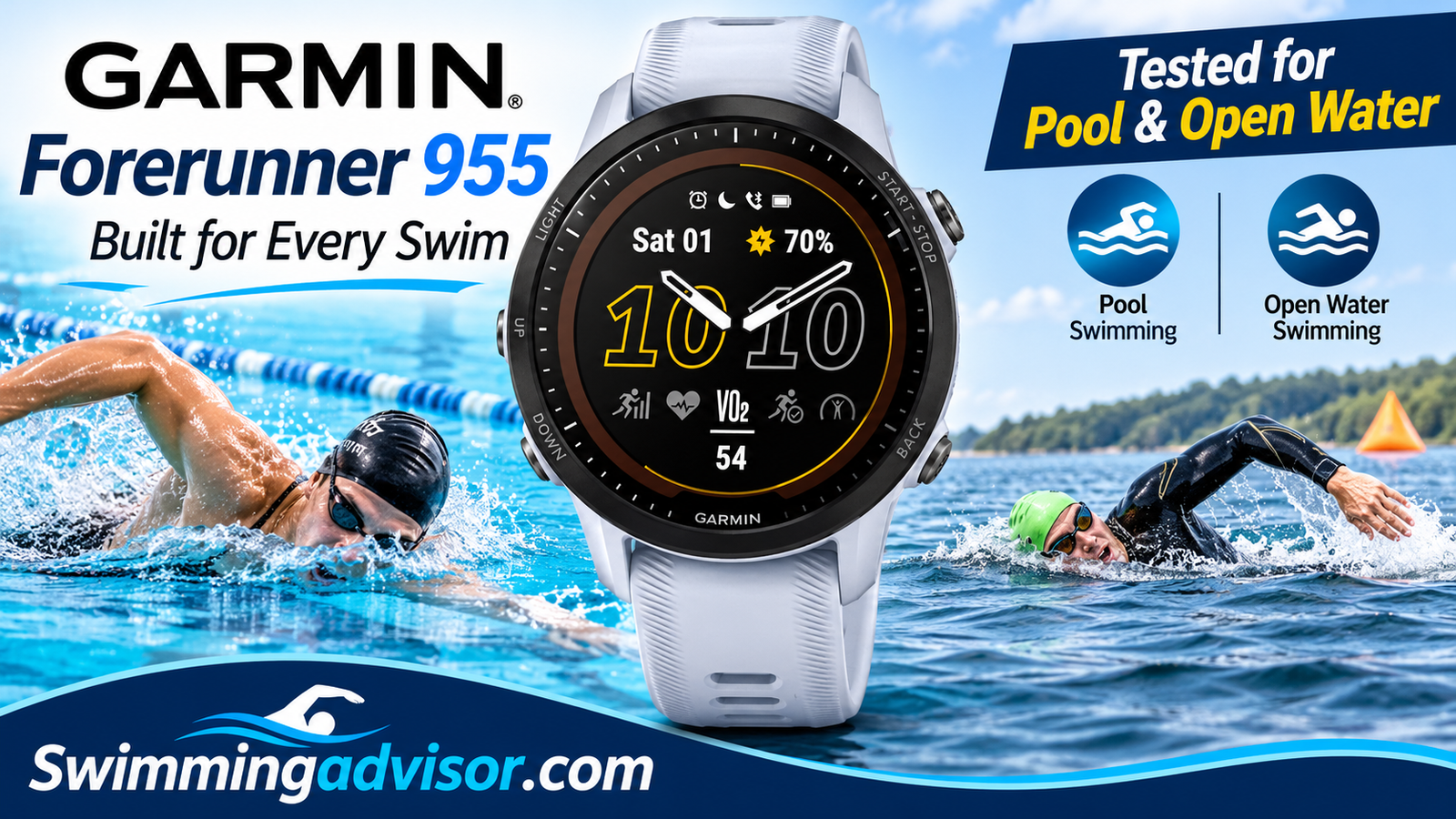
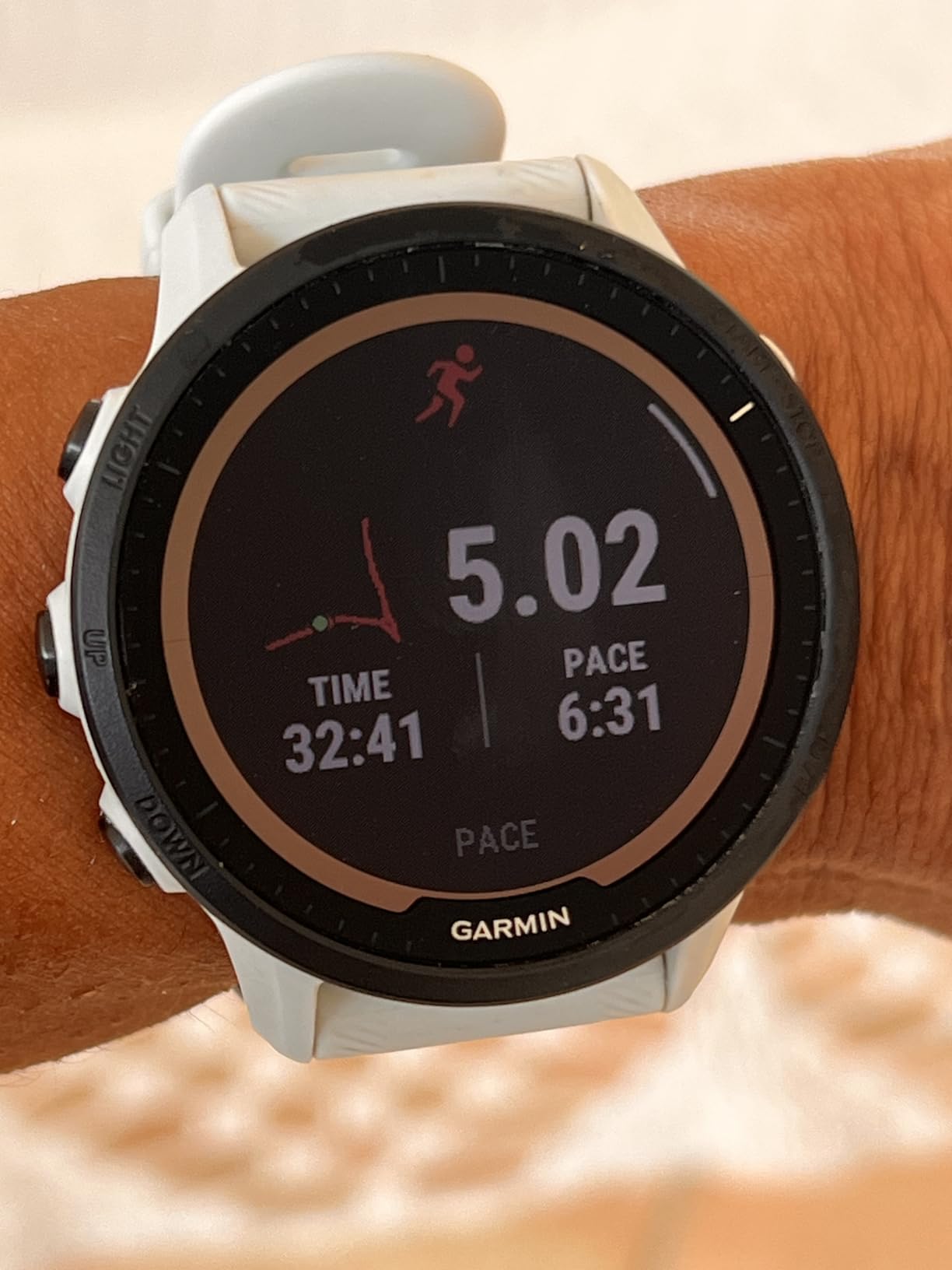
Why This Review Is Different
Most GPS watch reviews are written by runners who dip into the pool once a week and call it cross-training. This one flips that. Everything you are about to read comes from a swimmer’s point of view: how the watch counts laps when you switch strokes mid-set, whether it survives a season of chlorinated water, what happens when you press buttons with wet hands at the wall, and how useful the data actually is once you are standing in the shower wondering if the session moved you forward.
The Garmin Forerunner 955 is a flagship multisport watch, and the marketing naturally leans toward running, cycling and triathlon. But swimming is one of the places where a watch has to earn its keep in a completely different way. On land, GPS does the heavy lifting. In a pool, there is no satellite signal at all — the watch has to infer distance from accelerometers, turns, stroke counts and your own pool-length setting. In open water, the GPS signal only reaches the watch during the brief seconds your wrist is above the surface. Both environments punish sloppy engineering, and both reward a watch that has been tuned by people who understand the rhythm of a swim set.
So the question this review answers is not “is the Forerunner 955 a good watch?” — that has been settled by plenty of people. The question is narrower and, for swimmers, far more useful: how well does it swim? Where does it shine, where does it cut corners, and what should you know before you rely on it to guide your training?
Along the way, we will cover stroke detection, lap counting quirks, open water track quality, heart rate limitations underwater, the training metrics that matter to swimmers and the ones that can mislead them, battery management across a week of sessions, and the small maintenance habits that decide whether the watch still looks new after a year of pool decks and lake shores. If you are still deciding between a swim-specific tracker and a do-everything multisport watch, our broader best swimming watches roundup is worth a read first — then come back here for the deep dive.
See the Garmin Forerunner 955 on Amazon
Current pricing, available band options, and stock in one place.
Check Price on Amazon1. Design, Build & Fit for the Pool
Before you ever press “start” on a swim profile, the physical shape of a watch decides half of your experience. A watch that is too tall catches on the lane rope when you push off. A strap that holds water drags on your wrist during the recovery phase. A case that sits proud of the skin collects a ring of grit from the pool deck. The Forerunner 955 gets most of this right, and it is worth explaining why in practical terms rather than in millimetres.
The case is lean by multisport standards. It does not have the chunky, tool-watch presence of an adventure-focused model, and that is a genuine advantage in the water. During a long freestyle set, the back of your hand passes close to your head at the front of the stroke; a thick case turns that into an occasional knock. The 955 simply does not get in the way, whether you swim freestyle, backstroke, or a drill-heavy session where the hands move through unusual paths.
Strap behaviour in and out of the water
The silicone strap is the right material for swimmers. It does not absorb water, it rinses clean, and it dries quickly enough that you can put the watch back on after a shower without that clammy feeling. The perforations help drainage and also let you fine-tune the fit more precisely than a plain strap — and fit matters enormously for swim tracking. A watch that slides around on the wrist during the pull phase registers phantom movement and can nudge the stroke count off.
Our practical advice is simple: wear it slightly tighter than you would for everyday use, and position it about two finger-widths above the wrist bone. Tight enough that it does not rotate when you grip the wall, loose enough that it does not leave a mark after a two-hour session. That single habit fixes more swim-tracking problems than any setting in the menu.
Weight, balance and the wetsuit question
Weight is one of those specs that sounds irrelevant until kilometre six of an open water swim, at which point anything annoying becomes infuriating. The 955 feels light on the wrist, and because the mass is concentrated close to the skin rather than stacked outward, it stays put. If you swim in a wetsuit, you will want to experiment with placement: under the sleeve is more comfortable but can compress the strap, while wearing the watch over the sleeve keeps the display accessible but can shift during the stroke. There is no universally right answer — it depends on your sleeve length and how tight the suit is at the forearm.
For pool swimmers who also use equipment days, the slim case is a quiet win. When you wear swim paddles, the strap sits under the paddle’s wrist band; a bulky case creates pressure points there, while the 955’s flatter profile mostly avoids that conflict.
What the design gets right for daily wear
Swimmers tend to be watch-averse people. You take a watch off for the pool, the shower, the sauna and sleep — and then you stop wearing it at all. A swim watch only delivers value if you can leave it on between sessions so it keeps collecting recovery and sleep data. The 955’s comfort profile makes that realistic. It is understated enough to wear with a shirt, light enough to sleep in, and it does not look like a piece of sporting equipment at dinner.
The corollary is that you should treat it like a piece of sporting equipment anyway. Rinse it after every swim. Dry the strap before you forget. Small habits, long service life — more on that in the care section further down.
Ready to See It in Person?
Check band choices and current availability before you commit.
Check Price on Amazon2. Pool Swim Tracking Accuracy: Laps, Strokes and SWOLF
This is the core of the review for most readers, so let us be precise about how pool tracking works and where the errors come from. Indoors, the watch cannot use satellite positioning. Instead, it detects your movement pattern through motion sensors, identifies the moment you push off the wall — the strongest, most consistent acceleration in any swim stroke — and counts that as one length. Distance is then a simple calculation: lengths swum multiplied by the pool length you entered when starting the activity.
That means the single most important setting on the entire watch is the pool length value. If your pool is 25 metres and you start a 25-yard profile, every single session will be wrong in a consistent, invisible way. The watch will look accurate because the lap counts are right; the total distance will quietly be off by several percent. Set it once, set it correctly, and the foundation of your data becomes solid.
Lap counting: where it is strong
For continuous freestyle — the bread and butter of most fitness and masters swimmers — the 955 counts lengths with impressive reliability. Strong push-offs are unambiguous signals, and the algorithm recognises the classic glide-to-stroke transition. The same is generally true for backstroke, where the push-off is equally distinct.
Where the counting gets more interesting is in the messy reality of a real training session: drills, kick sets, pull sets with a buoy, rest intervals at the wall, and mid-lane pauses. The watch handles kick sets reasonably because the push-off is still there, but any set where you stop in the middle of a length — to adjust a goggle, to chat, to fix a strap — can trick the counter into thinking you have finished a length and started another.
- Keep mid-lane stops short. The longer you hang in the middle of a length, the more likely the algorithm is to misread it.
- Use the drill mode for drill sets. Drills break the stroke pattern on purpose, so the automatic detection has less to work with; drill mode lets you log distance manually while still recording the time.
- Push off firmly and streamline for a moment. A clean push-off is the anchor point for the entire count.
- Rest at the wall with the watch still. Deliberate stillness helps the watch understand that a rest interval is a rest, not movement.
Stroke detection and stroke count
The 955 recognises the common pool strokes and will label your lengths accordingly, which is more useful than it sounds. When you review a session, you can see where you switched from freestyle to breaststroke, and how the stroke count per length changed as fatigue set in. That is real coaching information: a rising stroke count at the same pace is a fairly honest signal that your technique is deteriorating, not just your fitness.
Automatic stroke detection is not infallible, and it is least reliable in two situations. First, mixed-stroke sets like individual medley, where the transitions between strokes happen at the wall and the watch has a fraction of a second to reclassify. Second, technically unusual swimmers — people with an exceptionally long glide, a two-beat kick that is almost motionless, or a very short stroke rate. If you fall into those categories, expect occasional mislabelling of the stroke type even when the distance is perfect.
SWOLF: the swimmer’s efficiency number
SWOLF — the sum of your time and your stroke count for a length — is the closest thing swimming has to a running cadence-plus-pace metric. Lower is better, and it changes meaningfully with technique rather than just effort. The 955 calculates it automatically, and over weeks of training it becomes one of the most useful trends to watch, because it exposes technique drift long before your times get slower.
Two cautions. First, SWOLF is only comparable within the same pool and the same stroke; a 25-metre pool and a 50-metre pool produce different numbers because the turn count differs. Second, SWOLF is sensitive to how you swim a length — sprinting with a high stroke rate will produce a different number than cruising, so treat it as a relative measure inside similar sets, not as an absolute grade.
| Data Field | What It Tells You | How To Use It |
|---|---|---|
| Lengths / Distance | The raw volume of the session, counted from push-offs and your pool length setting. | The foundation of every other number. Verify the pool length setting first. |
| Pace per Length | How fast you are moving through the water for a given distance. | Compare like-for-like sets; expect it to vary with rest interval. |
| Stroke Count | How many strokes it takes you to complete a length. | Rising count at the same pace usually signals fatigue or slipping form. |
| SWOLF | A blend of speed and efficiency for the same stroke and pool. | Track the trend over weeks; ignore day-to-day noise. |
| Stroke Type | Which stroke the watch believes you swam on each length. | Useful for medley sets; correct it mentally if detection slips. |
One more practical note on accuracy. If you swim in a pool with unusual geometry — a very shallow teaching pool, a narrow endless setup, or lanes where you routinely swim half-lengths — the counting has a harder time, because the push-off pattern becomes irregular. In those environments, the watch is best treated as a reliable log of effort and time, with distance as an approximation.
Track Your Pool Sessions Properly
Check the current price and available versions on Amazon.
Check Price on Amazon3. Open Water Swim Performance: GPS Between the Strokes
Open water is where swim tracking turns from a counting problem into a signal problem, and it is where the hardware quality of a watch shows up most clearly. Here is the physical reality: the antenna is underwater for most of your stroke cycle. Your wrist is submerged during the catch and pull, and it only surfaces briefly during recovery — for freestyle, that window is a fraction of a second per stroke. The watch has to grab a satellite fix in those tiny windows, stitch the positions together, and produce a track that resembles the route you actually swam.
The 955 handles this about as well as any wrist-worn device reasonably can. Over a typical open water session, the resulting track is recognisable: you can see the shape of your loop, the direction of your out-and-back, and where you drifted off line. That last point is the underrated value of open water tracking. Most swimmers believe they swim straight. The GPS trace is the only honest witness, and it frequently shows a gentle arc toward the side you breathe on.
What affects track quality
Four variables matter more than the watch itself. Understanding them will save you a lot of frustration.
- Stroke and breathing pattern. A stroke with a long, high recovery gives the antenna more air time than a low, splashy one. Bilateral breathing means more consistent exposure on both sides.
- Water conditions. Chop, waves and boat wash scatter the signal and keep the wrist lower. Flat water produces cleaner tracks.
- Sighting habits. Lifting your head changes your body position and gives the watch an extra moment of exposure — but the real benefit is that you swim a straighter line.
- Start conditions. Acquiring satellites before you enter the water always beats starting the activity and swimming immediately.
A pre-swim routine worth adopting
Before an open water session, start the open water swim profile while you are still on shore or standing in the shallows. Wait for the satellite lock, confirm it, and only then push off. It costs you thirty seconds and it prevents the watch from spending the first hundred metres of your swim trying to establish a position from a submerged wrist — which is precisely the stretch of the track most likely to look odd.
During the swim, sight like a real open water swimmer rather than relying on the watch. Look up every few strokes to fix on a landmark. This is good practice regardless of technology, and as a side effect it gives the antenna slightly more exposure. If you want to build that habit systematically, our guide on how to improve swimming technique covers sighting and body position in more detail.
Distance accuracy in practice
Open water distance is always an estimate, and it will never match a mapped course to the metre. Wrist-worn GPS typically reports a little less distance than a course actually covers, because a straight-line approximation cuts the corners of your natural weaving. The practical approach is to treat the watch as a consistent measuring tool rather than a surveyor’s instrument. If the same route reads the same way over several swims, you can compare sessions confidently — and that consistency is what actually helps your training.
For swimmers who split their time between a backyard pool and open water, the same logic applies to the pool: consistency of setup matters more than perfection. If you train in a small inflatable pool for technique work and drills, our guide on what to put under an inflatable swimming pool will help protect the liner while you work on your catch.
Planning Open Water Sessions?
Grab the watch that keeps a track even when your wrist is under the surface.
Check Price on Amazon4. Underwater Heart Rate & the Case for External Sensors
Let us clear up one of the most misunderstood areas of swim watches: wrist-based heart rate in the water. Optical heart rate works by shining light into the skin and measuring how blood flow changes the reflection. On land, with the watch held steadily against the wrist by gravity and movement, it works well. Underwater, three things conspire against it. Water blocks and scatters the light. The watch moves more during the pull phase. And the cold constricts surface blood flow, which weakens the signal precisely when your effort rises.
The result is that wrist heart rate during swimming should be treated as indicative rather than precise. During steady aerobic sets, it will usually track in the right region. During intervals — where heart rate swings quickly and the wrist is moving hard — it is most likely to lag behind reality or drop out briefly. This is not a flaw specific to the 955; it is the nature of the technology in this environment.
Why this matters for training decisions
Swimmers who train by heart rate zones need to understand the consequence. If your intervals are being paced by a heart rate figure that lags by twenty or thirty seconds, you will overshoot the first rep and undershoot the last one. The fix is not to distrust the watch entirely — it is to use heart rate for the broad shape of the session and use pace per length, stroke count and perceived effort for the fine tuning.
The external sensor option
For swimmers who genuinely want accurate heart rate in the water, the practical solution is a chest-strap style sensor that records internally and syncs after the session. It cannot stream live to the watch while you are submerged, because the wireless signal does not travel well through water — but it records the data on its own memory and merges it into the activity afterwards. That gives you clean interval data for analysis without pretending the wrist sensor can do something it cannot.
Is it worth it? For recreational fitness swimmers, no. For masters swimmers, triathletes and anyone following a structured programme with zone-based sessions, it is one of the few accessories that materially changes the quality of your data. If you are still exploring complementary equipment, our roundups of the best swim snorkels and the best swimming kickboards cover the tools that pair naturally with metric-driven training.
A note on honesty in data
The most common mistake swimmers make with a new watch is chasing every number on the first week. Heart rate, SWOLF, stroke count, training status, recovery time — all of it feels urgent. Give the data three weeks before you act on it. Trends matter; single sessions mostly do not.
Get the Full Picture on Your Wrist
See current pricing and what is included in the box.
Check Price on Amazon5. Multisport, Triathlon & Brick Days
Where the Forerunner 955 earns its premium over a swim-only tracker is the day you string disciplines together. A triathlon watch has to move from pool or open water straight into cycling and running without losing the thread of the session, and the transitions have to be quick enough that you are not fighting a menu while standing in a wet wetsuit.
The multisport workflow is straightforward once you have done it twice. You select the triathlon or custom multisport profile, the watch sequences the legs in order, and a single button press moves you from one discipline to the next. In transition, that is the difference between a device that supports you and one that interrupts you. The button-based interface matters here — see the usability section below for why touchscreens struggle at this exact moment.
Transitions: small details, real time saved
There are a few habits worth building before race day so that nothing on the watch surprises you.
- Practise the transition press at home with wet hands, so muscle memory takes over.
- Decide in advance whether the watch sits under or over your wetsuit sleeve, and stick to it.
- Check that the strap is snug before the swim; you will not want to adjust it in transition.
- Practise the full sequence at least once in training — a short swim-to-bike brick is ideal.
Swim leg data inside a triathlon
Within a multisport activity, the swim leg records exactly the same metrics as a standalone swim: distance, pace, stroke count and stroke type for pool sessions, and GPS track and distance for open water. After the event, you can review each leg separately as well as the combined activity, which makes post-race analysis genuinely useful. You can see whether you swam harder than planned and paid for it on the bike — the classic amateur triathlon mistake.
| Moment | What The Watch Does | What You Should Do |
|---|---|---|
| Pre-race | Waits for satellite and sensor lock in the chosen multisport profile. | Start the profile early and stand still until it confirms lock. |
| Swim leg | Records distance, pace and stroke data, then waits for your transition input. | Push off cleanly at the start and avoid mid-length stops. |
| Transition | Moves to the next discipline with a single button press. | Practise the press with wet hands so it becomes automatic. |
| Bike and run | Carries the session forward and links the legs into one activity. | Ignore the watch for the first few minutes; settle into rhythm. |
| Finish | Saves a combined activity plus per-leg summaries. | Rinse the watch after the event, especially after open water. |
Pool-based triathlon training
Plenty of triathletes never touch open water before race day, which is a coaching problem rather than a technology problem. If you are building race readiness in a pool, the 955 lets you structure brick sessions indoors — swim set, quick transition, then straight onto the bike trainer — and keeps all of it in one activity. It is not glamorous, but it rehearses exactly the decisions you will make on race morning.
If your pool training includes equipment work to build open water strength, take a look at our guide to the benefits of hand paddles for swimming — paddles build the pulling power that wetsuit swimming rewards.
Build Your Tri Setup Around One Watch
Check availability and bundle options on Amazon.
Check Price on Amazon6. Training Metrics, Structured Workouts & Coaching Tools
Data is only worth collecting if it changes what you do on Tuesday morning. The 955 sits at the top of Garmin’s training-analysis stack, and while much of that ecosystem was built for runners, several of its features translate to swimming with surprising usefulness — provided you understand what the algorithms can and cannot see.
Structured workouts on the wrist
You can build swim workouts with intervals, rest periods, drills and repeats, then send them to the watch and follow them step by step in the water. The watch buzzes at the end of each interval and shows the next target, which is far better than trying to remember a set written on a whiteboard. For anyone training alone — which is most recreational swimmers — this is one of the most valuable features on the device, because it removes the mental load of counting repeats and lets you concentrate on technique.
Building workouts takes a little patience the first time. Once you have a library of your usual sessions — an endurance set, a threshold set, a technique day, an easy recovery swim — the process becomes quick, and you will find yourself rotating through them the way a coach would.
Load, recovery and training status
Features that track training load, recovery time and readiness are genuinely helpful for swimmers who also run or cycle, because they unify effort across disciplines. A hard swim session and a hard run both contribute to the same picture, and the watch will tell you when the cumulative load is climbing faster than your body is adapting.
For pure swimmers, the caveat is that the algorithms are tuned heavily toward activities with reliable pace and heart rate data. Pool swimming provides pace reliably but heart rate imperfectly, so the load numbers can read slightly lower than the effort felt. Treat them as a directional guide: if the watch says your load is rising and you feel flat, believe the feeling and back off.
VO2 max, pace trends and the long view
Over months, the real payoff is trend data. Watch your pace per length on a standard set — say, ten repeats at a fixed effort — and the slow drift upward or downward tells you more about your fitness than any single race result. Pair that with stroke count trends and you have a simple, honest picture of whether your technique and your engine are both improving.
This is also where swimming connects to the rest of your health picture. If you are swimming partly for body composition, our pieces on whether swimming helps you lose weight and whether swimming builds muscle set realistic expectations about what pool time can and cannot do.
Three metrics worth checking every week
Average pace on a standard set. Same set, same effort, same pool — the only fair comparison.
Stroke count per length. Rising at the same pace usually means fatigue or drifting form.
Session frequency. The simplest metric of all, and still the one that predicts improvement best.
Train With Structure, Not Guesswork
See current pricing for the Forerunner 955 on Amazon.
Check Price on Amazon7. Battery Life & Charging Habits for Swimmers
Battery behaviour is where a lot of reviews lose touch with how people actually use a watch. Nobody sits down and calculates theoretical runtime. What you experience is a nagging question in the back of your mind: will it make it through tomorrow’s session? For swimmers, the answer depends far more on habits than on the marketing figure.
The 955 is comfortably a multi-day device in normal smartwatch use, and it will handle a week of regular swim sessions without anxiety if you are not running long GPS activities every single day. Open water swims and long multisport sessions consume more, because the satellite receiver is active for the duration. The practical takeaway: if you swim indoors most days and do one long outdoor session at the weekend, charging once a week is realistic.
Charging rituals that actually work
- Charge on a schedule, not when the warning appears. Pick a consistent moment — after your Sunday swim, for instance — and it becomes automatic.
- Rinse and dry before charging. Never seat a wet watch on a charger; residual chlorine or salt at the contacts does slow damage.
- Charge while you shower and change. Fifteen minutes here and there keeps the level high without ever taking the watch off for long.
- Top up before travel. If you are heading to a swim camp or a race, start at full and turn off features you are not using.
Settings that quietly save power
Most of the battery drain on a watch like this comes from features that are nice rather than essential. Always-on display, frequent background health measurements, music storage and playback, and extended satellite modes all add up. For a swim-focused week, you can turn several of these off without losing anything you use in the pool. The pool swim profile does not need satellite positioning at all, so an indoor session is already efficient.
| Your Week | What Drains Power | Sensible Charging Habit |
|---|---|---|
| Pool-only training | Screen time, background health tracking, notifications. | A short top-up after your longest session of the week. |
| Mixed pool and open water | Extended satellite use during outdoor swims. | Charge the evening before any open water day. |
| Triathlon or brick training | Long multi-hour activities with sensors and GPS active. | Top up after every long session; never start a long day below half. |
| Travel and swim camps | Extra sessions, unfamiliar pools, extra tracking. | Bring the cable, charge during meals, disable unused features. |
The larger point is psychological. A watch you trust to be on your wrist when the session starts is a watch whose data becomes meaningful. Build the charging habit early, and the battery stops being a topic of conversation entirely.
Spend More Time Swimming, Less Time Charging
Compare current listings and what ships with your order.
Check Price on Amazon8. Display, Buttons & Wet-Hand Usability
Here is a scenario every swimmer knows: you finish a hard interval, you grab the wall, your hands are streaming water, your goggles are fogged, and you have fifteen seconds of rest to check your split. In that moment, the interface design of a watch matters more than any feature list. This is where button-controlled watches quietly outclass touchscreen-first devices, and where the 955 shows its experience.
Physical buttons work when wet. Touchscreens generally do not — water on the surface registers as phantom taps, and wet fingers slide instead of press. The 955 keeps a button-first interface, which means you can start, lap, scroll and stop a swim without ever looking at the screen properly. After a few sessions, it becomes muscle memory, and that is exactly what you want.
Reading the screen at the wall
Display legibility in a bright, humid indoor pool is different from legibility on a sunny run. Glare off the water, condensation on the face, and the angle at which you hold your wrist all matter. The 955’s screen is clear and high-contrast, and the data fields during a swim are large enough to read with a quick glance — which is realistically all you get during a rest interval.
- Keep the swim screen simple. Two or three fields maximum: elapsed time, distance, and pace or last split.
- Turn off the fields you do not use mid-set. More data on the screen means more searching with tired eyes.
- Use the lap button deliberately. Pressing it at the wall gives you clean interval splits instead of auto-detected guesses.
- Check the big numbers afterwards. Detailed analysis belongs on a phone or laptop, not at the wall.
Menus and accidental presses
The other wet-hand risk is the accidental press — starting a second activity while towelling off, or scrolling past a menu you wanted. The 955’s button layout and travel reduce this, and a quick look at the lock behaviour before your first swim is worthwhile. Knowing how to lock and unlock the controls while your hands are wet removes a whole category of irritation.
Glove and wetsuit users should note that buttons also work through neoprene far more reliably than touch does, which is another point in favour of this approach for open water swimmers.
Designed to Be Used With Wet Hands
Check the Forerunner 955’s current price on Amazon.
Check Price on Amazon9. Smart Features & Everyday Wear Between Sessions
A swim watch that only gets worn in the pool is a swim watch that misses half its value. The 955’s usefulness depends on you wearing it the rest of the day and night, so the everyday experience deserves serious attention: notifications, payments, music, sleep tracking and the general comfort of having it on while typing, cooking and sleeping.
Notifications, payments and music
Phone notifications arrive reliably and are legible without pulling out your phone — useful in the moments between a swim and the next part of your day. Contactless payments work for the classic post-swim coffee, which is a small delight the first time you use it with damp hands and no wallet. Music storage lets you leave your phone in your bag and take audio with you on a run or to the poolside — though of course headphones and water remain uneasy partners, so this is mostly a land-based feature for swimmers.
Sleep, recovery and the overnight picture
Sleep tracking is where a multisport watch starts to justify its price for athletes. Swimmers who train early benefit enormously from knowing whether last night’s sleep supported this morning’s session. Over weeks, patterns emerge: the nights that precede good sessions, the late meals that cost you depth, the rest days that actually restore you.
Pair this with the readiness and recovery features and you get a genuinely practical decision tool. Not a perfect one — no wrist device measures sleep stages with laboratory accuracy — but a consistent one, and consistency is what turns data into behaviour change.
Daily wear comfort
Between sessions, the watch is light enough to forget. That sounds like faint praise, but it is the single biggest predictor of whether an athlete keeps wearing a device three months later. Heavy watches get left on the dresser; comfortable ones become part of your routine. If you are swimming for health reasons rather than competition — for your back, for stress, for general fitness — the daily wear experience is arguably more important than the swim tracking itself. Our guide on whether swimming is good for your back and another on swimming and anxiety explore those benefits in depth.
10. Water Resistance, Chlorine, Salt & Long-Term Care
Any watch rated for swimming will handle a normal pool session on day one. The real test is what happens after two hundred of them. Chlorine is a mild but persistent chemical attack on seals and strap materials; salt water is worse, because crystals form as it dries and grind into every gap. The difference between a watch that looks new after a year and one with clouded sensors and a brittle strap comes down to habits, and those habits cost you thirty seconds per session.
The post-swim routine
- Rinse in fresh water immediately. Not later, not when you get home. Immediately.
- Wash the strap separately. A drop of mild soap once a week removes the film that chlorine leaves behind.
- Dry before charging or storing. Water sitting at the charging contacts is the most common avoidable issue.
- Keep it out of hot environments. Saunas, hot tubs and hot car dashboards degrade seals faster than swimming ever will.
- Check the sensor window. A soft cloth over the back keeps optical sensors clean and accurate.
| Environment | What It Does To A Watch | What You Should Do |
|---|---|---|
| Chlorinated pool | Dries out seals and strap material over time; leaves a residue film. | Rinse straight after the session and wash the strap weekly. |
| Salt water | Leaves abrasive crystals in gaps and speeds corrosion of exposed metal. | Fresh water rinse as soon as possible; dry thoroughly afterwards. |
| Fresh lake or river | Grit and silt work into the strap and button seams. | Rinse, then check the buttons move freely before drying. |
| Hot tub or sauna | Heat and chemicals together age seals much faster than swimming. | Take it off. This is the single easiest way to extend its life. |
Chlorine and the rest of you
While we are on the subject of chlorine, it is worth remembering that your hair and skin absorb far more of it than your watch does. Rinsing before you swim — yes, before — reduces how much chlorine your hair binds in the first place, and a proper post-swim wash makes a noticeable difference over a season. We cover the specifics in our guide on whether chlorine is bad for your hair, and if you want a proper post-swim cleanse, see our pick of the best chlorine removal body washes.
For swimmers training in smaller or temporary pools where water chemistry is managed at home, the maintenance side is a project of its own — our guide to the chemicals needed for inflatable swimming pools is a solid starting point.
Keep Your Gear In Good Shape
Browse swim watch accessories and care essentials on Amazon.
Shop Swim Watch Accessories on Amazon11. How the Forerunner 955 Compares to Swim-Focused Alternatives
No watch exists in a vacuum, and a fair review should tell you when a different tool is the better answer. The 955 is a do-everything watch with excellent swim support. If swimming is your only sport, or if you want a very specific kind of swim data, other options deserve a look. Below is an honest comparison of the categories we have tested alongside it — read the linked full reviews for the details on each.
| Watch | Best For | Swim Tracking | Verdict | Read More |
|---|---|---|---|---|
| Top PickGarmin Forerunner 955 | Swimmers who also run, ride or race triathlon | Pool lap counting, stroke detection, SWOLF, open water GPS track | The complete package if swimming is one of several sports. | Check Price on Amazon |
| Garmin Swim 2 | Dedicated pool and open water swimmers on a lighter budget | Focused swim features without the full multisport stack | Simpler, swim-first, and easier to justify for pool-only use. | Read Full Review |
| Coros Pace 3 | Lightweight training watch buyers who swim and run | Pool and open water modes with clean, simple data | A featherweight alternative with a strong training focus. | Read Full Review |
| Form Smart Swim Goggles | Swimmers who want data in their line of sight | Heads-up display showing splits and metrics live | Completely different experience — see the data while you swim. | Read Full Review |
| Apple Watch Ultra 2 | Swimmers deep in the Apple ecosystem | Capable pool and open water tracking with a polished app | Excellent hardware; training depth depends on third-party apps. | Read Full Review |
When a swim-only tracker is the smarter buy
If you swim three times a week and never run or cycle, a large part of what makes the 955 special goes unused. In that case, a swim-focused tracker gives you the same pool metrics in a simpler, lighter package and leaves money in your pocket. Our best Garmin swimming watch guide lays out the trade-offs within the range, and if budget is the deciding factor, start with our look at affordable swimming watches.
When the 955 is clearly the right choice
Conversely, if your week contains a swim, a run, a ride and a strength session — or if you are training toward a triathlon or a long open water event — the 955 is in its element. Nothing else in this comparison puts pool metrics, open water GPS, training load analysis, mapping and everyday smartwatch features into a single, comfortable device. For open water specialists who want maximum outdoor tracking confidence, our guide to the best open water swimming watches covers the alternatives worth considering.
Compare Prices Before You Decide
See the Forerunner 955’s current listing on Amazon.
Check Price on Amazon12. Value, Buying Advice & Who Should Buy It
Reviews tend to end with a score and move on. Swimmers deserve a more useful conclusion: a clear picture of who will be happy, who will be disappointed, and what to think about before spending the money.
The honest pros and cons
| Pros | Cons |
|---|---|
|
|
Who should buy it
- Multisport athletes who want one watch for swim, bike and run, including race day.
- Triathletes in training who need reliable swim legs inside a combined activity.
- Data-minded swimmers who will actually use SWOLF, stroke count and workout structure.
- Open water swimmers who value a GPS track that shows where they really went.
- Swimmers who also want daily health tracking and will wear the watch between sessions.
Who should look elsewhere
- Purely recreational pool swimmers who want simple lap counts and nothing more.
- Swimmers who train by precise heart rate zones and refuse to use a chest sensor.
- Anyone on a tight budget who will never use the running, cycling or mapping features.
- Swimmers who dislike wearing anything on the wrist — a heads-up display may suit them better.
Getting the most out of it: a short checklist
Before your first swim, set the pool length correctly. After your first swim, rinse the watch. Before your first open water session, wait for satellite lock on shore. After your first month, look at the trends rather than the individual sessions. Those four habits will deliver more value than any additional accessory you can buy.
And if you are building out the rest of your kit, there is no shortage of worthwhile additions. A good pair of swim paddles builds pulling strength, a swim bag keeps the routine organised, and a set of kickboards gives you technique days that the watch will log beautifully.
Decide With The Full Picture
Check today’s price and available options on Amazon.
Check Price on AmazonFrequently Asked Questions
Does the Garmin Forerunner 955 count laps accurately in a pool?
For continuous swimming — especially freestyle and backstroke — lap counting is reliably good. Accuracy drops when you stop mid-length, swim drills that break your stroke pattern, or use unusual turns. Setting the correct pool length before you start is the single most important step, because distance is calculated from lengths multiplied by that setting.
Can I use it for open water swimming?
Yes. The open water swim profile uses satellite positioning to build a route track and estimate distance. Because your wrist is underwater for most of the stroke cycle, the track is an approximation rather than a survey — but it is consistent enough to compare sessions and, importantly, to show whether you swim straight.
Does it measure heart rate while swimming?
It records wrist-based heart rate in the water, but optical sensors struggle underwater because of water interference, wrist movement and cold. During steady sets the readings are broadly useful; during hard intervals expect lag or gaps. Swimmers who train by heart rate zones usually pair it with a chest-style sensor that records internally and syncs after the swim.
Is it suitable for triathlon training and racing?
Very much so. Multisport profiles sequence swim, bike and run legs with a single button press per transition, and the combined activity can be reviewed both as a whole and leg by leg. It is one of the strongest reasons to choose this watch over a swim-only tracker.
How should I wear it for the most accurate swim tracking?
Snug, and roughly two finger-widths above the wrist bone. A watch that slides during the pull phase registers phantom movement and can nudge stroke counts. For open water swimming in a wetsuit, decide in advance whether it sits under or over the sleeve and keep that consistent.
Will chlorine damage it over time?
Not with basic care. Chlorine gradually dries seals and strap materials, so rinse the watch in fresh water immediately after every pool session, wash the strap weekly with mild soap, and dry everything before charging or storing. Avoid hot tubs and saunas, which age seals far faster than swimming.
What is SWOLF and is it worth watching?
SWOLF combines your time and stroke count for a length — lower is better. It is one of the most useful swimmer-specific metrics because it reflects efficiency rather than raw effort. Compare it only within the same stroke and the same pool, and pay attention to the trend over weeks rather than any single swim.
How often will I need to charge it?
For a typical week of pool sessions plus one longer outdoor session, charging once a week is realistic. Long open water swims, extended multisport sessions, music playback and always-on display all draw more power. A simple habit — short top-ups after your longest session — removes the anxiety entirely.
Can I create my own swim workouts on it?
Yes. You can build interval-based swim workouts with repeats, rest periods and drills, then follow them on the watch with alerts between intervals. For swimmers training without a coach, this is one of the most valuable features on the device because it removes the mental load of counting sets.
Is it overkill if I only swim?
Possibly. If you never run or cycle, a swim-focused tracker covers pool metrics in a simpler package and costs less. The 955 makes sense when you want swim tracking alongside running, cycling, triathlon, training-load analysis and daily health monitoring in one device.
Does it work for beginners, or is it only for serious swimmers?
Beginners benefit too — lap counting removes the most common frustration of pool swimming, which is losing count. The trick is not to drown in data at the start. Watch distance, time and stroke count first, and only start using the deeper metrics once swimming regularly feels automatic.
Final Verdict: A Watch That Swims as Well as It Runs
After weeks of pool sessions, open water swims and the everyday wear that connects them, the picture is clear. The Garmin Forerunner 955 is not a swim watch that happens to do other sports — it is a genuinely capable multisport watch that takes swimming seriously, and that is a rarer thing than it sounds.
In the pool, it counts laps reliably for continuous swimming, detects strokes well enough to be useful, and gives you SWOLF and stroke-count trends that actually tell you something about your technique. In open water, it produces a track that reflects the route you swam and quietly reveals whether you swim straight. Underwater heart rate is the one area where physics wins, and the practical answer is either to use it loosely or to pair the watch with an external sensor.
Around all of that, the supporting experience is strong: buttons that work with wet hands, a screen you can read at the wall, structured workouts you can follow without a coach, battery life that disappears into your week with a little discipline, and a comfortable enough design that you will keep wearing it long after the novelty fades. That last point matters more than any single metric, because a watch left in a drawer collects nothing.
If you swim, run and ride — or you are building toward a triathlon or a long open water event — this is an easy recommendation. If you only swim and want something simpler and cheaper, a swim-focused tracker will serve you well and our wider guides will help you choose. Either way, the real improvement in your swimming comes from showing up consistently, and a good watch is simply a tool that makes showing up a little easier to measure.
Take the Garmin Forerunner 955 to the Pool
Check the current price and available options today.
Check Price on Amazon