Best Swim Paddles: The Complete Buyer’s Guide for Faster, Stronger Strokes
We compared hand shape, strap systems, drag profiles, and durability across the most popular swim paddles on the market to help you pick the right pair for your training goals.


Introduction: Why Swim Paddles Belong in Your Training Bag
Ask any competitive swimmer or dedicated masters athlete what single piece of equipment reshaped their stroke the fastest, and there’s a good chance they’ll point to a pair of swim paddles. Unlike fins, which primarily target kick propulsion, paddles zero in on the upper body — the catch, the pull, and the finish — turning every lap into a targeted strength and technique session. The resistance they add forces your shoulders, lats, and forearms to work harder per stroke, while the increased surface area gives you immediate, tactile feedback about whether your hand entry is clean or whether you’re slipping water on the catch.
But not all paddles are created equal. Some are built for sprinters chasing raw power, others for triathletes who want a gentler introduction to resistance training, and others still for swimmers recovering from shoulder issues who need a low-strain option that still builds feel for the water. Sifting through dozens of models with different strap systems, drainage holes, and hand-shape philosophies can be overwhelming, especially if you’ve never used paddles before and aren’t sure how aggressive a design you can handle.
That’s exactly what this guide sorts out. We dug into nine of the most talked-about swim paddles on the market today, comparing their sizing options, strap durability, tether systems, and overall feel in the water. Whether you’re after a general daily-training pair or a super low-drag, sculling-focused paddle to fine-tune your catch, you’ll find a fit below. If you’re still unclear on what these tools actually accomplish, our breakdown of what swim paddles do is a useful companion read before diving into the reviews.
Ready to upgrade your stroke? See our top overall pick for swim paddles.
Check Price on AmazonHow We Chose These Paddles
Every paddle on this list was evaluated against the same core criteria so the comparisons would actually mean something. We looked closely at hand-shape ergonomics (does the paddle track the natural contour of the palm, or does it force an unnatural grip), strap quality (silicone tends to outlast rubber, and double-strap systems are generally more secure than single-strap tethers), drainage and drag profile (more holes usually mean a gentler paddle better suited to beginners and rehab swimmers), sizing range (a paddle that only comes in one size is a dealbreaker for a lot of swimmers), and overall value relative to comparable options.
We also paid attention to real swimmer feedback around common failure points — wrist strap snapping, tether cord fraying, or paddles that dig uncomfortably into the base of the fingers during long sets. A paddle can look great in a marketing photo and still be miserable to use across a 3,000-yard main set, so durability and comfort during sustained use mattered just as much as first impressions.
Quick Comparison Table
| Paddle | Best For | Drag Level | Strap Type | Sizing |
|---|---|---|---|---|
| Sporti Power Swim Hand Paddles | All-around training | Medium-High | Double strap | Multiple sizes |
| INIS Agility Floating Swim Paddles | Technique & catch feel | Low-Medium | Tether-free | One size, adjustable fit |
| Contour Swim Paddles Hand | Ergonomic comfort | Medium | Single strap | Multiple sizes |
| Speedo Swim Paddles | Beginners | Low | Single strap | Multiple sizes |
| TYR Catalyst Stroke Swim Paddles | Competitive sprinters | High | Double strap | Multiple sizes |
| Motionchic Hand Paddles | Budget training | Medium | Double strap | Multiple sizes |
| Arena Elite Finger Swimming Paddle | Sculling & drills | Very Low | Finger loop | Multiple sizes |
| Hikeen Curved Swim Hand Paddles | Shoulder-friendly power | Medium-High | Double strap | Multiple sizes |
| HacoFlash Swim Paddles | Value all-rounder | Medium | Double strap | Multiple sizes |
1. Sporti Power Swim Hand Paddles

The Sporti Power paddle is one of the most balanced options on this list. It’s not the most aggressive paddle you can buy, nor the gentlest — it sits comfortably in the middle, which is exactly why it tends to become a swimmer’s daily driver rather than a specialty tool pulled out only on power days.
The contoured shell follows the natural curve of the hand fairly closely, which helps reduce the awkward “flat plate” feeling that cheaper paddles are notorious for. The double-strap setup, one across the fingers and one across the wrist, keeps the paddle locked in place even during flip turns and hard push-offs, which is where a lot of single-strap paddles tend to shift or twist.
Pros
- Balanced medium-high drag suits most training levels
- Secure double-strap design resists shifting
- Wide size range fits juniors through adults
- Reasonably priced for the build quality
Cons
- Straps can feel stiff for the first few sessions
- Not ideal for swimmers with existing shoulder issues
Sporti Power Swim Hand Paddles — reliable, balanced, and built for daily training.
Check Price on Amazon2. INIS Agility Floating Swim Paddles

If your goal is fixing a leaky catch rather than piling on brute-force resistance, the INIS Agility paddle is worth serious consideration. It ditches the traditional wrist strap entirely, relying instead on a small finger loop that lets the paddle float freely against the palm. That freedom is the whole point: any inefficiency in your hand entry or pull path is immediately obvious because the paddle will slip or twist if your technique breaks down.
This tether-free design also makes the paddle noticeably gentler on the shoulder joint, since there’s no strap forcing your wrist into a fixed position during the recovery phase. Coaches often recommend this style of paddle specifically for swimmers coming back from shoulder impingement or rotator cuff soreness.
Pros
- Excellent for correcting catch and hand-entry mechanics
- Shoulder-friendly, tether-free design
- Lightweight and comfortable for long technique sets
Cons
- Takes practice to keep the paddle from slipping off entirely
- Not designed for high-resistance power sets
INIS Agility Floating Swim Paddles — sharpen your catch with instant feedback.
Check Price on Amazon3. Contour Swim Paddles Hand

True to its name, the Contour paddle’s biggest selling point is comfort. The shell is molded with a deeper cup than most competitors, which cradles the palm rather than sitting flush against it like a flat plastic plate. Swimmers with wider hands in particular tend to prefer this fit, since narrower paddles can feel pinched at the edges.
The single-strap system is simpler than dual-strap competitors, which means less setup time between sets, though it does sacrifice a bit of the lockdown security you get from a two-point strap design.
Pros
- Deep, ergonomic cup reduces hand fatigue
- Quick on-and-off with single strap
- Good option for wider or larger hands
Cons
- Single strap loosens faster over long sessions
- Medium drag may feel underpowered for advanced sprinters
Contour Swim Paddles Hand — a deep, comfortable cup built for long training sessions.
Check Price on Amazon4. Speedo Swim Paddles

Speedo’s paddle lineup leans intentionally gentle, and that’s precisely why it earns a spot on this list as the go-to option for swimmers dipping their toes into paddle training for the first time. The lower drag profile means less strain on the shoulder while you’re still learning proper hand entry and stroke tempo with added resistance.
Brand recognition also counts for something here — replacement straps and sizing charts are easy to find, and the fit is fairly predictable across Speedo’s broader gear lineup, which is reassuring if you’re already using their goggles or swimsuits.
Pros
- Gentle, beginner-friendly drag level
- Widely available replacement parts
- Consistent, predictable sizing
Cons
- Advanced swimmers may outgrow the resistance quickly
- Basic strap design compared to premium competitors
Speedo Swim Paddles — an easy, low-strain entry point into paddle training.
Check Price on Amazon5. TYR Catalyst Stroke Swim Paddles

The TYR Catalyst is the paddle you reach for when the goal is raw pulling strength. Its larger surface area and minimal drainage create noticeably higher resistance than most of the paddles on this list, making it a favorite among competitive swimmers building race-pace power in the pull phase of their stroke.
That extra resistance is a double-edged sword, though. It’s genuinely effective for building strength, but it also places more load on the shoulder joint, so it’s not the paddle we’d recommend for swimmers who are new to resistance training or working through any shoulder sensitivity.
Pros
- High resistance builds serious pulling strength
- Secure double-strap lockdown for hard efforts
- Popular choice among competitive swim programs
Cons
- Too aggressive for beginners or rehab swimmers
- Higher shoulder strain if overused
TYR Catalyst Stroke Swim Paddles — serious resistance for competitive-level power work.
Check Price on Amazon6. Motionchic Hand Paddles
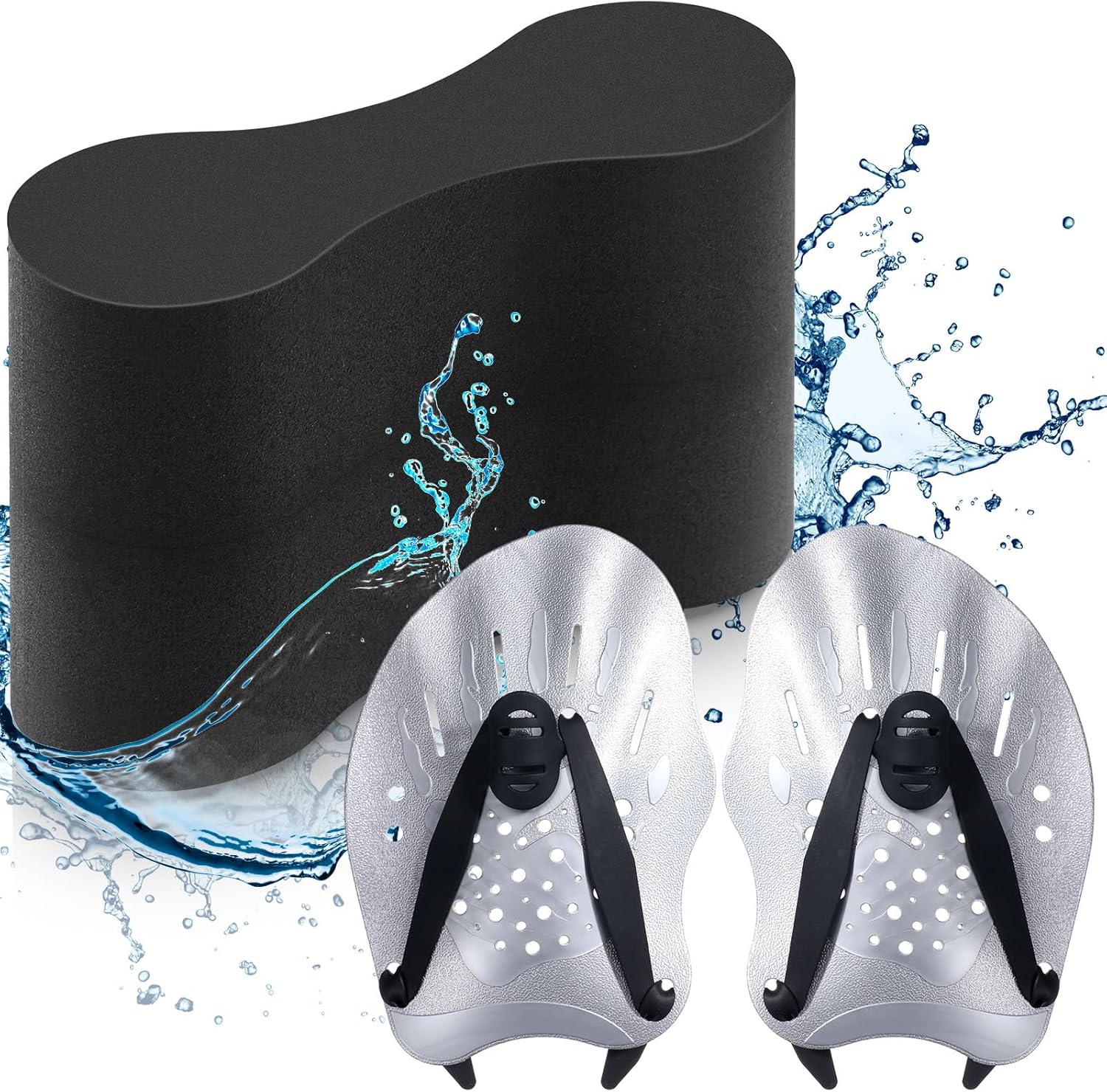
Motionchic’s paddle proves you don’t need a premium price tag to get a genuinely usable training tool. The medium-drag design and double-strap setup mirror what you’d find on paddles costing noticeably more, and the sizing range covers most hand sizes without issue.
Build quality is solid rather than exceptional, but for swimmers who want to test whether paddle training fits into their routine before investing in a higher-end pair, this is a low-risk way to get started.
Pros
- Strong value relative to price
- Secure double-strap system
- Solid choice for testing paddle training
Cons
- Materials feel less premium under heavy daily use
- Strap stitching may wear faster over time
Motionchic Hand Paddles — affordable, dependable, and easy to size.
Check Price on Amazon7. Arena Unisex Adult Elite Finger Swimming Paddle

The Arena Elite is a compact finger paddle designed almost exclusively for drill work and sculling sets. Because it’s so small relative to full-hand paddles, it adds just enough resistance to sharpen your feel for the water without overloading the shoulder, which makes it a staple in warm-up and technical drill sets for competitive programs.
It’s not a paddle you’ll use for main-set power work, but as a technique tool, it’s one of the most respected finger paddles on the market.
Pros
- Very low drag, ideal for sculling and drills
- Minimal shoulder strain
- Compact and easy to travel with
Cons
- Not suitable as a standalone power-training paddle
- Finger loop fit takes some adjustment
Arena Elite Finger Swimming Paddle — the coach’s pick for drills and sculling.
Check Price on Amazon8. Hikeen Curved Swim Hand Paddles

The Hikeen paddle takes a curved-shell approach that’s meant to reduce strain on the wrist during the pull phase. Rather than a flat plate that forces the wrist into an unnatural angle at full extension, the curve follows a more anatomically neutral path, which a lot of swimmers with previous wrist discomfort find noticeably more comfortable over long sets.
Despite the ergonomic focus, the drag level still lands on the higher side of medium, so it’s far from a beginner-only paddle — it’s a solid middle ground for swimmers who want power without sacrificing joint comfort.
Pros
- Curved shell reduces wrist strain
- Medium-high resistance for real training benefit
- Secure double-strap fit
Cons
- Curved shape takes a session or two to adjust to
- Slightly bulkier than flat-plate competitors
Hikeen Curved Swim Hand Paddles — power training with a joint-friendly curve.
Check Price on Amazon9. HacoFlash Swim Paddles

Rounding out the list, the HacoFlash paddle is a dependable, no-frills option that covers most of the bases a recreational or club-level swimmer needs. The medium drag profile works well across a range of stroke sets, and the double-strap system keeps things secure without being fussy to adjust between reps.
It won’t outperform the specialized picks above in any single category, but as a well-rounded everyday paddle at a fair price, it’s an easy recommendation for swimmers who just want one solid pair that does everything reasonably well.
Pros
- Well-rounded performance across training types
- Secure, adjustable double-strap fit
- Competitive pricing
Cons
- Doesn’t excel in any single specialty use case
- Sizing runs slightly small for some swimmers
HacoFlash Swim Paddles — a well-rounded value pick for everyday training.
Check Price on AmazonBuying Guide: How to Choose the Right Swim Paddles
Choosing swim paddles isn’t just about grabbing whatever pair looks the most aggressive on the shelf. The right choice depends heavily on your current fitness level, any joint concerns you’re managing, and what you’re actually trying to accomplish in the water. Here’s what actually matters when comparing options.
Drag Level and Surface Area
Bigger isn’t automatically better. A paddle with a large, mostly solid surface generates more resistance, which builds strength faster but also places more load on the shoulder with every stroke. Smaller, more perforated paddles are gentler and better suited to technique work, warm-ups, or swimmers managing shoulder sensitivity. If you’re unsure where to start, a medium-drag paddle is almost always the safer entry point.
Strap System
Single-strap paddles are quicker to put on and take off but tend to shift more during hard efforts. Double-strap designs, one across the fingers and one around the wrist, hold more securely through flip turns and push-offs, which matters a lot if you’re doing sprint sets or anything involving rapid direction changes. Tether-free finger-loop paddles sit at the opposite end of the spectrum, prioritizing feel and feedback over lockdown security.
Shape and Ergonomics
Flat-plate paddles are simple and affordable but can feel unnatural against the palm, especially during long sets. Contoured or curved paddles track the hand’s natural shape more closely, which generally translates to less fatigue and less strain on the wrist joint during full extension.
Sizing
Most reputable brands offer at least two or three size options based on hand length or swimmer experience level. Sizing up too aggressively as a beginner is one of the most common mistakes new paddle users make, and it’s a fast track to shoulder soreness. When in doubt, size down rather than up.
Durability
Straps are almost always the first thing to fail on a swim paddle, so look for silicone rather than thin rubber, and check whether replacement straps are sold separately. A slightly more expensive paddle with a reliable strap system will usually outlast a cheaper pair by a wide margin.
Paddle Sizing Guide
| Swimmer Level | Recommended Size | Notes |
|---|---|---|
| Beginner / Rehab | Small | Focus on technique, minimal added resistance |
| Intermediate / Recreational | Medium | Balanced resistance for general fitness training |
| Advanced / Competitive | Large | Maximum resistance for strength and power sets |
| Junior Swimmers | Small or Youth-specific | Reduced surface area protects developing joints |
If you’re between sizes, it’s almost always better to size down. A paddle that’s slightly too small simply offers a bit less resistance, while a paddle that’s too large can overload the shoulder and increase injury risk, especially during longer sets.
How to Measure Your Hand for a Paddle Size Chart
Most brand sizing charts ask for a simple measurement: the distance from the base of your palm, where it meets the wrist, to the tip of your middle finger. Measure this with a flexible tape measure or a ruler laid flat against your hand, keeping your fingers extended naturally rather than stretched out further than they’d normally sit. Write down the measurement in both inches and centimeters if you can, since different brands list their charts in different units, and having both on hand avoids a conversion error when you’re comparing paddles across manufacturers. If your measurement falls exactly between two listed sizes on a given brand’s chart, default to the smaller size, particularly if you’re newer to paddle training or have any history of shoulder sensitivity.
Benefits of Hand Paddles for Swimming
Beyond the obvious strength-building benefit, paddles offer a level of stroke feedback that’s hard to replicate with any other piece of equipment. The added surface area makes it immediately obvious when your hand entry is off-angle or when you’re slipping water mid-pull, which accelerates the technical learning curve in a way that swimming unassisted often can’t.
They’re also a genuinely efficient way to build upper-body endurance without needing a separate dryland session. A well-structured paddle set can deliver a strength stimulus comparable to light resistance training, all while reinforcing proper stroke mechanics at the same time. For a deeper look at the specific physical and technical advantages, our full guide on the benefits of hand paddles for swimming breaks down the science in more detail.
How to Use Swim Paddles Safely
Paddles are a fantastic training tool, but they’re also one of the easiest ways to aggravate a shoulder if introduced carelessly. A gradual approach pays off far more than diving straight into full sets on day one.
- Start small and short. Begin with a few 25-yard reps using a smaller or medium paddle before attempting longer sets.
- Warm up thoroughly first. Never put paddles on cold; a proper warm-up reduces shoulder strain significantly.
- Pair with a pull buoy sparingly. Combining paddles with a pull buoy removes kick assistance, increasing shoulder load further, so build up to this combination gradually.
- Watch for shoulder discomfort. Any sharp or persistent pain is a signal to stop immediately, not push through.
- Alternate with paddle-free sets. Don’t rely on paddles for every session; balance is key to avoiding overuse injuries.
Care & Maintenance Tips
Rinse paddles with fresh water after every pool or ocean session to prevent chlorine or salt buildup from degrading the straps. Let them air dry fully before storing in a mesh bag rather than a sealed container, which helps prevent mildew. Periodically inspect strap stitching and buckle points, since these are the most common failure areas, and replace straps promptly if you notice fraying rather than waiting for a full snap mid-set.
Paddle Drills and Sets by Goal
A pair of paddles sitting in your mesh bag doesn’t do much on its own — the real value shows up in how you structure the sets around them. Coaches build paddle work around three broad goals: raw strength, catch technique, and race-pace power endurance. Trying to chase all three in the same session usually means you do none of them particularly well, so it helps to pick a focus for the day and build the set around that single intention.
Strength-Focused Paddle Sets
Strength sets favor lower repetitions with more rest, similar to how you’d structure a dryland lifting session. A typical strength-oriented main set might look like 8 x 50 yards on a generous interval, paddles on, holding the fastest sustainable pace with full recovery between reps. The goal isn’t to hold a tight interval; it’s to make each rep as powerful as possible without your form breaking down. Because the rest is longer, you can use a higher-drag paddle like the TYR Catalyst here without the fatigue compounding into a stroke breakdown by the last few reps.
Catch and Technique Sets
Technique-focused sets go the opposite direction: shorter distances, tighter intervals, and a paddle chosen specifically for feedback rather than raw resistance. A finger paddle or a tether-free design like the INIS Agility shines here. A classic technique set is 16 x 25 yards paddles-only, focusing entirely on a clean, early vertical forearm on the catch and a smooth, unrushed hand entry. Because the paddle floats freely or barely covers the fingers, any sloppiness in the pull path shows up instantly as the paddle twisting or slipping, which gives you real-time feedback no coach standing on deck could replicate as consistently.
Race-Pace Power Endurance
This is where paddles and pace work overlap. A common set is 6 x 100 yards on a moderate interval, paddles on for the first 50 of each rep and off for the second 50, which trains your body to carry the powerful feel from the paddle into unassisted swimming. This contrast method, sometimes called “paddles on/paddles off,” is one of the most effective ways to transfer paddle-built strength directly into your actual racing stroke, since it prevents you from becoming paddle-dependent for generating propulsion.
Sample Weekly Paddle Rotation
| Day | Focus | Suggested Paddle | Sample Set |
|---|---|---|---|
| Monday | Technique | Finger paddle or tether-free | 16 x 25 catch drill |
| Wednesday | Strength | Medium-high drag | 8 x 50 max effort |
| Friday | Power endurance | Medium drag | 6 x 100 paddles on/off |
This kind of rotation gives your shoulders a built-in recovery window between higher-load sessions while still hitting all three training qualities across a normal week. Swimmers who use paddles every single session without varying the drag level or intent are the ones who most commonly end up with nagging shoulder soreness, simply because the joint never gets a lower-stress day to adapt.
A Brief History of Swim Paddles
Swim paddles aren’t a new invention — competitive swimmers have been strapping extra surface area to their hands since at least the 1970s, when early coaches began experimenting with basic wooden and then molded-plastic plates as a way to add resistance without needing a weight room. The earliest designs were crude by today’s standards: flat, rigid plates with a single strap and no drainage holes at all, which made them extremely high-drag and, by modern safety standards, fairly rough on the shoulder joint.
Through the 1980s and 1990s, as sports science began paying closer attention to shoulder overuse injuries in swimmers, manufacturers started introducing drainage holes, contoured shells, and sizing ranges rather than the old one-size-fits-all flat plate. The double-strap system that’s now standard on most mid-to-high-drag paddles emerged during this period as well, largely as a response to swimmers losing paddles or having them twist mid-stroke with older single-strap designs.
The more recent shift toward tether-free and finger-loop paddles reflects a broader change in how coaches think about resistance training. Rather than treating paddles purely as a strength tool, many programs now use low-drag, feedback-oriented paddles as a technical instrument first and a strength tool second, which is part of why designs like the INIS Agility have found a dedicated following among technique-focused coaches and swimmers recovering from injury. Understanding that evolution helps explain why the swim paddle market today looks so different from a single generic plastic plate — it’s really several distinct tool categories that happen to share a name.
Materials, Construction & What They Actually Mean
Not every paddle on the market is built the same way, and the materials used in the shell and straps have a bigger impact on feel, durability, and price than most swimmers realize before they start comparing options closely.
Shell Materials
Most modern paddles are built from injection-molded polypropylene or a similar rigid plastic. This keeps the shell lightweight while maintaining enough stiffness to transfer force efficiently through the water without flexing or warping. Cheaper paddles sometimes use thinner-gauge plastic that can develop stress cracks near the strap attachment points after a season or two of regular use, which is one of the more common complaints in budget-tier reviews. Higher-end paddles typically use a slightly thicker, more rigid polymer blend, and some competitive models add small internal ribbing on the underside of the shell to reinforce the structure without adding meaningful weight.
Strap Materials
Straps generally fall into three categories: rubber, elastic, and silicone. Rubber straps are the cheapest to produce but also the most prone to drying out, cracking, and eventually snapping, especially with regular chlorine exposure. Elastic straps are more comfortable but stretch out over time and lose their snug fit. Silicone straps, increasingly common on mid-range and premium paddles, resist chlorine and saltwater degradation far better than rubber and hold their shape and tension for much longer, which is why silicone has become something of a shorthand for “durable” among experienced paddle shoppers.
Drainage Holes and Drag Engineering
The pattern and number of drainage holes on a paddle’s surface is a deliberate design choice, not a manufacturing afterthought. More holes let water pass through the paddle more easily, reducing resistance and making the paddle feel gentler through the pull. Fewer holes, or a solid shell with minimal perforation, trap more water against the surface and dramatically increase the load on your shoulder with every stroke. This is why a large, mostly solid paddle like the TYR Catalyst feels so much more demanding than a heavily perforated beginner paddle of a similar physical size — the hole pattern, not just the outline, is doing most of the work.
Buckle and Tether Hardware
Plastic buckles and cord locks are a small detail that matters more than it seems. Cheap buckles can crack in cold storage or under repeated flexing, and a failed buckle mid-set is a fast way to lose a paddle at the bottom of the pool. Look for paddles with reinforced buckle housings, and if you’re buying a finger-loop or tether-free style, check that the cord or loop material is rated for chlorine exposure rather than a generic craft-grade elastic that will perish quickly.
Color and Surface Texture
Color is mostly cosmetic, but surface texture is not. Some manufacturers add a light texture or ridge pattern to the underside of the shell, which is meant to reduce the paddle sliding around against wet skin mid-stroke. A perfectly smooth underside can feel slippery when your hand sweats inside the shell during a hard set, so if you have particularly sweaty palms or train in warmer indoor pools, a textured underside is a small but genuinely useful feature to look for.
How Paddle Sizing Actually Varies by Brand
Because there’s no industry-wide sizing standard, a “medium” from one manufacturer can be noticeably larger or smaller than a “medium” from another. Some brands size by hand length in centimeters or inches, others use vague labels like “youth,” “small adult,” and “large adult” without a precise measurement guide at all. This inconsistency is one of the most common sources of buyer frustration, and it’s the main reason we recommend checking a brand’s specific chart rather than assuming your size carries over from a different paddle you’ve used in the past.
Choosing Paddles by Stroke and Swimmer Type
Most swimmers default to using the same paddle for every stroke, but paddle choice can genuinely be tailored to what you’re working on, and a handful of specific swimmer profiles benefit from a slightly different approach than the general recommendations above.
Freestyle and Backstroke
These two strokes are the most forgiving when it comes to paddle choice, since the pull path is relatively linear and most paddle shapes accommodate it well. A medium to medium-high drag paddle with a secure double strap, like the Sporti Power or HacoFlash, works well for both. Backstroke swimmers in particular benefit from a curved or contoured shell, since the wrist angle at full extension behind the head can feel more natural with a shell that isn’t perfectly flat.
Breaststroke
Breaststroke pull mechanics are shorter and more lateral than freestyle, and full-size paddles can sometimes feel awkward or even encourage an overly wide, inefficient pull if the paddle is too large. Many breaststroke specialists prefer a smaller paddle or a finger-style paddle to keep the emphasis on a tight, efficient in-sweep rather than maximizing surface area.
Butterfly
Butterfly places enormous demand on the shoulders already, so this is one stroke where a conservative approach to paddle size pays off. A medium-drag paddle used sparingly, combined with careful attention to timing between the pull and the recovery, tends to work better than a high-drag paddle that can quickly overload the shoulder given how much force butterfly already demands per stroke cycle.
Swimmers Returning from Shoulder Injury
For swimmers coming back from a shoulder injury or working through physical therapy, the tether-free, low-drag category (like the INIS Agility or a basic finger paddle) is almost always the safer starting point, and even then, only after getting clearance from a physical therapist or sports medicine provider. The goal at this stage isn’t building strength as fast as possible — it’s re-establishing clean mechanics without loading the joint excessively while it’s still healing.
Masters and Older Swimmers
Masters swimmers, especially those managing age-related shoulder wear or rotator cuff sensitivity, often do best sticking permanently in the small-to-medium drag range rather than progressing all the way up to competitive-level high-drag paddles. There’s no rule that says paddle training has to escalate indefinitely; plenty of masters swimmers get excellent results using the same moderate paddle for years, simply adjusting volume and set structure rather than drag level.
Swim Paddles vs. Other Resistance Training Tools
Paddles are one of several tools swimmers use to add resistance and build strength in the water, and it’s worth understanding how they compare to the other common options so you can decide whether paddles alone are enough or whether they’re best combined with something else.
Paddles vs. Drag Suits and Drag Socks
Drag suits and drag socks add resistance to the entire body rather than isolating the upper body the way paddles do. They’re excellent for building general strength-endurance and are often used in taper-adjacent training blocks, but they don’t provide the same specific, stroke-by-stroke feedback on hand entry and catch mechanics that paddles do. Many programs use drag equipment and paddles in the same training cycle but on different days, since combining maximum drag from both categories in a single session is a fast way to overload the shoulders.
Paddles vs. Resistance Parachutes
A swim parachute clips to a waist belt and creates resistance from the whole body’s drag through the water, primarily challenging leg drive and overall body position rather than isolating the pull. It’s a complementary tool rather than a substitute — parachutes build a different kind of full-body power, while paddles remain the more precise option for refining the upper-body pull specifically.
Paddles vs. Stretch Cords and Dryland Resistance Bands
Dryland resistance bands let you rehearse the pulling motion outside the pool, which is useful for building general strength and can be done on rest days without any pool access at all. However, they can’t replicate the actual water feel, buoyancy, and stroke-timing feedback that paddles provide in the water. Most competitive programs use both: dryland bands for supplemental strength work, and paddles for in-water technical and power development.
Paddles vs. Just Swimming More Volume
It’s a fair question: why not just swim more yardage instead of adding equipment? The honest answer is that paddles let you overload the specific muscles and movement pattern involved in the pull far more efficiently than volume alone. Ten minutes of focused paddle work can produce a strength stimulus that would otherwise take a much larger volume of unassisted swimming to approximate, which makes paddles a time-efficient addition for swimmers balancing training with a busy schedule.
Combining Paddles With Fins, Snorkels & Pull Buoys
Paddles rarely operate in isolation during a real training session — most programs layer them with other equipment to target specific qualities. Understanding how these combinations change the demand on your body helps you avoid accidentally stacking too much load into a single set.
Paddles and Fins
Adding fins while wearing paddles increases your speed through the water, which in turn increases the resistance your arms feel per stroke, since drag scales with velocity. This combination is popular in sprint-focused programs specifically because it lets swimmers hold race-pace speeds while still getting the strength stimulus from the paddles, something that’s hard to do with paddles alone if your unassisted sprint speed isn’t already high. The tradeoff is that fins mask a lot of body position and kick issues, so this pairing is best used deliberately for power work rather than as a default combination for every set.
Paddles and Snorkels
A center-mounted swim snorkel removes the need to turn your head to breathe, which lets you focus entirely on the arm pull and body rotation during a paddle set without breathing mechanics interfering with your stroke count or symmetry. This combination is especially popular for technique-focused paddle work, since it isolates exactly the variable you’re trying to improve — the catch and pull — from everything else happening in the stroke cycle. Many coaches consider paddles-plus-snorkel one of the most efficient combinations for isolating and fixing a specific pull-path flaw.
Paddles and Pull Buoys
As mentioned earlier in this guide, a pull buoy removes kick contribution, which shifts essentially all of the propulsive burden onto the arms. Combined with paddles, this creates one of the highest upper-body loads you can generate in the water without external resistance equipment like a parachute. It’s an effective combination for building pulling strength and stamina, but because it removes two natural sources of variability (kick assistance and, often, breathing side alternation if paired with a snorkel too), it should be introduced gradually and monitored closely for shoulder fatigue, particularly for swimmers newer to paddle training.
Paddles and Resistance Parachutes Together
Stacking a parachute and paddles in the same rep is generally not recommended outside of very advanced, closely coached training blocks. The combined resistance from both tools at once creates a load that’s difficult to control technically, and the risk of reinforcing compensatory movement patterns — like over-rotating the hips or dropping the elbow to generate more force — goes up substantially. If you want to use both tools in a single session, most coaches suggest separating them into different sets rather than combining them in the same rep.
Signs Your Paddles Don’t Fit or Need Replacing
A paddle that fit perfectly out of the box doesn’t necessarily stay that way forever, and a lot of swimmers keep using a paddle well past the point where it’s actually doing its job properly. Here’s what to watch for.
The Paddle Rotates or Twists Mid-Stroke
Some rotation is normal and even useful for technique feedback with tether-free designs, but if a strapped paddle is consistently twisting during a normal, technically sound stroke, it’s usually a sign the paddle is too large for your hand or the strap has stretched out and lost its snug fit.
Red Marks or Persistent Discomfort at the Strap Line
A strap that’s been tightened too much to compensate for stretching, or one that was never quite the right size, can leave marks or cause discomfort at the base of the fingers or across the top of the hand. This is usually a sizing issue rather than something you can fix by adjusting tension alone, and it’s worth sizing down or trying a different brand’s shape.
Visible Strap Wear
Cracking, fraying, or a strap that no longer springs back to its original shape after stretching are all signs it’s time for a replacement, either through the manufacturer’s replacement parts if available or a new pair if not. Continuing to use a visibly worn strap is asking for it to fail mid-set, and elastic or rubber straps in particular tend to degrade faster than most swimmers expect, especially with frequent saltwater or heavily chlorinated exposure.
Shell Cracking Near Strap Attachment Points
This is the most common structural failure point on cheaper paddles, since the strap attachment holes concentrate stress every time the paddle flexes under load. A small crack here will only get worse with continued use, and once it starts to spread, the paddle should be retired rather than pushed further, since a shell failure mid-stroke can be more disruptive (and occasionally more painful) than a strap simply coming loose.
Common Mistakes to Avoid When Using Swim Paddles
Even experienced swimmers fall into a handful of predictable habits that reduce the benefit of paddle training or increase injury risk. Being aware of these upfront can save you a lot of frustration — and a lot of shoulder soreness.
- Sizing up too fast. The single most common mistake. Swimmers see faster times with paddles on and assume a bigger paddle means an even bigger benefit, when in reality it just means more load on a joint that hasn’t adapted yet.
- Using paddles every single session. Paddles are a tool for specific training blocks, not a permanent replacement for swimming with just your hands. Overuse is the leading cause of paddle-related shoulder strain.
- Ignoring strap wear. A stretched-out or cracking strap doesn’t just risk losing a paddle mid-set; it also lets the paddle shift on the hand, which changes your feel for the water in ways that can reinforce a bad catch pattern without you realizing it.
- Skipping the warm-up. Going straight into paddle work on a cold shoulder is one of the fastest ways to trigger impingement symptoms, especially with medium-to-high drag paddles.
- Letting the elbow drop. Paddles amplify whatever pull pattern you already have, including a bad one. If your elbow drops during the catch, a paddle will make that inefficient pattern feel more powerful without actually fixing it, so it’s worth having a coach or training partner periodically check your form while wearing paddles.
- Overpairing with a pull buoy. Removing kick assistance while also adding paddle resistance stacks two forms of increased shoulder load at once. It’s an effective combination in small, deliberate doses, but overusing it is a common contributor to overuse injuries.
- Not replacing worn straps promptly. Continuing to use a fraying strap “until it actually breaks” usually means it breaks mid-set, sometimes underwater, which is more annoying and occasionally more disruptive than just replacing it proactively.
Understanding Shoulder Health and Paddle-Related Strain
Most of the caution around swim paddles in this guide traces back to a single joint: the shoulder. Understanding, at a basic level, why paddles stress the shoulder the way they do makes it much easier to train with them intelligently rather than just following generic warnings without knowing the reasoning behind them.
Why the Shoulder Is Vulnerable in Swimming
The shoulder is the most mobile joint in the human body, which is exactly why it’s also one of the least inherently stable. Swimming already asks the shoulder to move through an enormous range of motion, repeatedly, for thousands of strokes per week in the case of a competitive swimmer. Adding paddle resistance increases the force transmitted through that joint on every single stroke, which is fine in moderation but compounds quickly if volume, drag level, and recovery aren’t managed together.
Impingement and Overuse Patterns
Shoulder impingement, one of the most common swimming-related injuries, happens when tendons around the shoulder get compressed repeatedly during overhead movement. Paddle training doesn’t cause impingement on its own, but it can accelerate an existing overuse pattern if a swimmer increases paddle volume or drag too quickly without a corresponding increase in shoulder strength and mobility work outside the pool. This is part of why gradual progression, rather than jumping straight to a high-drag paddle, matters so much for long-term shoulder health.
Supporting Shoulder Health Outside the Pool
Swimmers who use paddles regularly generally benefit from a basic dryland routine that includes rotator cuff strengthening and scapular stability work, since these smaller stabilizing muscles often don’t get adequately trained by swimming volume alone. This isn’t a substitute for professional guidance if you’re already dealing with shoulder pain, but as a preventive measure, a few sets of light external rotation work and band pull-aparts a couple of times a week is a common recommendation among swim coaches and sports physical therapists alike.
When to See a Professional
Occasional muscle fatigue or mild soreness after a hard paddle set is normal and typically resolves within a day or two. Sharp pain during a stroke, pain that persists or worsens over several sessions, or any clicking or catching sensation in the joint are signals to stop paddle work and consult a doctor or physical therapist rather than trying to train through it. Continuing to push through these warning signs is one of the more common ways a minor, manageable issue turns into a more serious, longer-term injury.
Glossary of Swim Paddle Terms
| Term | What It Means |
|---|---|
| Drag | The resistance a paddle creates as it moves through water; higher drag means more resistance per stroke. |
| Catch | The point in the stroke cycle where the hand first grips the water and begins the propulsive pull. |
| Tether-free | A paddle design with no wrist strap, typically held on with just a finger loop, allowing it to float freely against the palm. |
| Sculling | A technical drill involving small, repeated hand movements used to build feel for the water, often done with finger paddles. |
| Drainage holes | Perforations in a paddle’s shell that let water pass through, reducing drag and softening the resistance level. |
| Contoured shell | A paddle shape molded to follow the natural curve of the palm rather than sitting as a flat plate. |
| Double strap | A paddle strap system with two points of attachment, typically one across the fingers and one around the wrist, for added security. |
| Power endurance | The ability to sustain strong, powerful strokes over an extended distance or set rather than just a single maximal effort. |
Swim Paddles for Kids, Triathletes & Open Water Swimmers
Not every paddle shopper is a pool-based competitive swimmer, and a few specific groups have their own considerations worth calling out separately.
Junior and Youth Swimmers
Young, still-developing shoulders are particularly vulnerable to overload injuries, so junior swimmers should stick to the smallest available paddle size, and coaches typically recommend delaying regular paddle use until a swimmer has developed reasonably solid stroke mechanics without added resistance first. Introducing paddles too early, before technique is established, tends to reinforce whatever flaws are already present rather than correct them. Many club programs also cap paddle volume more strictly for age-group swimmers than for older or more experienced athletes.
Triathletes
Triathletes often come to swimming later than lifelong pool swimmers and can be more prone to catch and pull inefficiencies simply due to less accumulated stroke repetition. A gentler, technique-oriented paddle, similar to what beginners use, tends to be more useful than jumping straight to a high-drag competitive paddle, since the priority for most triathletes is building an efficient, sustainable freestyle stroke rather than maximizing sprint power. Because open water swims are typically pace-limited by efficiency rather than raw sprint speed, technical improvement from paddle work often has an outsized impact on race times relative to the time invested.
Open Water and Marathon Swimmers
Distance and open water swimmers generally benefit from paddle sets that emphasize sustainable, repeatable mechanics over short bursts of maximum resistance. A moderate-drag paddle used in longer, steady-state paddle sets — rather than short, max-effort reps — tends to translate more directly to the kind of consistent, fatigue-resistant stroke that open water racing demands. Because open water conditions add variables like chop and sighting that pool swimming doesn’t, some open water swimmers also use paddle sets specifically to reinforce a stable, high-elbow catch that holds up even when the stroke rhythm gets disrupted by rougher water.
Building a Beginner-to-Advanced Paddle Progression Plan
One of the most common questions from swimmers new to paddle training isn’t which paddle to buy, but how to actually introduce it into an existing routine without overdoing it. A structured, multi-week progression tends to work far better than jumping straight into regular paddle sets at full volume.
Weeks 1–2: Introduction
Start with a small or gentle paddle used no more than once per week, in short sets of 25s or 50s with generous rest. The goal during this phase is purely to let your shoulders adapt to the new demand and to get comfortable with the strap fit and feel of the paddle in the water, not to chase speed or measure improvement yet.
Weeks 3–4: Building Frequency
Once the initial adaptation period has passed without any joint discomfort, frequency can increase to twice a week, and set length can extend modestly, perhaps into the 50–100 yard range. This is also a reasonable point to introduce a second paddle style if your training goals call for it, such as adding a technique-oriented finger paddle alongside a general training paddle you’ve already been using.
Month Two and Beyond: Full Integration
By the second month, most swimmers without pre-existing shoulder issues can comfortably work paddles into two to three sessions per week, following a rotation similar to the sample weekly plan outlined earlier in this guide. This is also a reasonable stage to consider whether a higher-drag paddle fits your goals, but any increase in drag level should still be introduced gradually rather than jumping straight from a beginner paddle to a competitive high-drag model in one step.
Signs You’re Progressing Too Fast
Persistent shoulder fatigue that doesn’t resolve within a day, a noticeable change in stroke mechanics under paddle load (like an elbow that starts dropping during the catch), or any sharp pain are all signals to scale back frequency, volume, or drag level rather than pushing through. Progression should feel steady and manageable, not like you’re constantly on the edge of overuse symptoms.
Where and How to Buy Swim Paddles
Swim paddles are widely available through general swim shops, sporting goods retailers, and online marketplaces, but a few practical considerations can save you from an ill-fitting or short-lived purchase.
Checking Sizing Charts Before You Buy
Because paddle sizing isn’t standardized across brands the way, say, shoe sizing loosely is, it’s worth checking the specific brand’s sizing chart against your hand length rather than assuming a “medium” from one manufacturer matches a “medium” from another. Most brands measure from the base of the palm to the tip of the middle finger, so having that measurement on hand before you shop speeds up the process considerably.
Buying Replacement Straps
If you already own a paddle you like but the strap has worn out, check whether the manufacturer sells replacement straps separately before assuming you need an entirely new pair. Many established brands do offer replacement parts, and it’s almost always cheaper than buying a whole new paddle, especially if the shell itself is still in good condition.
Reading Reviews with a Critical Eye
Online reviews for swim paddles are often skewed by two extremes: swimmers who bought a paddle far too aggressive for their level and blame the product for shoulder soreness that was really a sizing or programming issue, and swimmers who never actually used the paddle regularly enough to hit a failure point like strap wear. Look for reviews that specifically mention sizing accuracy, strap durability after extended use, and how the paddle performed across different stroke types, since these details tend to be more reliable indicators of real-world quality than a simple star rating.
Budget Considerations
Swim paddles are generally an inexpensive piece of equipment relative to other swim gear like wetsuits or performance goggles, which means the gap between a budget option and a premium one is often just a few dollars. Given how much strap durability affects the overall lifespan of a paddle, it’s usually worth spending slightly more for a silicone strap system rather than saving a small amount and risking a cracked rubber strap within the first season of regular use.
Matching Budget Tier to Training Commitment
How much to spend on a pair of paddles really comes down to how often you expect to use them. A swimmer testing out paddle training for the first time, unsure whether it’ll become a regular part of their routine, loses very little by starting with a budget-friendly option like the Motionchic Hand Paddles — the resistance profile and strap security are perfectly adequate for a few sessions a week, and if paddle training doesn’t end up sticking, there’s little sunk cost. Swimmers who already know paddles will be a permanent fixture in their weekly training, on the other hand, generally get better long-term value from investing a bit more upfront in a pair with a proven strap system and a more durable shell, since the cost of replacing a budget paddle every season or two can end up exceeding the price difference of a higher-quality pair bought once.
It’s also worth thinking about whether you need more than one paddle at all. Many swimmers eventually end up owning two pairs — a gentler, technique-oriented paddle for catch work and warm-ups, and a higher-drag paddle for dedicated strength sets — rather than trying to make a single pair cover every training goal. If budget is a genuine constraint, prioritize the technique-oriented paddle first, since correcting stroke flaws early tends to pay off more over time than adding raw resistance to an already inefficient pull.
Frequently Asked Questions
Are swim paddles good for beginners?
Yes, as long as beginners choose a small or medium paddle with a gentler drag profile. Starting with a low-resistance option helps build strength and feel gradually without overloading the shoulder joint.
How often should I use swim paddles in training?
Most coaches recommend limiting paddle work to two or three sessions per week, balanced with paddle-free swimming, to avoid overuse strain on the shoulders.
Can swim paddles cause shoulder injuries?
They can, particularly if a swimmer jumps straight into large, high-drag paddles without building up gradually. Proper sizing, warm-up, and moderate volume significantly reduce this risk.
What size swim paddles should I buy?
Base your size on both hand size and experience level. Beginners and swimmers managing shoulder sensitivity should choose smaller sizes, while advanced competitive swimmers can typically handle larger, higher-drag paddles.
Do swim paddles help with stroke technique?
Yes. The added surface area makes technical flaws like a weak catch or inconsistent hand entry much easier to feel, which speeds up the process of correcting them.
Should I use a pull buoy with swim paddles?
You can, but combining the two increases shoulder load since kick assistance is removed. It’s best to introduce this combination gradually rather than from the very first session.
What’s the difference between finger paddles and hand paddles?
Finger paddles are smaller and designed mainly for sculling and technical drills with minimal resistance, while full hand paddles cover more surface area and are built for both technique work and strength training.
How do I stop my swim paddles from falling off?
Make sure the wrist and finger straps are snug but not restrictively tight, and double-check strap condition regularly since worn elastic or silicone is the most common cause of paddles slipping during a set.
Can swim paddles help with weight loss or fitness goals?
Paddles increase resistance per stroke, which raises the intensity of a swim workout and can contribute to a stronger overall fitness stimulus when used as part of a balanced training plan.
Are curved paddles better than flat paddles?
Curved paddles tend to be more comfortable for the wrist since they follow a more natural hand path, but flat paddles are simpler and often slightly cheaper. Neither is objectively better — it comes down to personal comfort and training goals.
How long do swim paddles typically last?
With proper rinsing and storage, a good pair of paddles can last several years of regular use. Straps are usually the first component to wear out and can often be replaced separately from the paddle shell.
What other gear pairs well with swim paddles?
A quality swimming watch can help track pace and stroke count during paddle sets, and if you’re training at home, a well-sized inflatable swimming pool can extend your season year-round.
Do swim paddles work for breaststroke and butterfly, or just freestyle?
Paddles work for every competitive stroke, but sizing and drag level matter more for breaststroke and butterfly since both place unique demands on the shoulders and, in breaststroke’s case, a shorter pull path. Smaller or finger-style paddles tend to suit breaststroke’s lateral in-sweep better than a large freestyle-oriented paddle.
Can I use swim paddles without a pull buoy?
Yes, and many sets are designed specifically to use paddles without a pull buoy so the kick stays engaged. Using paddles alone is actually the more common setup for technique-focused work, since removing the buoy keeps the stroke feeling more like normal swimming.
Are silicone straps really better than rubber straps?
Generally, yes. Silicone resists chlorine and saltwater degradation significantly better than rubber, holds its shape and tension longer, and is less prone to the cracking and snapping that eventually affects most rubber straps with regular use.
How do I know what size swim paddles to buy if I’ve never used them before?
Measure from the base of your palm to the tip of your middle finger and compare that measurement against the specific brand’s sizing chart, since sizing isn’t standardized across manufacturers. As a first-time buyer, it’s safer to size down if you’re between two options.
Can swim paddles be used in open water or only in a pool?
Paddles can be used in open water, and many triathletes and open water swimmers do incorporate them into open water sessions, though pool-based sets are more common simply because it’s easier to control pace, distance, and rest intervals in a lane.
Do finger paddles build strength, or are they purely for technique?
Finger paddles are designed primarily for technique and sculling work rather than strength building. Their small surface area generates comparatively little resistance, so they’re best thought of as a feedback tool rather than a power-training tool.
What’s the best swim paddle for shoulder rehab?
Tether-free, low-drag designs like the INIS Agility are generally the safest starting point for shoulder rehab, though anyone recovering from an injury should get clearance from a physical therapist or doctor before reintroducing resistance equipment of any kind.
Do I need different paddles for short course and long course pools?
No — paddle choice depends on your training goal and shoulder health, not pool length. The same paddle works fine in both settings; only your set structure and interval planning typically change between short course and long course training.
Is it normal for my forearms to be sore after using paddles for the first time?
Yes, mild forearm and shoulder soreness after your first few paddle sessions is a normal adaptation response, similar to how a new resistance exercise in the gym causes soreness at first. It should ease within a few sessions as your body adapts; if soreness persists or turns into sharp pain, scale back frequency or drag level.
Can I travel with swim paddles, or are they too bulky?
Most swim paddles are compact and lightweight enough to pack easily in a swim bag or even a carry-on, especially finger paddles and smaller sizes. Full hand paddles take up a bit more room but are still far less bulky than most other swim training equipment.
Final Verdict: Which Swim Paddles Should You Buy?
For most swimmers, the Sporti Power Swim Hand Paddles hit the sweet spot between resistance, comfort, and durability, making them the easiest all-around recommendation on this list. If your priority is fixing technical flaws in your catch, the tether-free INIS Agility Floating Swim Paddles are worth the learning curve, and competitive swimmers chasing raw power will get the most out of the TYR Catalyst Stroke Swim Paddles. Whichever pair you choose, start conservatively, prioritize proper warm-up, and let your shoulders adapt gradually — that’s the difference between paddles becoming your favorite training tool or a source of nagging soreness.
Shop the Full Swim Paddle Lineup