Swim Belt: The Complete Guide to Choosing, Fitting, and Using One With Confidence
Whether you’re training for open water, teaching a nervous beginner, or doing tethered swim workouts in your backyard pool, the right swim belt changes everything. Here’s everything you need to know before you buy one.
1. What Is a Swim Belt?
A swim belt is a padded or foam-buoyant strap that wraps around your waist to provide flotation, resistance, or tethering during swimming, water aerobics, or open-water training. Unlike a life jacket, which is bulky and covers the torso and shoulders, a swim belt sits low on the hips or midsection and lets the arms and legs move completely freely. That’s the whole point of the design: it gives you support without interfering with your stroke mechanics.
Swim belts show up in a surprising number of contexts. Triathletes wear them during open-water swim legs so they’re visible to boat traffic and rescue teams. Parents strap them on kids who are still building confidence in the water. Physical therapists use them for aquatic rehab, where controlled buoyancy takes pressure off injured joints while still allowing movement. And swim coaches use tethered versions to anchor a swimmer in place so they can grind out stroke technique without covering a single lap of pool deck.
The category is broader than most people expect. Some belts are pure flotation devices meant to keep a swimmer’s hips up and their body horizontal. Others are resistance tools that attach to a fixed point with a bungee cord, letting a swimmer stroke in place against tension — essentially a treadmill for swimming. A few hybrid designs do both, with removable foam blocks and a tether ring built into the same strap.
What unites all of them is the waist-mounted form factor. That’s what separates a “swim belt” from a life vest, a pull buoy, or a kickboard — it’s worn, not held, and it’s built to disappear into your stroke rather than dominate it.

Compare current pricing, sizing charts, and verified buyer photos before you commit.
Check Price on Amazon2. Types of Swim Belts
“Swim belt” is really an umbrella term. Once you start shopping, you’ll notice the products split into a handful of distinct categories, each built for a different job.
Flotation Belts
These are foam-filled belts designed to keep a swimmer’s midsection buoyant. They’re common in learn-to-swim programs and open-water racing, where the goal is simply to add passive support without restricting the stroke. Many are made from closed-cell EVA foam blocks threaded onto a webbing strap, so a swimmer or instructor can add or remove blocks to dial in exactly how much lift they want.
Tether/Resistance Belts
These attach to a bungee cord or leash anchored to a pool ladder, fence post, or dock. The swimmer stays in one spot while stroking against constant resistance — ideal for stroke-technique work, endurance training, or squeezing a real swim workout into a small backyard or apartment pool that isn’t long enough for laps.
Hydration/Utility Belts
Less common, but worth knowing about: open-water swimmers sometimes use a low-profile waist belt to carry a small dry pouch, a safety whistle, or a flashing beacon light for visibility. These aren’t primarily flotation devices, but they often get grouped under “swim belt” in product listings.
Safety/Visibility Buoy Belts
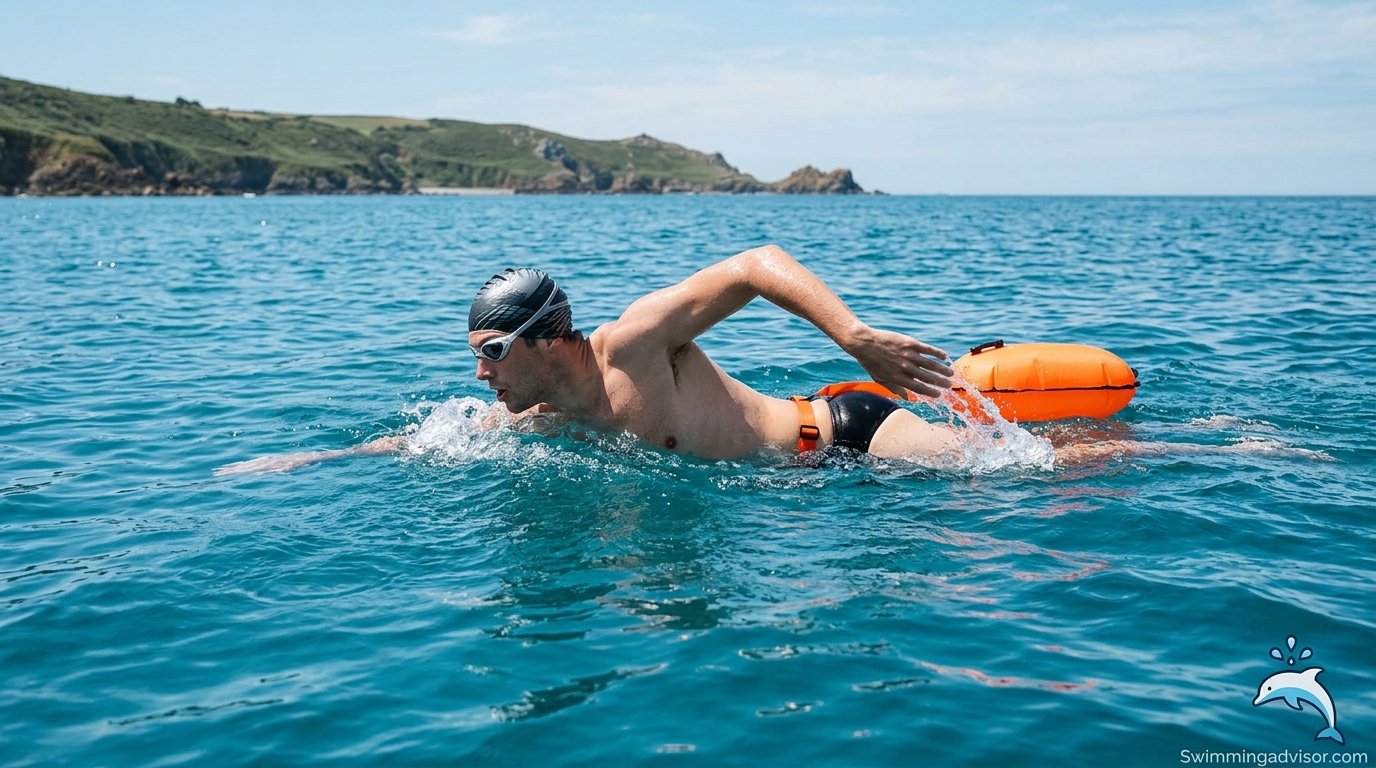
This style pairs a waist strap with an inflatable tow float — a bright orange or pink air-filled buoy trailing behind the swimmer on a short line. It’s become standard gear for open-water and triathlon swimmers, since it makes them dramatically easier for boats, lifeguards, and other swimmers to spot from a distance.
Kids’ Learn-to-Swim Belts
Built specifically for children, these typically use multiple small foam blocks arranged around a soft belt, letting parents or instructors progressively remove blocks as the child’s confidence and skill improve — a gradual weaning process rather than an abrupt jump from full support to none.
3. Who Actually Needs One?
Not every swimmer needs a belt, and it’s worth being honest about that before you spend money. Here’s a realistic breakdown of who benefits most.
- Open-water swimmers and triathletes — for visibility, safety, and occasionally light buoyancy during long swims.
- Beginners and nervous swimmers — a low-profile flotation belt offers reassurance without the bulk of a life vest, letting them focus on technique instead of staying afloat.
- Children learning to swim — progressive-block belts let kids build independence in stages instead of relying on arm floaties that can restrict stroke development.
- Home or small-pool owners — a tether belt turns any pool, even one too small for real laps, into a usable training space.
- Rehab and therapy patients — aquatic physical therapy often uses a belt to control buoyancy precisely, reducing joint stress during recovery exercises.
- Competitive swimmers doing dryland-adjacent training — tethered swimming is a well-established tool for building stroke endurance and power without adding yardage-related joint stress.
If you swim exclusively in a full-length pool, already have solid technique, and don’t need extra visibility, you may genuinely not need one. But for the groups above, it’s one of the more useful pieces of gear you can own.
4. How a Swim Belt Works
The mechanism is simple, but understanding it helps you buy the right style. A flotation belt works by displacing water with a buoyant material — usually closed-cell foam — positioned at the hips or lower back. Because the hips are close to a swimmer’s natural center of mass, lifting them slightly helps keep the whole body horizontal in the water, which is exactly the position that makes swimming efficient. A swimmer whose hips sink tends to fight the water with every stroke; a belt corrects that instantly.
A tether belt works completely differently. It doesn’t add buoyancy at all — instead, it connects the swimmer to a fixed anchor point through a stretchy cord. As the swimmer strokes forward, the cord stretches and pulls back, creating resistance that increases the harder the swimmer works. The swimmer never actually moves forward through the water; they stay in roughly the same spot while the cord absorbs and returns their effort, similar to how a resistance band works for strength training on land.
A visibility buoy belt works on pure physics of contrast: a large, brightly colored inflatable object floating on the surface is far easier to spot from a boat, jet ski, or shoreline than a swimmer’s head, which barely breaks the surface and blends into wave chop.

Turn a backyard pool into a real training tool with a resistance tether belt.
Check Price on Amazon5. Buoyancy Belts vs. Tether Belts
Because these two categories dominate the market, it’s worth comparing them directly rather than treating “swim belt” as one product.
| Factor | Buoyancy Belt | Tether Belt |
|---|---|---|
| Primary purpose | Adds flotation, keeps hips up | Adds resistance, anchors swimmer in place |
| Best for | Beginners, open water, rehab | Technique work, small pools, endurance training |
| Moves swimmer forward? | Yes, normally | No, stays roughly stationary |
| Requires an anchor point? | No | Yes — ladder, post, or dock |
| Typical material | Closed-cell EVA foam | Neoprene/webbing + bungee cord |
| Learning curve | Minimal | Moderate — takes a session or two to adjust |
If your goal is confidence and support in open water or a standard pool, go buoyancy. If your goal is technique refinement or squeezing a workout into limited pool space, go tether. Some swimmers eventually own both, since they solve completely different problems.
6. Key Features to Compare
Once you know which category fits your goal, the differences between individual products come down to a handful of concrete features.
Buoyancy Level (Adjustable vs. Fixed)
Adjustable belts let you add or remove foam blocks to dial in exactly how much lift you get. This matters a lot for kids progressing through skill levels, and for adults who want less support over time as their confidence builds.
Strap Material and Buckle Type
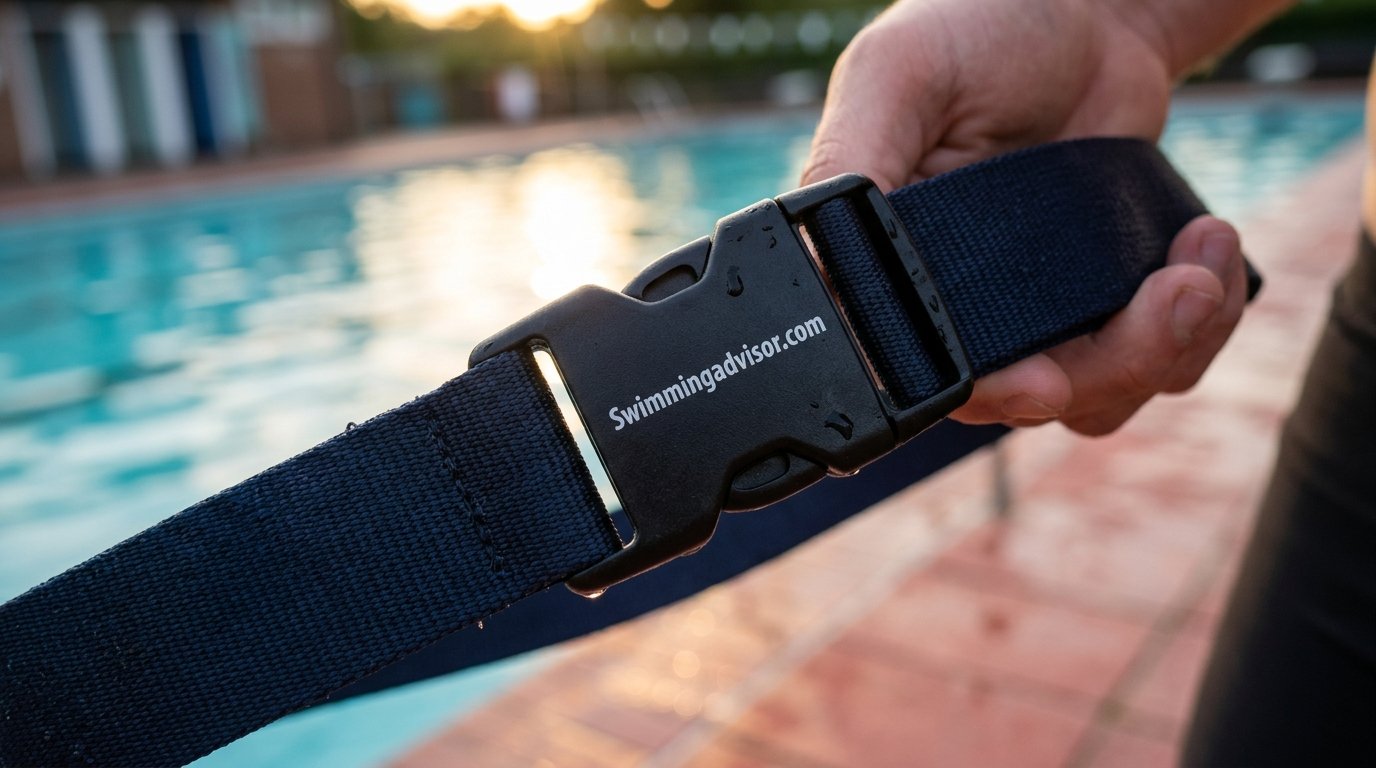
Nylon webbing with a quick-release plastic buckle is the standard. Look for a buckle that’s easy to operate one-handed and that won’t pop open under tension — a real concern with tether belts, where the cord is actively pulling against the buckle.
Cord Length and Resistance (Tether Belts Only)
Shorter cords create more resistance sooner; longer cords give a swimmer more room to build up speed before the pull kicks in. Some models offer adjustable-length cords or multiple resistance bands you can combine.
Chafe Resistance
A belt that sits against bare skin for 30+ minutes needs a soft-edged strap or a fabric-wrapped buckle. Cheaper belts often use raw plastic edges that irritate skin on longer sessions.
Visibility (Open Water)
For open-water and triathlon use, bright colors — orange, pink, yellow — aren’t cosmetic, they’re a safety feature. Some belts include reflective stitching for early-morning or evening swims.
Packability
If you’re traveling with a belt, foam-block designs pack down smaller than solid-foam belts, and tether cords typically coil into a small pouch.
7. Sizing and Fit
A swim belt that’s too loose will ride up during strokes and stop doing its job; one that’s too tight restricts breathing and torso rotation. Most adjustable belts fit a fairly wide waist range — commonly somewhere around 26 to 44 inches — but always check the specific product’s sizing chart rather than assuming.
For kids’ belts, sizing is usually done by age and weight range rather than waist measurement alone, since a child’s proportions change quickly. Buy based on current weight, not projected growth — an oversized flotation belt on a small child can actually be dangerous, since it may ride up toward the chest or slip off entirely.
For tether belts, fit matters even more than with flotation belts, because the pulling force is constantly testing the strap. A snug, secure fit around the natural waist (not the hips) keeps the belt from twisting or sliding during hard strokes.
Good Fit Signs
- Belt stays level, doesn’t rotate during strokes
- You can slide two fingers under the strap comfortably
- No pinching when you take a full breath
Poor Fit Signs
- Belt rides up toward the ribs during swimming
- Buckle digs into skin or leaves marks
- Foam blocks shift or twist out of position
Removable blocks let confidence build in stages instead of all at once.
Check Price on Amazon8. Comparison Table: Popular Swim Belt Styles
| Style | Best For | Buoyancy | Portability | Price Range |
|---|---|---|---|---|
| Adjustable foam-block belt | Open water, beginners | High, adjustable | Medium | $$ |
| Bungee tether belt | Small pools, technique work | None (resistance only) | High | $$ |
| Tow-float safety belt | Open-water visibility | Low (buoy trails behind) | High | $ |
| Kids’ progressive belt | Learn-to-swim | High, removable blocks | Medium | $ |
| Rehab/therapy belt | Aquatic physical therapy | Medium, precise control | Low | $$$ |
Prices vary by brand and included accessories, so use this as a directional guide rather than a fixed quote — always confirm current pricing before buying.
9. Swim Belt vs. Other Swim Aids: A Head-to-Head Comparison
One of the most common questions from swimmers shopping for training gear is whether they actually need a swim belt or whether another swim aid would serve them better. The answer depends on what problem you’re trying to solve, because each tool does something fundamentally different — even when they look similar on the surface.
Swim Belt vs. Pull Buoy
A pull buoy is a figure-eight piece of foam you squeeze between your thighs to hold your legs still and keep your hips elevated while you focus on your arm stroke. It’s a standard pool training tool for competitive swimmers. The key difference from a swim belt is positioning: a pull buoy sits between the legs, not around the waist, and it’s held in place by muscle tension rather than a strap. That means a pull buoy only works while you’re gripping it — the moment you relax or switch strokes, it can slip. A swim belt stays locked in position around your torso regardless of what your legs do, making it a more passive and consistent form of support. For beginners who lack the leg strength or body awareness to hold a pull buoy in place, a swim belt is almost always the better starting point.
However, experienced swimmers doing pull-set training in a lap pool often prefer a pull buoy because it isolates the upper body more precisely and doesn’t add any bulk around the midsection that might alter rotation mechanics. For competitive swimmers, even a thin belt can subtly change the feel of a stroke in ways a pull buoy doesn’t.
Swim Belt vs. Kickboard
A kickboard does the opposite of what a swim belt does in many ways. A kickboard supports the upper body — specifically the arms and shoulders — by giving the swimmer something buoyant to hold in front of them. A swim belt supports the lower body by lifting the hips. A kickboard isolates the legs for kick-focused training; a swim belt leaves the arms free for full-stroke work while improving body position. They’re complementary rather than competing tools. Many swim coaches prescribe sets that use both — kick sets with a board, then swim sets with a belt — to balance training stimulus across the whole body.
For nervous swimmers specifically, a kickboard offers a psychological advantage that a belt doesn’t: something to grip. Holding onto a solid object can feel more reassuring than trusting a strap around your waist, especially in deep water. On the flip side, a kickboard forces a vertical upper body position that makes horizontal swimming technique harder to practice. A swim belt lets the swimmer work on full-streamline body position while still getting support.
Swim Belt vs. Life Jacket
This comparison comes up constantly, especially from parents, and it’s important to get the distinction right. A life jacket — whether a Type I, II, or III personal flotation device — is designed to keep an unconscious or exhausted person’s head above water. It wraps around the torso and often includes neck support or head flotation. It is a certified safety device rated by the U.S. Coast Guard (or equivalent regulatory body in your country) for specific water conditions.
A swim belt is none of those things. It is not rated by any safety certification body. It will not keep an unconscious person afloat. It is not a substitute for a life jacket in boats, on docks, or in genuinely dangerous open-water conditions. A swim belt is a training and comfort aid — it helps a conscious, active swimmer maintain better body position and build confidence. Conflating the two can create a genuinely dangerous false sense of security, especially for children near open water.
Swim Belt vs. Arm Floaties (Water Wings)
Arm floaties are inflatable rings worn around a child’s upper arms. They keep the child’s upper body elevated but do nothing for horizontal body position — in fact, they force the child into a near-vertical posture with their head tilted back, which is essentially the opposite of efficient swimming position. They also restrict shoulder movement and can slip off unexpectedly.
A children’s swim belt, by contrast, supports the core and hips, keeping the child in a more horizontal orientation that better mimics actual swimming. It leaves the arms completely free for proper stroke development. Most swim instructors and pediatric safety organizations now recommend swim belts over arm floaties for children who are learning to swim, precisely because arm floaties teach bad body mechanics that have to be unlearned later.
Swim Belt vs. Swim Vest
A swim vest is a lighter, more form-fitting version of a life jacket — typically made of neoprene with built-in foam panels. It covers the torso and sometimes the shoulders, providing more distributed buoyancy than a belt but less than a full life jacket. Swim vests are popular for young children in pool settings where a full life jacket feels like overkill but arm floaties aren’t enough.
Compared to a swim belt, a swim vest offers more total buoyancy and a more secure fit (since it wraps around a larger area of the body), but it also restricts torso rotation more. For adults learning to swim, a swim belt is usually preferable because it allows the torso to rotate naturally — rotation is fundamental to freestyle and backstroke technique. For very young children who need maximum support and minimum risk of the aid slipping off, a swim vest can be the better choice.
| Aid | Supports | Body Position | Arm Freedom | Best For |
|---|---|---|---|---|
| Swim belt | Hips/lower body | Horizontal | Full | Adults, open water, rehab |
| Pull buoy | Legs (between thighs) | Horizontal | Full | Upper-body swim sets |
| Kickboard | Upper body (held) | Vertical torso | None (hands hold board) | Kick-focused training |
| Life jacket | Full torso + head | Vertical | Limited | Safety in boats/deep water |
| Arm floaties | Arms | Vertical | Limited | Not recommended by most coaches |
| Swim vest | Torso | Semi-horizontal | Moderate | Young children in pools |
10. Using a Swim Belt With Different Swimming Strokes
A swim belt isn’t equally compatible with every stroke. Understanding how each stroke interacts with the belt’s buoyancy and position helps you get the most out of your training — and avoid reinforcing bad habits.
Freestyle (Front Crawl)
Freestyle is the stroke where a swim belt arguably helps the most. The belt lifts the hips, which counteracts the most common freestyle flaw: sinking legs. When the hips are elevated to a more horizontal line, drag drops significantly and the swimmer can focus on catch, pull, and rotation without fighting to stay level. For beginners especially, a belt can provide that “aha” moment where they feel what a horizontal body position actually feels like — sometimes for the first time. Once they’ve internalized that sensation, they can start working toward maintaining the same position without the belt.
One caution: if the belt adds too much buoyancy, it can prevent the swimmer from feeling the natural up-and-down rhythm of the freestyle kick. A slight amount of leg drop between kicks is normal and even efficient; an overly buoyant belt can mask this rhythm entirely. Start with fewer foam blocks than you think you need and add more only if your hips are still dropping noticeably.
Backstroke
Backstroke works well with a swim belt because the swimmer is face-up and the belt helps keep the hips near the surface. The main adjustment is that a belt worn at the natural waist may feel like it’s pressing into the lower back during backstroke, since the swimmer is supine rather than prone. Some swimmers prefer to shift the belt slightly lower toward the hips for backstroke sets, or choose a belt with a wider, more padded back section.
One thing to watch for: backstroke relies heavily on hip rotation, and a tight belt can restrict that rotation if it’s cinched too snugly. Two-finger clearance under the strap is the rule of thumb here — enough to stay in place but loose enough to let the hips roll naturally.
Breaststroke
Breaststroke is the trickiest stroke to combine with a swim belt. The breaststroke kick involves a significant amount of hip flexion, abduction, and external rotation — the knees draw up and out, then snap together. A belt that sits too low can physically interfere with this motion, catching against the hip flexors or riding into the groin area during the kick phase. A belt positioned slightly higher, around the natural waist, works better for breaststroke, but even then the added buoyancy can throw off the timing of the stroke’s characteristic glide phase, where the swimmer is supposed to be fully streamlined and slightly underwater. Too much lift from the belt can make it hard to get low enough during the glide.
For breaststroke-focused training, most coaches recommend removing one or two foam blocks from an adjustable belt to reduce buoyancy, or skipping the belt entirely and using a pull buoy between the legs during breaststroke pull sets.
Butterfly
Butterfly and swim belts don’t mix well for most swimmers. The butterfly stroke depends on a powerful undulating body wave that starts at the chest, travels through the hips, and finishes at the feet. A belt around the waist directly interferes with this undulation — it creates a rigid point at exactly the place that needs to be the most fluid. The added buoyancy at the hips can also prevent the swimmer from getting deep enough during the downkick phase, which is where much of butterfly’s propulsion comes from.
Some advanced swimmers use a very thin belt for butterfly endurance sets, accepting a slight technique compromise in exchange for the ability to sustain the stroke longer before fatigue destroys their form. But this is an advanced training choice, not something a beginner or intermediate swimmer should attempt.
Individual Medley (IM) Training
If you’re training IM sets, the most practical approach is to put the belt on for the backstroke and freestyle legs and remove it for butterfly and breaststroke — or use an adjustable belt and swap blocks on and off between intervals. Many competitive swimmers simply train their fly and breast without any aid, then add the belt for the free and back legs where it’s most beneficial. This takes a bit more time and effort at the pool wall between intervals, but it keeps the training stimulus honest for each stroke.
11. Swim Belt for Water Aerobics & Aqua Fitness
Water aerobics has exploded in popularity as a low-impact exercise option, and a swim belt is one of the most commonly recommended pieces of equipment for these classes. But the way a belt is used in aqua fitness is fundamentally different from how it’s used in swim training — the goals, the movements, and the criteria for a good belt all shift.
Why Aqua Fitness Uses Belts Differently
In water aerobics, the belt isn’t helping the swimmer move horizontally through water. It’s keeping the exerciser buoyant and stable while they perform vertical movements — jumping jacks, high knees, cross-country skiing motions, leg lifts, and upper-body resistance exercises — in chest-deep or deep water. The belt’s job is to hold the person upright with their head comfortably above the surface while they work their muscles against water resistance.
This means the ideal aqua fitness belt prioritizes comfort and all-around buoyancy over streamlined body position. A wider belt with more foam surface area is often better for aqua fitness than a narrow, low-profile swim belt, because the exerciser isn’t worried about drag — they’re worried about staying upright and comfortable through 45 to 60 minutes of continuous movement.
Deep-Water Running Belts
A specific subset of aqua fitness — deep-water running — has its own belt requirements. Deep-water running means jogging in water that’s too deep to touch the bottom, typically while wearing a swim belt for buoyancy and sometimes a tether to keep the runner in one spot. The movement mimics running on land: arms pump, legs cycle, and the core stays engaged to maintain an upright posture. Because this exercise is used heavily by injured runners who can’t bear the impact of land-based running, the belt needs to provide enough buoyancy to keep the head well above water without so much lift that it throws off the natural running posture.
Deep-water running belts are typically more heavily padded than standard swim belts, with a wider profile that distributes buoyancy across the lower back and sides rather than concentrating it at the rear. Some are contoured to fit the shape of the lower torso, with thicker padding in the back and thinner panels at the sides to allow hip movement.
Fitness vs. Swim Belt Buying Considerations
| Feature | Swim Training Belt | Aqua Fitness Belt |
|---|---|---|
| Body position | Horizontal (prone) | Vertical (standing/running) |
| Buoyancy distribution | Concentrated at rear | Distributed around circumference |
| Width | Narrow, low-profile | Wider, more padding |
| Comfort during movement | Moderate | High priority |
| Drag concern | Yes — affects speed | No — exerciser is stationary |
| Tether compatibility | Sometimes | Rarely needed |
If you’re shopping specifically for aqua fitness or water aerobics classes, look for belts labeled “aqua fitness” or “deep-water exercise” rather than “swim training.” They’re designed with a different use case in mind, and the difference in comfort over a 45-minute class is significant.
12. Swim Belt for Seniors & Older Adults
Swimming is one of the best forms of exercise for older adults — it’s low-impact, easy on the joints, and provides cardiovascular benefits without the fall risk that comes with land-based exercise. A swim belt can make pool time safer and more productive for seniors in several specific ways.
Balance and Confidence in the Pool
One of the biggest barriers to pool exercise for older adults is the fear of losing balance or becoming fatigued in deep water. A flotation belt addresses this directly by keeping the hips elevated and the body stable, which reduces the effort needed to stay afloat and gives the swimmer confidence to move freely. This is especially important for seniors who may have reduced grip strength (making it harder to hold a kickboard or pool noodle) or limited shoulder mobility (making a life vest uncomfortable).
A belt’s hands-free design is particularly valuable for this demographic. Seniors doing aquatic therapy or gentle lap swimming need their hands free for balance, for holding pool edges during rest breaks, and for performing therapeutic exercises — none of which are possible if they’re gripping a kickboard or noodle.
Aqua Jogging for Joint Health
Aqua jogging — running in deep water while wearing a swim belt — is prescribed frequently for seniors with osteoarthritis, hip replacements, or knee problems. The water provides natural resistance that strengthens muscles, while the buoyancy takes weight off the joints. A well-fitted belt is essential for this activity because it keeps the senior upright and stable while they perform a running motion, without requiring them to tread water or hold onto the pool wall.
For seniors doing aqua jogging, belt fit is especially important: the belt should be snug enough not to ride up during the jogging motion, but not so tight that it restricts breathing. Seniors with respiratory conditions like COPD should pay particular attention to this balance, and may benefit from a belt with a wider, more flexible strap that distributes pressure evenly rather than a narrow strap that concentrates it.
Reducing Injury Risk
For older adults who swim primarily for fitness and enjoyment rather than competition, a belt serves as a low-level safety net. It won’t replace supervision for those with significant health concerns, but it does add a layer of protection against unexpected fatigue or muscle cramps — situations where a swimmer might otherwise struggle to reach the pool wall. In open-water settings, the added visibility of a brightly colored belt is an additional safety benefit for seniors who may swim more slowly and be harder for boaters to spot.
13. Swim Belt for Pregnancy & Prenatal Swimming
Swimming during pregnancy is widely recommended by healthcare providers as one of the safest and most comfortable forms of prenatal exercise. Water supports the weight of the growing belly, reduces swelling in the extremities, and provides gentle resistance for maintaining muscle tone. A swim belt can enhance these benefits, though it requires some specific considerations.
How a Belt Helps During Pregnancy
As pregnancy progresses, the added weight in the abdomen shifts the swimmer’s center of buoyancy forward and down. This can cause the legs to drag lower in the water, creating more drag and making swimming feel harder than it did pre-pregnancy. A swim belt positioned under the belly or at the lower back can counteract this shift, helping the expectant mother maintain a more horizontal position and reducing the effort required to swim.
The psychological benefit is equally important. Many pregnant swimmers report feeling more secure in the water with a belt, especially in the third trimester when balance on land becomes more challenging. Knowing that the belt provides passive flotation can reduce anxiety about fatigue or sinking, making pool sessions more enjoyable and more likely to be maintained throughout the pregnancy.
Fitting Considerations for Pregnancy
A standard swim belt may not fit comfortably over a pregnant belly, especially in the second and third trimesters. Adjustable belts with generous extra webbing are the best option, since they can be loosened progressively as the belly grows. Some pregnant swimmers prefer to position the belt higher than usual — just below the bust line — where it sits above the belly rather than across it. This requires a belt with enough length to reach that position comfortably and enough foam blocks in the back section to provide lift from that higher point.
Avoid belts with rigid plastic buckles that could dig into the belly. Look for flat, low-profile buckles or hook-and-loop closure systems that lie smooth against the body.
Important Disclaimer
A swim belt is not a medical device and should never be used as a substitute for medical guidance during pregnancy. Always consult your healthcare provider before beginning or continuing a swimming exercise program during pregnancy, and stop immediately if you experience dizziness, shortness of breath, contractions, or any unusual symptoms in the water.
14. Swim Belt Workout Routines
Owning a swim belt is one thing — knowing how to structure workouts around it is another. Here are three sample routines designed around specific belt types, ranging from beginner-friendly to advanced.
Beginner Buoyancy Belt Routine (30 Minutes)
This routine is for swimmers who are still building comfort and basic technique. The belt provides consistent support throughout.
- Warm-up (5 min): Easy freestyle with the belt on. Focus on long, smooth strokes and relaxed breathing. Don’t worry about speed — the goal is to find a rhythm.
- Kick set (5 min): Kick on your side (one arm extended forward, one arm at your side) for 25 meters, then switch sides for 25 meters. The belt keeps your hips up so you can focus entirely on the kick. Rest 20 seconds between lengths.
- Stroke count set (10 min): Swim freestyle, counting strokes per length. Try to take the same number of strokes each length — this builds consistency and efficiency. Rest 15 seconds between lengths.
- Backstroke set (5 min): Easy backstroke. Focus on keeping your head still and your hips rotating. Rest 20 seconds between lengths.
- Cool-down (5 min): Very easy mixed-stroke swimming. Reduce effort gradually.
Intermediate Tether Belt Routine (40 Minutes)
This routine uses a tether belt in a small pool or even a single-lane space. The resistance from the tether builds power and endurance.
- Warm-up (5 min): Easy freestyle against the tether at low intensity. Get used to the pull and find your rhythm against the resistance.
- Power set (15 min): Six 90-second intervals of freestyle at moderate-to-hard effort, with 30 seconds of easy backstroke or rest between each interval. Focus on a strong catch and a complete finish on each stroke — the tether makes it easy to feel whether you’re pulling all the way through.
- Stroke variety set (10 min): Alternate 60-second intervals of backstroke and freestyle against the tether. Four intervals of each stroke.
- Sprint set (5 min): Five 30-second all-out sprint intervals with 30 seconds of rest between each. These are short enough to maintain high intensity.
- Cool-down (5 min): Easy freestyle against the tether, gradually decreasing effort to near-zero.
Advanced Mixed Belt Routine (60 Minutes)
This routine combines a buoyancy belt for the warm-up and cool-down with a tether belt for the main set, assuming the swimmer has access to both and a pool where switching between them is practical.
- Warm-up with buoyancy belt (10 min): 400 meters easy freestyle, focusing on body rotation and a high elbow catch.
- Transition to tether belt (2 min): Switch belts at the pool wall. Secure the anchor and test the cord length.
- Threshold set on tether (20 min): Eight 2-minute intervals at a pace you could sustain for 10 minutes but not much longer. Rest 30 seconds between intervals. Use a waterproof watch or clock at the pool to track time.
- Kick-only set with buoyancy belt (10 min): Switch back to the buoyancy belt. 200 meters kick-only (arms at sides or extended), 200 meters drill — catch-up drill or fingertip drag.
- Easy swim, no belt (10 min): Remove the belt entirely and swim 300-400 meters easy. This is where you internalize the body position the belt helped you find — maintaining it without the belt is the real training effect.
- Cool-down (8 min): Very easy mixed-stroke swimming without the belt. Focus on relaxed breathing and long strokes.
Deep-Water Aqua Fitness Belt Routine (30 Minutes)
This routine is designed for deep water where you cannot touch the bottom, using a flotation belt for support throughout.
- Warm-up jog (3 min): Gentle aqua-jogging in place. Focus on posture: head up, shoulders relaxed, arms swinging naturally.
- High knees (3 min): Drive knees up toward the chest alternately, pumping arms. 45 seconds on, 15 seconds rest, repeat three times.
- Cross-country ski (3 min): Alternate legs in a striding motion, reaching arms opposite to legs. 45 seconds on, 15 seconds rest, repeat three times.
- Treading arms (3 min): Keep legs still (the belt holds you up) and do large circular arm movements — both forward and backward — to work the shoulders and upper back.
- Bicycle legs (3 min): Cycle the legs as if riding a bicycle in the vertical position. The belt keeps the torso stable.
- Jumping jacks (3 min): Full-range jumping jacks in the water. 45 seconds on, 15 seconds rest, repeat three times.
- Core twist (3 min): Legs together, arms extended in front. Rotate the torso left and right, keeping the hips facing forward. The water provides resistance against the rotation.
- Sprint jog (3 min): Aqua-jogging at maximum effort. 30 seconds sprint, 30 seconds easy, repeat three times.
- Cool-down (6 min): Gentle floating, stretching legs and arms in the water, slow walking motions. Let the heart rate come down gradually.
15. Swim Belt for Triathlon & Open Water Racing
Triathlon swimming is one of the primary use cases for swim belts, and for good reason: the open-water leg of a triathlon presents challenges that don’t exist in a pool — currents, chop, no lane lines, no walls to rest on, and boat traffic sharing the same water. A swim belt in this context isn’t primarily about buoyancy; it’s about visibility and safety.
The Visibility Imperative
In a mass triathlon start with hundreds of swimmers entering the water simultaneously, spotting a single swimmer’s head in a field of churning arms and spray is nearly impossible for safety boats and lifeguards. A tow-float belt — with a brightly colored inflatable buoy trailing 3 to 6 feet behind the swimmer — makes that swimmer visible from hundreds of meters away. For solo training swims in open water, this visibility can be lifesaving. Jet ski operators, kayakers, and boaters can see and avoid a swimmer they might otherwise never notice.
The numbers are worth stating plainly: most open-water swimming fatalities involve a swimmer who was not seen by other watercraft users. A tow-float belt doesn’t make you invincible, but it dramatically changes the probability of being spotted in time.
Race-Day Rules and Regulations
Most triathlon governing bodies and open-water race organizers have specific rules about swim aids. In many sanctioned triathlons, flotation devices of any kind are prohibited during the race itself — you’re expected to swim unaided. Tow-floats are sometimes permitted in non-competitive open-water events, charity swims, and training swims, but always check the specific event’s rules before assuming.
For training, the rules are different. Almost all coaches and training programs encourage the use of tow floats during open-water training swims, both for safety and for the peace of mind that lets the swimmer focus on pace and technique rather than worrying about being invisible to boats.
Transition Considerations
If you plan to use a tow-float belt during a training swim that includes a transition to cycling or running, practice removing the belt quickly and efficiently. The waist strap should unclip with one hand in a few seconds — fumbling with a buckle while waves are washing over you is not the time to discover that the clasp is stiff. Practice the on-and-off sequence a few times on land, then in shallow water, before using it on a long training swim far from shore.
16. Swim Belt for Weight Loss & Calorie Burning
Swimming is frequently recommended as a weight-loss exercise because it’s low-impact, works the entire body, and burns significant calories. But many heavier or less-fit swimmers find it difficult to sustain swimming long enough to reach meaningful calorie burn because poor body position causes them to fight the water with every stroke. A swim belt can break this cycle.
How Buoyancy Affects Calorie Burn
The relationship between a swim belt and calorie burn isn’t straightforward. On one hand, the belt reduces the effort required to stay afloat and move through the water, which technically means fewer calories burned per stroke. On the other hand, the belt allows the swimmer to maintain a more efficient body position, which means they can swim longer and more comfortably — and total calorie burn is a function of duration and intensity together, not just instantaneous effort.
For a swimmer who can only manage 10 minutes of struggling, inefficient swimming before fatigue forces them to stop, adding a belt that lets them swim for 30 or 40 minutes comfortably is a massive net gain in total calories burned, even though the per-minute burn rate is slightly lower. The math works in the belt’s favor for almost every swimmer who currently struggles with endurance.
Water Aerobics for Weight Loss
For people who don’t swim laps at all, deep-water aerobics with a flotation belt is an excellent calorie-burning alternative. Research consistently shows that water aerobics burns between 400 and 700 calories per hour depending on intensity, body size, and water temperature. The belt provides the buoyancy needed to exercise in deep water without the skill requirement of lap swimming, making it accessible to people who may not know how to swim at all but still want the benefits of a water-based workout.
Tether Belt Training for Metabolic Conditioning
A tether belt in a pool turns swimming into something closer to interval training on land. Because the cord creates increasing resistance as the swimmer strokes harder, it naturally encourages a high-intensity interval pattern: go hard, feel the cord pull back, ease off, go hard again. This kind of interval training is one of the most effective approaches for improving metabolic conditioning and promoting the afterburn effect (excess post-exercise oxygen consumption), which means your body continues burning calories at an elevated rate for hours after the workout ends.
If your primary goal is weight loss and you have access to a pool and a tether belt, a structured interval routine three to four times per week — like the intermediate tether belt routine described in Section 14 — can be a highly effective component of a broader weight-management plan that also includes nutrition and lifestyle factors.
17. Swim Belt for Plus-Size & Heavy Adults
Larger adults face specific challenges in the water that a swim belt can address — but finding the right belt requires attention to sizing, buoyancy capacity, and comfort features that many standard products don’t prioritize.
Why Standard Belts May Not Work
Most swim belts are designed for a waist range of roughly 26 to 44 inches. For adults with a waist measurement above that range, the standard webbing strap simply isn’t long enough to wrap around and buckle securely. Even if the strap technically reaches, there may not be enough excess webbing to adjust for different body positions — sitting on the pool edge vs. floating horizontally vs. swimming freestyle — and a belt that’s adjusted to its maximum length has no room for fine-tuning.
Beyond strap length, buoyancy needs to be proportionate to body weight. A belt with four small foam blocks might provide enough lift for a 140-pound swimmer but be completely insufficient for a 250-pound swimmer. The heavier swimmer will still feel their hips sinking, which defeats the purpose of wearing the belt. Some belts offer more foam blocks per strap or larger individual blocks, but not all do — it’s a specification worth checking before buying.
What to Look For
If you’re a plus-size adult shopping for a swim belt, prioritize the following:
- Extended strap length: Look for belts explicitly rated for waist sizes up to 52 or 60 inches. Some brands offer “extended” or “plus” versions of their standard belt.
- Higher buoyancy rating: More foam blocks or thicker foam sections. Some belts specify a maximum supported weight — if this information is available, use it as a guide.
- Wide strap design: A wider strap (3 inches or more) distributes pressure more evenly across the torso, reducing the chance of the belt digging into skin or creating pressure points during a long swim.
- Quick-release buckle rated for higher tension: A larger body creates more drag, which means more force on the belt during swimming. Make sure the buckle is rated for that load and won’t pop open unexpectedly.
Building Confidence Gradually
If you’re a plus-size adult who is new to swimming or returning to the pool after a long break, start with maximum buoyancy (all blocks in the belt) in shallow water where you can stand comfortably. Get used to the sensation of the belt supporting your hips before you move to deeper water. As your confidence and technique improve, you can gradually remove blocks — but there’s no rush. The goal is to make pool time enjoyable enough that you keep coming back, and a belt that makes you feel secure in the water is the tool that makes that possible.
18. Swim Belt for Kids: A Detailed Age-by-Age Guide
Children develop swimming skills at vastly different rates, and the right swim belt changes as they grow. Here’s a stage-by-stage breakdown to help parents make informed choices.
Toddlers (Ages 1-3)
At this age, a swim belt should provide maximum buoyancy with minimum restriction. Toddlers are still developing basic water comfort — getting their face wet, splashing, and learning to kick. A belt with all foam blocks installed gives them the support they need to enjoy the water while a parent holds them or stands nearby. Look for belts with very soft webbing and no exposed buckle hardware that could scratch or pinch sensitive toddler skin.
Important: a swim belt is not a substitute for direct physical contact with a parent or caregiver at this age. Toddlers should always be within arm’s reach of a supervising adult, regardless of what flotation aid they’re wearing.
Preschoolers (Ages 3-5)
This is the sweet spot for progressive-block swim belts. Preschoolers are typically ready to start blowing bubbles, floating on their backs with assistance, and kicking short distances. A belt with removable blocks lets the instructor or parent reduce buoyancy in stages as the child demonstrates new skills. A common progression: start with all blocks, remove one block when the child can float on their back for 10 seconds with the belt, remove another when they can kick 5 meters unassisted, and so on.
Early School Age (Ages 5-8)
Children in this range are often learning formal stroke mechanics — freestyle arm recovery, rhythmic breathing, backstroke body position. A swim belt can be a powerful teaching tool here because it frees the child’s arms and lets them focus on the stroke rather than on staying afloat. Many swim schools use belts as part of their regular curriculum for this age group. By the end of this stage, many children can swim well enough to remove the belt entirely during lessons, keeping it only for open-water swims or particularly tiring drills.
Older Children (Ages 8-12)
By this age, most children who have had consistent swim instruction can swim multiple strokes without a belt. For those who are still building confidence or who swim in open water where conditions are unpredictable, a low-profile belt with minimal buoyancy — just enough to provide a psychological safety net — is appropriate. Tow-float visibility belts are also worth considering for children who swim in lakes, rivers, or ocean settings, where boat traffic is a real concern.
19. Swim Belt for Rehabilitation: Specific Exercises & Protocols
Aquatic rehabilitation — using the pool for therapeutic exercise under the guidance of a physical therapist — is one of the most medically validated uses for swim belts. The buoyancy of water reduces the effective load on joints by 50 to 90 percent depending on immersion depth, making it possible to perform movements that would be painful or impossible on land. A swim belt adds another layer of control, letting the therapist and patient dial in exactly how much support the patient gets during each exercise.
Common Rehab Applications
Swim belts are used in aquatic rehab for a wide range of conditions, including:
- Post-surgical recovery: After hip or knee replacement surgery, patients often begin aquatic therapy within weeks of the procedure. A belt keeps the patient stable and supported while they practice walking, gentle range-of-motion exercises, and muscle activation drills in the water.
- Lower back pain: The buoyancy of a belt takes pressure off the lumbar spine, allowing patients to perform core-strengthening exercises like gentle leg lifts and torso rotations with less pain than on land.
- Chronic conditions: Arthritis, fibromyalgia, and multiple sclerosis patients use aquatic therapy with belts to maintain muscle strength and joint mobility without the joint stress of land-based exercise.
- Sports injury rehab: Runners with stress fractures, swimmers with shoulder injuries, and athletes recovering from ACL tears often use belts during the aquatic phase of their rehab to maintain cardiovascular fitness while protecting the injured area.
Sample Rehab Exercise Protocol
The following is a general example of a belt-assisted aquatic rehab routine. Always follow the specific protocol prescribed by your physical therapist — this is for illustration only, not medical guidance.
- Warm-up walk (5 min): Walk across the pool in chest-deep water wearing the belt. Focus on heel-to-toe gait and upright posture.
- Standing hip abduction (3 sets of 10 each leg): Stand in chest-deep water, hold the pool wall with one hand, and lift the opposite leg out to the side against water resistance. The belt provides buoyancy that reduces the load on the hip joint.
- Water walking with high knees (3 min): Walk forward lifting knees to hip height, pumping arms. The belt helps maintain balance during this more demanding movement.
- Supine float with leg cycling (5 min): Float on your back (the belt supports your hips) and cycle the legs gently, as if pedaling a bicycle. This works the hip flexors and quadriceps with minimal joint loading.
- Gentle freestyle (10 min): Swim easy freestyle with the belt on. Focus on smooth, pain-free movement through the full range of motion. If any stroke causes pain, stop and consult your therapist before continuing.
- Cool-down and stretch (5 min): Stand in waist-deep water and perform gentle stretches for the hamstrings, quadriceps, hip flexors, and shoulders. The water provides gentle resistance during the stretch, and the belt keeps you stable.
20. How Swim Coaches Use Belts in Training Programs
Swim coaches have been using belts as training tools for decades, and their collective experience offers valuable insight into how belts can be integrated into a structured swimming program — whether you’re a self-coached adult swimmer or a parent helping a child develop skills at home.
The “Feel” Approach
Many experienced coaches use a buoyancy belt as a “feel” tool rather than a permanent training aid. The idea is simple: put the belt on, swim a set focusing on one specific aspect of technique (high elbow catch, hip rotation, bilateral breathing), and let the belt’s support show you what the correct body position feels like. Then remove the belt and try to replicate that feeling unaided. Over time, the swimmer internalizes the sensation and can maintain the improved position without the belt. This approach treats the belt as a temporary scaffold, not a crutch — and it’s one of the most effective ways to use one.
Tether Belt for Power Development
Competitive swim coaches frequently use tether belts during the off-season or during taper periods to build stroke power without the repetitive-impact stress of high-yardage pool training. The constant resistance of the tether forces the swimmer to generate more force per stroke, which develops the pulling muscles (lats, shoulders, forearms) in a way that free swimming in a pool doesn’t always achieve, especially for swimmers whose stroke rate is high but whose pull is relatively shallow.
Coaches typically program tether work in intervals — 30 to 90 seconds of hard effort against the tether, followed by equal rest — rather than long continuous sets. This mirrors the intensity pattern of sprint racing and avoids the form breakdown that happens when a fatigued swimmer starts cutting their stroke short against the resistance.
Progressive Belt Weaning for Young Swimmers
The best swim school programs use a structured belt-weaning process for children. A child starts their first lessons with all foam blocks installed, then blocks are removed one at a time as the child passes specific skill benchmarks — floating independently for 15 seconds, kicking 10 meters without stopping, performing a streamline push-off from the wall, and so on. This gives the child a clear progression and a sense of accomplishment at each stage, which is far more motivating than an all-or-nothing jump from full support to no support.
21. Swim Belt for Cold Water Swimming
Cold water swimming — whether it’s ocean dips, lake swims, or year-round outdoor pool training in cooler climates — has its own set of considerations when it comes to swim belts.
How Cold Water Affects Buoyancy
Cold water is slightly denser than warm water, which means a swimmer naturally floats a bit better in cold water than in a heated pool. This also means a swimmer wearing a buoyancy belt in cold water may feel more lifted than usual, which can actually change the feel of their stroke. If you’re transitioning from warm-water pool training to cold-water open-water swimming, start with fewer foam blocks in your belt and add more only if your hips are still sinking in the colder water.
Neoprene Compatibility
Many cold-water swimmers wear a wetsuit, which itself provides significant buoyancy — typically around 2 to 5 millimeters of neoprene distributed across the torso, arms, and legs. Adding a swim belt on top of a wetsuit can create excessive buoyancy at the hips, throwing off body position rather than improving it. For wetsuit-clad swimmers, a tow-float visibility belt (which adds minimal buoyancy to the swimmer’s body, since the float trails behind on a tether) is usually a better choice than a foam buoyancy belt.
Safety Considerations for Cold Water
Cold water presents genuine safety risks — cold shock response, hypothermia, and swimming failure — that a swim belt does nothing to mitigate. A belt will not keep you warm, will not prevent cold shock, and will not slow the onset of hypothermia. If you’re swimming in water below about 15°C (60°F), a swim belt should be considered one layer of a broader safety approach that also includes a wetsuit or thermal swimwear, a buddy swimmer or shore-based observer, a time limit based on water temperature, and an emergency plan for getting out of the water quickly if something goes wrong.
22. Swim Belt Myths & Misconceptions
Swim belts are simple enough that misinformation tends to stick around. Here are some of the most persistent myths — and what’s actually true.
Myth 1: “Swim Belts Are Just for Beginners”
Not true. While beginners certainly benefit from the flotation support, some of the most dedicated users of swim belts are experienced triathletes (for tow-float visibility), competitive swimmers (for tether power training), and physical therapists (for rehab protocols). The belt is a tool, and tools don’t have skill-level prerequisites.
Myth 2: “A Swim Belt Will Teach My Child to Swim”
A swim belt supports the body; it doesn’t teach technique. Breath control, kick timing, arm recovery, and water safety awareness all require instruction — either from a qualified teacher or from a knowledgeable parent who can demonstrate and correct form. A belt helps a child practice what they’ve been taught by reducing the effort required to stay afloat, but it can also mask poor technique if it’s relied on as a substitute for lessons rather than a supplement to them.
Myth 3: “Swim Belts Are a Life-Saving Device”
This is the most dangerous myth on this list. A swim belt is not a personal flotation device. It is not Coast Guard certified. It is not designed to keep an unconscious person’s head above water. Treating a swim belt as a life-saving device — for example, letting a child wear only a swim belt on a boat or near deep, unsupervised water — is a serious safety error. Swim belts are for supervised, controlled aquatic activities. Life jackets are for safety in open water and boating.
Myth 4: “If I Use a Belt, I’ll Never Learn to Swim Without One”
This is only true if you never plan to reduce your dependence on the belt. Used as a progressive training tool — gradually removing buoyancy blocks as technique improves — a belt actually accelerates the path to independent swimming by allowing the swimmer to focus on one skill at a time rather than struggling with everything at once. The key is intentionality: use the belt as a bridge, not a permanent destination.
Myth 5: “All Swim Belts Are Basically the Same”
As this guide makes clear, the “swim belt” category includes flotation belts, tether belts, tow-float belts, kids’ progressive belts, rehab belts, and aqua fitness belts — all with different designs, materials, buoyancy levels, and use cases. Treating them as interchangeable is like treating all shoes as the same because they all go on your feet.
Myth 6: “A Tighter Belt Means Better Support”
A belt that’s too tight restricts breathing and torso rotation, both of which are essential for efficient swimming. A swim belt should be snug enough not to ride up or rotate, but loose enough to allow a full breath and natural hip movement during the stroke. Over-tightening also increases chafing, especially on longer sessions.
23. Swim Belt Accessories & Add-Ons
A swim belt is useful on its own, but several accessories can extend its functionality and improve the overall experience.
Replacement Foam Blocks
Foam blocks wear out over time — they absorb small amounts of water through repeated use, become slightly less buoyant, and can develop surface cracks from UV exposure. Many belt manufacturers sell replacement block packs, and keeping a spare set on hand means you can refresh your belt’s buoyancy without buying an entirely new strap and buckle assembly. Replacement blocks are inexpensive and easy to swap in.
Extended Tether Cords
If your tether belt came with a standard-length bungee cord that doesn’t give you enough swimming room, aftermarket longer cords are available. A longer cord reduces resistance at the start of each stroke but gives you more room to build up speed before the pull kicks in — useful for longer interval sets where you want a more gradual resistance curve rather than an immediate tug.
Anchor Kits
A proper anchor point is critical for tether belt training. Purpose-built anchor kits typically include a heavy-duty suction cup or clamp designed to attach to a pool ladder, coping stone, or dock cleat, plus a swivel connector that lets the cord rotate freely without tangling. If you’re training in a backyard pool, investing in a dedicated anchor kit is much safer than improvising with a deck chair or fence post.
Dry Pouch Attachments
Some swim belts include a small waterproof pouch that clips onto the strap for carrying keys, a phone, or a small first-aid kit during open-water swims. If your belt doesn’t include one, aftermarket clip-on pouches are widely available. This is particularly useful for solo open-water swimmers who need to carry identification and a way to call for help.
Whistle and Safety Light
For open-water swimmers, a safety whistle that clips to the belt strap and a small waterproof LED light that attaches to the tow-float line are inexpensive additions that can make a critical difference in an emergency. A whistle carries much farther over water than a human voice, and a flashing light makes a swimmer visible in low-light conditions — early morning, late evening, or overcast days.
24. Swim Belt Alternatives: When a Belt Isn’t the Right Choice
Despite their versatility, swim belts aren’t always the best answer. Here’s when to consider alternatives and what those alternatives are.
For Pure Stroke Isolation: Pull Buoy
If your only goal is to isolate your upper body during a pull set in a standard lap pool, a pull buoy is simpler, cheaper, and more effective than a belt. You don’t need a strap around your waist to hold a piece of foam between your legs, and a pull buoy provides a more natural feeling of buoyancy for experienced swimmers who want minimal interference with their stroke.
For Maximum Safety in Boating: Life Jacket
If you’re on a boat, kayak, paddleboard, or any other watercraft, wear a certified life jacket — not a swim belt. This isn’t negotiable. A swim belt’s buoyancy is designed for active swimming; a life jacket is designed to keep you alive if you’re unconscious, injured, or exhausted in the water.
For Kick-Focused Training: Kickboard
If your primary training goal is to build leg strength and kick technique, a kickboard provides a better platform for focused kick work than a belt. The board supports the upper body and lets the swimmer isolate the legs more completely than a belt, which supports the lower body and can actually reduce the training demand on the kick.
For Full-Body Buoyancy: Wetsuit
For open-water swimmers who need warmth and buoyancy together, a wetsuit provides both in a single garment. A wetsuit distributes buoyancy across the torso, arms, and legs — not just the waist — which creates a more balanced and natural feeling of flotation compared to a belt that concentrates lift at one point. If you swim in water cold enough to need thermal protection, a wetsuit may make a separate buoyancy belt unnecessary.
For Very Young Children: Swim Vest
For toddlers and very young children (under 3), a neoprene swim vest with built-in foam provides a more secure and comprehensive fit than a belt, reducing the risk of the aid slipping off or shifting during active play. Once a child is old enough to follow instructions and participate in structured swim lessons, transitioning to a progressive-block belt is usually appropriate.
25. Environmental Considerations for Swim Belts
As swimmers, we spend our training hours immersed in natural water bodies — lakes, rivers, oceans — and it’s worth thinking about the environmental footprint of the gear we use in those environments.
Material Sustainability
Most swim belts are made from EVA foam (ethylene-vinyl acetate), nylon webbing, and plastic buckles. EVA foam is a petroleum-derived product that is not biodegradable and is difficult to recycle through standard municipal programs. When a foam block cracks, degrades, or loses buoyancy, it typically ends up in a landfill. Nylon webbing is similarly petroleum-based, though it’s durable enough to last many years before it needs replacing.
Some manufacturers are beginning to explore bio-based foam alternatives and recycled nylon webbing, but these products are still uncommon in the swim belt market as of this writing. If environmental impact is a priority for you, look for belts from brands that explicitly address material sourcing and end-of-life recycling in their product descriptions.
Microplastic Concerns
EVA foam degrades slowly in water, but over time — especially with repeated UV and chlorine exposure — it can shed small particles. While the amount of microplastic released from a single swim belt is tiny compared to other sources (tire wear, synthetic clothing, plastic packaging), it’s not zero. Rinse and dry your belt after every use, and replace blocks that are visibly cracking or crumbling rather than continuing to use deteriorated foam in the water.
End-of-Life Disposal
When a swim belt reaches the end of its useful life, the most responsible disposal approach is to separate the components: nylon webbing and plastic buckles can sometimes be recycled through textile or hard-plastic recycling programs (check your local facility’s accepted materials list), while EVA foam blocks should be disposed of in general waste if no foam recycling option is available. Some creative swimmers repurpose old foam blocks as kneeling pads for gardening, padding for boat dock edges, or insulation material for DIY projects.
Buying Durability Over Cheapness
The single most environmentally friendly thing you can do when buying a swim belt is to buy one that lasts. A well-made belt with UV-resistant foam, reinforced stitching, and a corrosion-resistant buckle will outlast two or three cheaper alternatives, reducing total waste even though it may cost more upfront. Treat the purchase as an investment in gear that will serve you for years rather than a disposable accessory that gets replaced each season.
26. Pros and Cons of Using a Swim Belt
Pros
- Frees the arms and legs completely, unlike a life vest
- Builds confidence for nervous or beginner swimmers
- Improves body position by lifting the hips
- Tether versions enable real training in a small pool
- Boosts visibility and safety in open water
- Progressive designs support gradual skill-building in kids
- Versatile across swimming, aqua fitness, rehab, and triathlon
- Low cost compared to wetsuits or other major swim gear
- Lightweight and packable for travel
- Adjustable buoyancy lets you customize support level
Cons
- Can create a false sense of security if relied on too heavily
- Tether belts have a learning curve and aren’t intuitive at first
- Cheaper models may chafe on long sessions
- Not a substitute for proper supervision with young children
- Buoyancy belts can mask poor kicking technique if overused
- Not compatible with all strokes equally (especially butterfly)
- Not a certified safety device — cannot replace a life jacket
- Foam blocks degrade over time with UV and chemical exposure
None of these downsides are dealbreakers — they’re simply things to keep in mind so you use the belt as a tool rather than a crutch.
27. How to Use a Swim Belt Safely
Getting the most out of a swim belt comes down to a few habits that experienced swimmers and coaches consistently recommend.
- Fit it at the waist, not the hips. A belt worn too low tends to slide and rotate.
- Test the buckle on land first. Make sure you can release it quickly and confidently before you’re in the water.
- Start tether sessions with a longer cord setting. Build up resistance gradually rather than starting at maximum tension.
- Always supervise children, even with a well-fitted flotation belt. No swim aid replaces active supervision.
- Check the anchor point before using a tether belt — a loose ladder rail or weak post can fail under repeated pulling.
- Inspect foam blocks and straps regularly for cracks, waterlogging, or fraying, especially with saltwater or chlorine exposure.
- Practice putting the belt on and taking it off in shallow water before using it in deep water or open water. Emergency removal should be second nature.
- Never use a swim belt as your sole safety measure in open water. Pair it with a buddy system, a shore-based observer, and — for tow-float models — the float itself for visibility.

A bright inflatable buoy trailing behind you dramatically improves visibility to boats and rescuers.
Check Price on Amazon28. Care, Cleaning & Storage
Rinse your belt in fresh water after every use in a chlorinated or salt water pool — both chemicals degrade foam and webbing over time if left to dry on the material. Let it air dry fully out of direct sunlight before storing, since UV exposure breaks down foam faster than water exposure does. Avoid tossing it in a hot car trunk or a sealed bag while still damp, which encourages mildew and odor.
For tether belts, uncoil the bungee cord before storage rather than leaving it wound tightly for long periods, which can cause the elastic to lose tension prematurely. A mesh gear bag is ideal for storage since it lets any residual moisture continue to evaporate.
Seasonal Storage Tips
If you won’t be using your belt for several months — say, over winter for a seasonal outdoor swimmer — store it in a cool, dry place away from direct sunlight. Avoid compressing the foam blocks under heavy objects, which can permanently deform them and reduce their buoyancy. Lay the belt flat or hang it from a hook. If possible, store it in a breathable cotton bag rather than a sealed plastic container, which can trap residual moisture and promote mildew.
Before your first swim of a new season, inspect the belt thoroughly: check the buckle for cracks or stiffness, look at each foam block for signs of waterlogging or crumbling, and test the strap for fraying. A belt that was fine when you stored it six months ago may have developed issues during the off-season, especially if storage conditions weren’t ideal.
29. Common Mistakes to Avoid
- Buying based on waist size alone without checking a chest or torso measurement for kids’ belts — proportions vary a lot.
- Over-relying on a flotation belt instead of building real stroke and kick technique underneath it.
- Anchoring a tether belt to something unstable, like a loose deck chair or a thin fence post.
- Skipping the buckle test on land before the first swim, then fumbling with it mid-session.
- Leaving a wet belt balled up in a gym bag, which shortens its lifespan significantly.
- Using a swim belt as a life jacket substitute in boating or unsupervised water activities.
- Ignoring stroke compatibility — wearing a thick belt during butterfly or breaststroke sets and then wondering why the stroke feels wrong.
- Not replacing worn foam blocks — degraded blocks provide less buoyancy, and you may not notice the gradual change until you’re struggling in the water.
- Choosing the wrong belt type for your goal — a tether belt for open-water visibility or a tow-float for lap pool training will both disappoint because they’re built for different jobs.
Frequently Asked Questions
Is a swim belt the same as a life jacket?
No. A life jacket is a Coast Guard-rated personal flotation device designed to keep an unconscious or struggling person’s head above water. A swim belt is a training and confidence-building aid, not a certified safety device, and shouldn’t be treated as a substitute for a life jacket in genuinely dangerous conditions.
Can adults use swim belts, or are they just for kids?
Adults use them constantly — for open-water swimming, triathlon training, tethered technique work, and aquatic rehab. Many belts are actually sized specifically for adults, with kids’ versions being the smaller, specialized category.
How much resistance does a tether belt provide?
It depends on cord length and how far you stroke away from the anchor point — the more the bungee stretches, the more resistance it creates. Most cords are adjustable in length, and some kits include multiple resistance bands so you can scale intensity up over time.
Do swim belts help improve technique, or do they hurt it?
Both are possible, depending on how they’re used. A correctly fitted buoyancy belt can improve body position and help a swimmer feel what a horizontal, efficient stroke feels like. But leaning on it constantly instead of building independent kick strength can slow technique development, so it’s best used as a training tool rather than a permanent aid.
What’s the right way to anchor a tether belt in a backyard pool?
Use a fixed, load-tested point — a securely mounted pool ladder, a permanent dock cleat, or a purpose-built anchor designed for tether training. Avoid anything that could shift, tip, or pull loose under repeated tension, like a lightweight pool step or an umbrella stand.
Are foam-block belts adjustable for growing kids?
Most are. Blocks can typically be added or removed as a child’s confidence and swimming ability improve, letting the belt scale down in support over months or years instead of requiring a brand-new product each season.
Can a swim belt be used in the ocean?
Yes, and it’s actually one of the more popular open-water use cases — particularly tow-float safety belts, which keep a swimmer visible to boats and lifeguards. Just be aware that ocean currents and chop behave differently than pool water, so a belt shouldn’t be treated as a substitute for ocean safety awareness.
Will a swim belt chafe my skin?
It can, especially on longer sessions with a cheaply made strap. Look for belts with soft-edged webbing or a fabric-wrapped buckle, and consider a thin rash guard or swimsuit layer underneath the strap for extra-long open-water swims.
How do I know what size swim belt to buy?
Check the manufacturer’s waist-measurement chart rather than guessing from your clothing size — belt sizing runs differently across brands. For kids, use current weight and torso measurements rather than projected growth.
Can a swim belt replace swim lessons for a child?
No. A flotation belt can support a child’s confidence while they’re actively learning, but it doesn’t teach breath control, kicking, or water safety awareness on its own. It works best alongside instruction, not instead of it.
How long do swim belts typically last?
With regular fresh-water rinsing and dry storage out of direct sun, a well-made belt can last several seasons. Foam blocks are usually the first component to show wear, becoming slightly less buoyant over time as they absorb tiny amounts of water through repeated use.
Do I need a swim belt if I already swim well?
Not necessarily for flotation — but many strong swimmers still use tether belts for technique-focused training in a small pool, or tow-float belts for open-water visibility, so the category isn’t only for beginners.
Can I use a swim belt with a wetsuit?
You can, but it’s usually unnecessary — a wetsuit provides its own buoyancy distributed across the torso and legs. Adding a foam belt on top of a wetsuit can create excessive lift at the hips that throws off body position. If you need additional visibility while wearing a wetsuit, use a tow-float belt instead of a foam buoyancy belt.
Is swimming with a belt good exercise?
Yes — especially for aqua fitness, deep-water running, and tether belt interval training. A belt doesn’t eliminate the effort of swimming; it changes the nature of the effort by improving body position and enabling longer sessions. For many people, a belt is the difference between a 10-minute struggle and a 45-minute workout.
Can I use a swim belt in a lake or river?
Absolutely — lakes and rivers are some of the most common settings for swim belt use, especially tow-float safety belts for visibility. Be aware of currents, water temperature, boat traffic, and underwater hazards, and always swim with a buddy or a shore-based observer in natural water bodies.
What’s the difference between a swim belt and a swim noodle?
A swim noodle is a long, cylindrical foam tube that you hold, wrap around your body, or place under your arms for buoyancy. It’s not worn — it’s a handheld or body-wrapped aid. A swim belt is strapped around the waist and stays in place hands-free. Noodles are popular in recreational and aqua-fitness settings, but they require you to use at least one hand to hold them, which limits their usefulness for actual swim training.
Final Verdict: Should You Get a Swim Belt?
A swim belt is one of those pieces of gear that looks simple but solves several very different problems depending on the version you choose. If you’re building confidence in open water, a buoyancy belt keeps your hips up without weighing down your stroke. If your pool is too small for real laps, a tether belt turns it into a genuine training space. And if visibility and safety are your priority in open water, a tow-float belt is inexpensive insurance that’s easy to justify.
Whether you’re a beginner learning to float, a triathlete training for your next open-water event, a senior looking for low-impact exercise, a parent guiding a child through swim lessons, or a rehab patient rebuilding strength — there’s a belt configuration that fits your situation.
Whichever category fits your goals, the belt should support your swimming — not replace the technique work underneath it.
Shop Top-Rated Swim Belts on Amazon