
Best Swim Diapers: The Complete Buying Guide for Leak-Free Pool Days
Disposable or reusable, newborn or toddler — here’s exactly which swim diaper keeps the water (and everything else) where it belongs.
Why Swim Diapers Matter More Than You Think
Anyone who has stood at the edge of a community pool and heard the lifeguard’s whistle blast, followed by the dreaded announcement of a “code brown,” understands immediately why swim diapers exist. It’s not a myth cooked up by pool management to sell more product — it’s a very real, very disruptive, and completely preventable situation. A single accident can shut down an entire pool for hours while staff drain, disinfect, and refill it, and if you’re the parent whose child caused it, the walk of shame back to your beach chair is one you won’t forget.
Regular diapers are engineered to absorb liquid and swell up, which is exactly the wrong behavior in a pool. They soak up pool water, become waterlogged, sag, and can even leak more than nothing at all. Swim diapers, on the other hand, are built with a completely different mission: they don’t try to absorb the ocean. Instead, they’re designed with tight-fitting leg cuffs and waistbands that contain solid waste while allowing water to pass through freely, so they don’t balloon up like a soggy sponge.
Whether you’re prepping for a beach vacation, enrolling your baby in swim lessons, or just trying to survive a summer of backyard pool parties, picking the right swim diaper is one of those small decisions that has an outsized impact on how enjoyable the day actually is. This guide walks through every major option on the market, breaks down the pros and cons of disposable versus reusable designs, and gives you research-backed sizing advice so you never have to deal with a leak-related evacuation again.
We’ve also included a full FAQ section, packed comparison table, and tips for everything from newborn swim lessons to toddler pool parties, so by the end of this guide you’ll know exactly which swim diaper to toss in your beach bag. If you’re still hunting for where to actually purchase these once you’ve decided, our guide on where to buy swimming diapers covers all the best retail and online options.
How Swim Diapers Actually Work
The engineering behind a good swim diaper is deceptively simple, but it matters enormously in practice. Unlike regular diapers that use superabsorbent polymers to lock away liquid, swim diapers use a looser, more porous inner layer that lets pool water flow through without adding bulk or weight. This is precisely why a swim diaper feels lightweight even after twenty minutes in the water — it isn’t absorbing anything, it’s simply containing.
The real work happens at the leg openings and waistband. Quality swim diapers use snug, elasticized cuffs that create a barrier tight enough to stop solid waste from escaping but gentle enough not to leave angry red marks on a baby’s thighs. Cheaper swim diapers often skimp here, using flat elastic that either digs in uncomfortably or, worse, gaps open the moment your toddler starts kicking during a lesson.
Some higher-end reusable swim diapers add a secondary layer — a light liner that captures any residue while still letting the diaper dry quickly between swim sessions. This becomes especially useful for families who swim multiple times per week and don’t want to run through a pack of disposables every visit.
Disposable vs Reusable Swim Diapers: Which Should You Choose?
This is the fork-in-the-road decision every parent faces, and honestly, there isn’t a universally “correct” answer — it depends heavily on how often your family swims, your budget, and how much laundry you’re willing to take on.
Disposable Swim Diapers
Disposable options like Huggies Little Swimmers are the go-to for occasional swimmers, vacationers, and anyone who wants a zero-maintenance solution. You use it once, toss it, and move on. They’re widely available at nearly any big-box retailer or pharmacy, which makes them a safe bet if you’re traveling and don’t want to worry about laundry facilities. The downside is cost over time — if you’re swimming three or four times a week during summer, disposables add up fast, and they also generate more landfill waste.
Reusable Swim Diapers
Reusable swim diapers, like the green sprouts snap-style diaper or FINIS reusable options, are the better long-term investment for families with a consistent swim routine — think weekly lessons, a home pool, or frequent beach trips. You rinse them out, hang them to dry, and reuse them dozens of times. The upfront cost per unit is higher, but when you divide that cost across a season of use, reusables often come out significantly cheaper per swim. They’re also the more environmentally conscious choice since they don’t contribute to single-use plastic waste.
Choose Disposable If:
- You swim only occasionally
- You’re traveling without laundry access
- You want zero maintenance
Choose Reusable If:
- You swim weekly or more
- You want to reduce long-term cost
- You care about reducing waste
Top 7 Swim Diapers Reviewed
1. Huggies Little Swimmers Swim Diapers
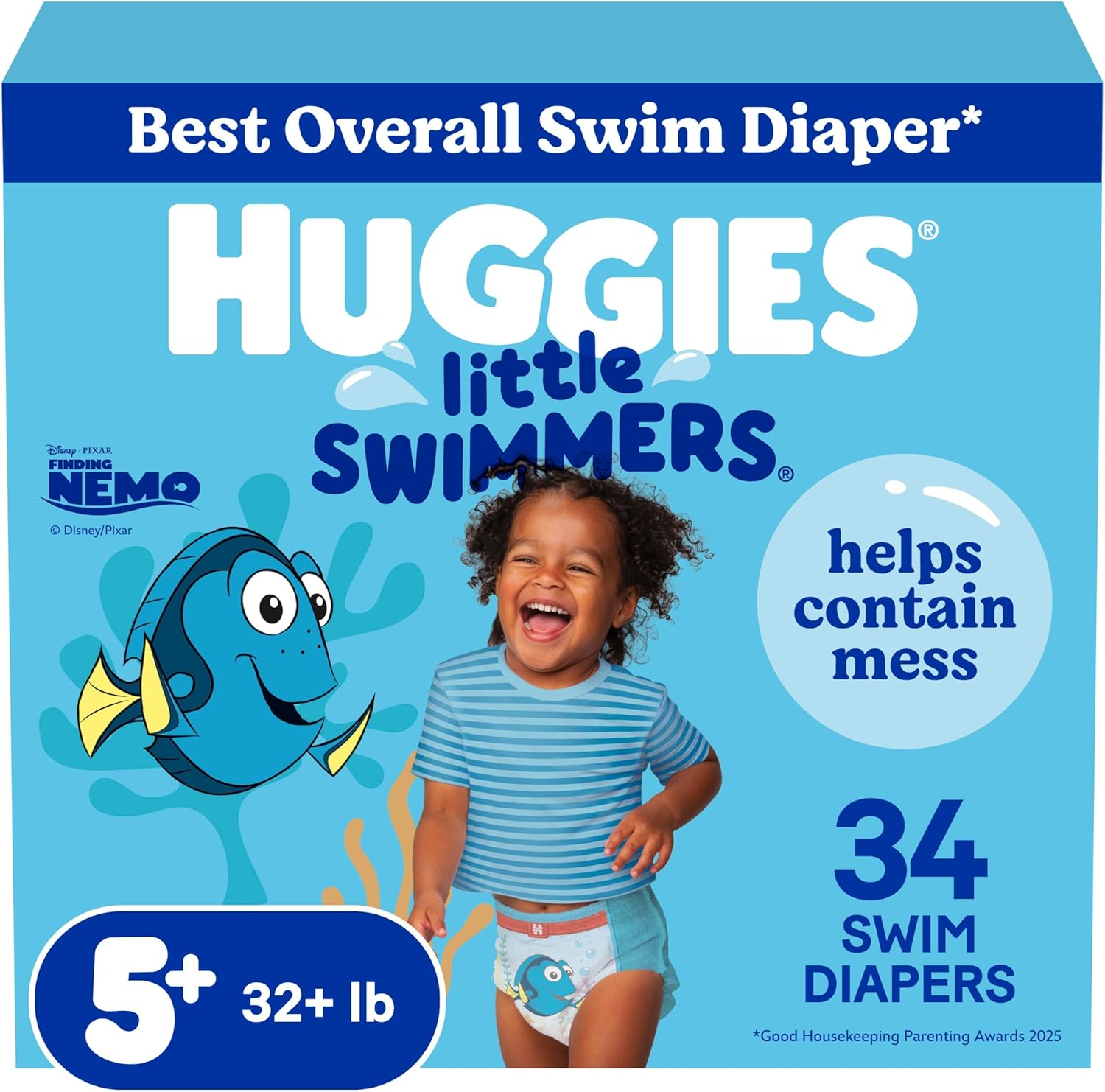
Huggies Little Swimmers is the name most parents already know, and for good reason. It’s the disposable option you’ll find on nearly every store shelf, and it has earned its reputation through consistent performance and easy availability. The stretchy sides pull on like underwear, which makes changes faster and less of a wrestling match compared to diapers with tabs. The design contains messes reliably without absorbing pool water, so your baby doesn’t end up wearing a soggy weight around their hips by the end of a swim lesson.
Pros
- Widely available everywhere
- Easy pull-on design
- Reliable, well-tested containment
- Affordable per-unit cost
Cons
- Single-use, adds to waste
- Sizing runs slightly large for some babies
Check current pricing and available sizes.
Check Price on Amazon2. Hello Bello Premium Swim Diapers

Hello Bello has built its brand around clean ingredient lists and thoughtful design, and their swim diaper line follows the same philosophy. These feel a bit more premium in hand than typical disposables, with a softer inner lining that’s gentler against sensitive skin — a real plus for babies prone to rashes or irritation. The fun prints are also a hit with toddlers who like to feel like they’re wearing something more exciting than a plain diaper.
Pros
- Gentle on sensitive skin
- Snug, reliable fit
- Cute, kid-approved designs
Cons
- Pricier than basic disposable brands
- Not sold in every retail store
See sizing options and current stock.
Check Price on Amazon3. Coterie Baby Swim Diapers

Coterie has developed a loyal following in the everyday-diaper world, and their swim diaper extends that same attention to detail. The fit tends to run true to size with a contoured design that follows a baby’s natural shape rather than a boxy, generic cut. Parents who already use Coterie’s regular diapers often appreciate the consistency in sizing between the two product lines, which removes some of the guesswork when packing for a swim day.
Pros
- True-to-size, contoured fit
- Consistent with Coterie’s daily diaper sizing
- Clean, simple aesthetic
Cons
- Premium price point
- Limited print/pattern variety
View current availability and pricing.
Check Price on Amazon4. Pampers Swim Diapers

Pampers brings the same trusted engineering from their everyday diaper lineup into the pool. These are a dependable middle-ground option — not the cheapest, not the most premium, but consistently well-reviewed for fit and containment. The tabs and stretch panels are designed to hold up through active splashing and kicking, which matters a lot once your baby moves from floating calmly to full-on paddling.
Pros
- Reliable, familiar brand quality
- Good stretch and mobility for active babies
- Easy to find in stores
Cons
- Not the most budget-friendly disposable option
Check today’s pricing and pack sizes.
Check Price on Amazon5. green sprouts Snap Reusable Absorbent Swimsuit Diaper

For families leaning reusable, green sprouts is one of the most established names in the space. The snap closures allow for a genuinely adjustable fit that grows with your baby over several months, which stretches the value of a single purchase much further than a disposable ever could. The outer layer resembles a normal swimsuit bottom, so it doesn’t look out of place layered under a swim outfit — a small but appreciated design touch for parents who care about how the whole look comes together.
Pros
- Adjustable snaps extend the fit range
- Reusable, cost-effective over time
- Doubles as a swimsuit bottom look
Cons
- Requires rinsing and drying between uses
- Higher upfront cost than a single disposable
See colors and sizing details.
Check Price on Amazon6. FINIS Reusable Swim Diaper for Babies

FINIS is a brand better known for swim training gear, and that background shows in the durability of their reusable diaper. Built with a snug, athletic-style fit, it’s a strong pick for parents enrolling babies in structured swim lessons where the diaper needs to perform reliably over repeated sessions rather than a single casual dip. The fabric dries quickly between classes, which is a genuine convenience if you’re swimming multiple days a week.
Pros
- Built for frequent, repeated use
- Dries quickly between sessions
- Snug fit reduces leak risk during active swimming
Cons
- Snug fit may feel tight on chunkier thighs
- Fewer print/color options
View pricing and available sizes.
Check Price on Amazon7. Editor’s Pick Overview

If you only remember one takeaway from this roundup: Huggies Little Swimmers remains the safest, most universally available disposable pick, while the green sprouts snap design is the standout reusable option for families who swim often. Both consistently outperform generic store-brand alternatives in fit and containment.
Swim Diaper Comparison Table
| Product | Type | Best For | Closure | Reusable |
|---|---|---|---|---|
| Huggies Little Swimmers | Disposable | Everyday convenience | Pull-on | No |
| Hello Bello Premium | Disposable | Sensitive skin | Pull-on | No |
| Coterie Baby | Disposable | Contoured true-to-size fit | Pull-on | No |
| Pampers | Disposable | Active babies | Tab/stretch | No |
| green sprouts Snap | Reusable | Frequent swimmers | Snap | Yes |
| FINIS Reusable | Reusable | Swim lessons | Pull-on | Yes |
Sizing & Fit Guide
Getting the size right is arguably more important than the brand you choose. A swim diaper that’s too loose will leak regardless of how well-engineered it is, and one that’s too tight can leave marks or restrict movement during a lesson. Most brands size based on weight rather than age, so always check the weight range printed on the package rather than assuming last season’s size still fits.
A good rule of thumb: the leg cuffs should sit snugly against the thigh without leaving deep red indentations after removal. A little pink line is normal and fades quickly; a deep groove means it’s time to size up. At the waist, you should be able to comfortably slide two fingers under the band.
| Weight Range | Typical Size |
|---|---|
| Under 15 lbs | Small / Newborn |
| 15–24 lbs | Medium |
| 24–34 lbs | Large |
| 34+ lbs | XL / Toddler |
Pool Rules & Public Swim Etiquette
Most public pools, water parks, and community centers require swim diapers for any child not yet fully potty trained — and many enforce this strictly, refusing entry without one. Some facilities go a step further and require both a disposable or reusable swim diaper AND a snug-fitting plastic swim cover on top, especially for infants. It’s worth calling ahead or checking a venue’s posted policy before you show up, since rules vary widely between municipal pools, hotel pools, and water parks.
If you’re planning a beach trip instead of a pool day, requirements are more relaxed since open water dilutes and disperses far more than a contained pool does, but it’s still considerate — and often just common sense — to use a swim diaper regardless.
Water Parks, Lakes & Splash Pads: Do the Rules Change?
Not every body of water treats swim diapers the same way, and it’s worth understanding the differences before you pack the car for a day trip. Large commercial water parks tend to have the strictest policies of all, often stricter than your neighborhood pool, because a contamination event in a wave pool or lazy river can force the closure of an attraction that thousands of guests are relying on that day. Many water parks require a snug-fitting reusable or disposable swim diaper as a baseline, and then layer a required plastic or rubber swim brief on top for any child in diapers, regardless of age. If you show up without the outer cover, expect to be redirected to the gift shop, where the same item is usually marked up considerably compared to what you’d pay ordering ahead online.
Splash pads present a slightly different risk profile. Because the water in a splash pad is typically recirculated through underground filtration rather than sitting in a large open basin, even a small accident can contaminate the system quickly and trigger a shutdown that affects every child playing there, not just yours. Many municipal splash pads post signage requiring swim diapers for any non-potty-trained child, and increasingly some are enforcing it with attendants on-site during peak hours. Because splash pad play involves running, jumping, and constant motion rather than calm floating, a pull-on style with strong elastic recoil tends to hold up better than a looser design.
Lakes, rivers, and ocean beaches are the most relaxed environments simply because of scale — a lake dilutes waste across a huge volume of water almost instantly, and tidal movement at the beach carries it away from swimmers. That said, “relaxed” doesn’t mean “no rules.” Some managed lake beaches and state park swim areas still post signage, and even where there’s no official policy, using a swim diaper on an infant or toddler in open water remains a basic courtesy to other families sharing that same stretch of shoreline. It also protects your own child, since open water often carries more waterborne bacteria than a chlorinated or saltwater pool.
Hotel and resort pools sit somewhere in the middle. Because they’re smaller and serve a captive audience of guests who can’t simply drive to another pool if it closes, many resorts enforce swim diaper policies just as strictly as public municipal pools, and some go further by banning swim diapers of any kind for infants under six months, citing liability concerns rather than product performance. If you’re booking a family resort stay, it’s worth a quick email to the front desk or a look at the resort’s FAQ page before you travel, so you’re not caught off guard poolside on day one.
Best Options for Newborns
Newborns present a unique challenge: their legs are tiny, their skin is extremely sensitive, and most swim diapers aren’t sized small enough for babies under 8 pounds. For very young infants, look specifically for a “newborn” or “small” designation, and prioritize a soft, non-irritating inner lining — Hello Bello and Coterie both perform well here thanks to their gentler materials. Reusable snap-style options like green sprouts are also excellent for newborns since the adjustable snaps allow the fit to be dialed in precisely rather than relying on a single fixed size.
Best Options for Active Toddlers
Toddlers move constantly — kicking, climbing out of the pool, jumping back in — and a swim diaper needs to keep up. This is where fit and elasticity matter most. Pampers and FINIS both hold up well under constant motion thanks to their stretch panels and athletic-style construction. If your toddler is enrolled in formal swim lessons, pairing a snug reusable diaper with a properly fitted swimsuit reduces the chance of any embarrassing mid-lesson mishaps. For families investing in home pool equipment to keep toddlers entertained between lessons, our guide to the best inflatable swimming pools is a useful next read.
Older Kids & Special Needs Swimmers
Standard swim diapers are sized and marketed almost entirely around infants and toddlers under roughly 35 pounds, which leaves a real gap for older children and teens who are not yet potty trained due to a developmental delay, a physical disability, or a medical condition. This is a more common situation than most mainstream product lines acknowledge, and it deserves a section of its own rather than being treated as an afterthought.
For older children, look specifically for brands that manufacture in youth and adult sizes rather than trying to stretch a toddler-sized product past its intended range. Reusable swim brief brands built for special needs swimmers typically offer sizing charts that extend well past 100 pounds and use heavier-duty snap or Velcro closures designed to withstand the stronger kicking and movement of an older, larger child. These are usually sold through specialty medical supply retailers and adaptive swimwear brands rather than the baby aisle, so a general search for “swim diaper” may not surface them — searching for “youth incontinence swimwear” or “adaptive swim brief” tends to return more relevant results.
For families managing this need long-term, reusable is almost always the more practical and economical choice, since youth and adult-sized disposables are harder to find and considerably more expensive per unit than infant disposables. Many families layer a reusable swim brief under a regular swimsuit exactly the way a toddler would wear one, which keeps the experience feeling normal and unremarkable for the child, an important consideration for older kids who are old enough to feel self-conscious. If your child also uses mobility equipment poolside, it’s worth calling ahead to confirm the facility has a pool lift or accessible entry point, since accessibility features and swim diaper policy are often handled by the same aquatics staff and questions can be answered in a single call.
Rashes, Chlorine Sensitivity & Skin Care
A surprising number of parents assume that a rash appearing after swim time must be a reaction to the swim diaper itself, when in many cases the real culprit is prolonged contact with chlorinated or heavily treated pool water combined with the friction of a snug elastic cuff. Understanding the difference matters, because the fix for each is different.
Chlorine can strip the skin’s natural protective oils, leaving it dry, tight, and more prone to irritation, especially around the diaper area where skin folds trap moisture and chemical residue longer than the rest of the body. Babies and toddlers with naturally sensitive or eczema-prone skin are particularly susceptible. The telltale sign of chlorine-related irritation is a broader, more diffuse redness across the whole diaper area rather than a sharply defined line — if you see a distinct red ring exactly where the leg cuff or waistband sat, that’s more likely friction or fit-related rather than a chemical reaction.
To reduce chlorine irritation, rinse your child off in fresh water immediately after swimming, ideally within a few minutes of getting out of the pool, since chlorine residue left to dry on the skin does more damage than chlorine that’s promptly washed away. A fragrance-free moisturizing barrier cream applied to the diaper area before swimming can also help create a protective layer, similar to how you’d protect skin before a long day at the beach. Avoid scented wipes, bubble bath, or heavily fragranced lotions in the hours around swim time, since fragrance additives can compound irritation on already-stressed skin.
Friction-related irritation, by contrast, is usually solved by sizing up, switching to a softer inner lining like Hello Bello or Coterie, or trying a reusable style with a wider, softer cuff rather than a thin elastic band. If a rash persists for more than a couple of days, spreads, blisters, or is accompanied by fever, it’s worth a call to your pediatrician rather than assuming it will resolve on its own, since it could indicate a yeast or bacterial infection rather than simple contact irritation.
Handling Blowouts & Leak Troubleshooting
Even the best swim diaper on the market will occasionally fail, and knowing how to respond quickly and calmly makes the situation far less stressful for everyone involved, including the lifeguards who have seen this a hundred times before and are not judging you nearly as harshly as it feels in the moment.
The first sign of a problem is usually visual — a small cloud or discoloration near your child, or the lifeguard’s whistle. If this happens, calmly and promptly exit the pool with your child rather than trying to finish out the last few minutes of playtime. Facilities are required to respond to any suspected contamination, and a fast, cooperative exit is genuinely appreciated by staff and other pool guests.
Once out of the water, change the swim diaper immediately in the designated changing area, and dispose of a disposable diaper in a covered trash receptacle rather than a regular bag left poolside. If you’re using a reusable diaper, seal the soiled item in a dedicated wet bag for washing later rather than attempting to rinse it in a public sink, which most facilities discourage for hygiene reasons. It’s worth packing a small container of hand sanitizer and a spare grocery bag specifically for this scenario so you’re not caught without supplies.
If leaks are a recurring problem rather than a one-off accident, work through this troubleshooting order: first check the weight range on the package against your child’s current weight, since growth spurts happen faster than most parents expect during the toddler years. Next, check the leg cuffs for any gapping when your child is standing, sitting, and squatting, since a diaper that fits when standing still can gap significantly during active movement. If both of those check out, consider that soft or loose stools — common with certain diets, teething, or minor stomach upset — are simply harder for any swim diaper to fully contain, and a reusable diaper with a secondary absorbent liner may perform better in that specific situation than a basic disposable.
Swim Diaper Alternatives Worth Knowing About
While traditional swim diapers are the standard solution, a few alternative products solve the same problem in slightly different ways, and knowing about them helps you make a more informed choice for your specific situation.
All-in-One Swim Diaper Suits
Some brands combine the containment layer and the swimsuit into a single garment, eliminating the need to layer a separate suit on top. These are especially popular for babies who dislike having clothing pulled on and off multiple times, since it reduces a swim outing to a single change rather than two separate layers. The tradeoff is less flexibility — you can’t mix and match with your child’s existing swimwear collection the way you can with a standalone swim diaper.
Swim Diaper Covers
A swim diaper cover is a snug, largely non-absorbent outer shell, often made of a stretchy neoprene-like material, worn over a standard swim diaper as a second layer of containment. Many water parks require this combination specifically for infants, so if you’re headed somewhere with a strict double-layer policy, it’s worth owning one even if you don’t use it for casual backyard swimming.
Training-Style Swim Briefs for Almost-Potty-Trained Kids
For toddlers who are in the final stages of potty training but not quite ready to be trusted in the water without protection, some brands make a thinner, more underwear-like swim brief. These offer less containment than a true swim diaper but feel less babyish to a toddler who has recently graduated to “big kid” underwear on land and may resist wearing anything that looks like a diaper at the pool.
Regular Swim Trunks with a Built-In Liner
A small number of boys’ swim trunk lines include a built-in mesh liner marketed as swim-diaper-adjacent, but it’s worth being clear-eyed that these liners are not designed for true containment the way a purpose-built swim diaper is, and most pool operators will not consider them an acceptable substitute for a non-potty-trained child.
Brand Deep Dive: Beyond the Top 7
Beyond the seven products reviewed in detail above, a handful of other brands come up often enough in parent forums and retail searches that they deserve a mention, even where we haven’t given them a full standalone review.
i play. by green sprouts
Sister brand to green sprouts, i play. focuses on ultra-affordable reusable swim diapers sold in multipacks, making it a popular choice for daycare centers and swim schools that need to stock spares in bulk. The tradeoff for the lower price point is a slightly less refined fit compared to the flagship green sprouts snap design.
Speedo
Speedo’s baby swim diaper line borrows design cues from their competitive swimwear background, resulting in a snug, low-profile fit that performs especially well for babies already in formal swim lesson programs where a bulkier diaper can interfere with kicking technique.
Bambino Mio
Popular in the reusable cloth diapering community generally, Bambino Mio’s swim diaper line appeals to parents who already use their brand for everyday cloth diapering and want matching sizing and fabric feel for pool days.
iPlay Ultimate Swim Diaper
A step up from the basic i play. line, the Ultimate version adds a fully waterproof outer shell on top of the standard reusable design, aimed at parents who want extra peace of mind during longer swim sessions or lessons where changes aren’t convenient mid-class.
Store Brands (Target, Walmart, CVS)
Nearly every major retailer sells a private-label disposable swim diaper at a meaningfully lower price than name brands. Performance varies more than with name brands, and reviews should be checked per retailer per season, since formulations occasionally change without much notice.
Cost Comparison: Disposable vs Reusable Over a Season
Numbers make this decision much easier than gut feeling alone. Here’s a simplified breakdown assuming a family swims twice a week for a 14-week summer season, which is a reasonably typical cadence for a family with a home pool membership or a weekly swim lesson plus a casual weekend swim.
| Scenario | Unit Cost | Units Needed | Estimated Season Cost |
|---|---|---|---|
| Disposable, 2x/week, 1 per swim | ~$0.60/unit | 28 | ~$17 |
| Disposable, 2x/week, 2 per swim (with 1 change) | ~$0.60/unit | 56 | ~$34 |
| Reusable, single diaper reused all season | ~$18 one-time | 1–2 | ~$18–36 |
| Reusable, 2 diapers rotated for wash days | ~$18 each | 2 | ~$36 |
Over a single season, the difference is fairly small — reusables and disposables land in roughly the same ballpark for light swimmers. The math changes dramatically over multiple seasons or with a second child, since the same one or two reusable diapers can often stretch across an entire summer and, with a larger snap range, into the following year as well, while disposable costs simply restart from zero every season with no residual value. Families who swim more than twice a week, or who have back-to-back children close in age, tend to see the clearest long-term savings from reusables, while occasional swimmers and vacationers often find that the convenience of disposables outweighs the modest cost difference.
Shopping for Twins, Multiples & Siblings Close in Age
Parents of twins or closely spaced siblings face a logistics problem that a single-child household doesn’t: doubling or tripling every swim day’s diaper needs while often managing two squirmy kids at once during a change. A few adjustments make this considerably more manageable. Buying reusable diapers in two different colors or patterns per size makes it instantly obvious which diaper belongs to which child, which matters more than it sounds like it would when you’re mid-change at a crowded pool deck. Sizing can also diverge between multiples faster than expected even when they’re the same age, so it’s worth checking weight-based sizing separately for each child rather than assuming a matched set will work for both indefinitely.
For frequent swimmers with multiples, owning three or four reusable diapers per child rather than just one or two reduces the pressure to hand-wash and dry between every single swim session, which becomes especially valuable during a busy week of back-to-back lessons. A dedicated wet bag with multiple internal pockets, one per child, also keeps soiled reusables organized on the drive home rather than tossed together in a single bag.
The Potty Training Transition: When to Stop Using Swim Diapers
There’s no universal age at which a child graduates from needing a swim diaper — it’s tied entirely to potty training progress rather than a birthday. Most pools define “potty trained” fairly strictly for water safety purposes, typically meaning the child has been fully accident-free, including bowel movements, for a consistent period both on land and, ideally, demonstrated in water as well, since some children who are reliably trained on land still have accidents when submerged in a pool due to the sensory difference of being in water.
A practical approach many parents use during the transition period is to keep a swim diaper in the pool bag as a backup even after a child seems mostly trained, using it for the first few pool visits after achieving dryness on land, then testing without one during a low-stakes backyard swim before trusting a public pool visit without protection. Some facilities will ask directly whether a child is potty trained before allowing pool access without a swim diaper, so it’s worth having an honest, matter-of-fact answer ready rather than guessing and risking a mid-swim accident in a public setting.
It’s also worth normalizing for your child that needing a swim diaper a little longer than their friends isn’t unusual — potty training timelines vary enormously between children, and water accidents in particular tend to resolve later than land accidents simply because the body’s signals feel different when submerged.
Eco-Friendly Considerations
Disposable swim diapers, like all disposable diapers, are not biodegradable and contribute to landfill waste over time. If sustainability is a priority for your family, reusable options are the clear winner — a single well-made reusable swim diaper can replace dozens of disposable units over a swim season. Some parents adopt a hybrid approach: reusable diapers for regular home or lesson swimming, with disposables kept on hand for travel or emergencies when laundry access isn’t guaranteed.
Beyond landfill impact, it’s worth considering the manufacturing footprint of each option as well. Disposable swim diapers require fresh raw materials for every single unit produced, while a reusable diaper’s environmental cost is front-loaded into its manufacturing and then amortized across every subsequent wear. Families who want to reduce impact further without fully committing to reusables can look for disposable brands that use partially plant-based or reduced-plastic materials in their outer shell, though it’s worth noting that even these “greener” disposables are still single-use and end up in the same waste stream as conventional versions.
Travel & Vacation Tips
Packing for a beach or resort vacation? Disposable swim diapers are almost always the more practical choice since you won’t need to worry about washing and drying a reusable option in a hotel room. Pack a couple extra beyond what you think you’ll need — pool days tend to run longer than planned, and having a backup on hand means one accident doesn’t end the day early. If you’re also researching gear for a family swim vacation, our roundup of best swimming watches is worth a look for tracking pool time and laps once the kids are old enough to swim independently.
For longer trips, particularly international travel, it’s worth researching swim diaper availability at your destination before you leave, since brand availability and even basic product presence vary considerably by country. In many destinations popular for family travel, imported swim diapers can be difficult to find or significantly marked up in resort gift shops, so packing enough disposables for the full trip, or a reusable option you can wash in a hotel sink, avoids an unnecessary scramble once you’ve arrived. Airlines generally treat swim diapers the same as regular diapers for carry-on purposes, so there’s no need to check them separately or worry about liquid restrictions.
Common Mistakes to Avoid
Mistakes Parents Make
- Sizing based on age instead of weight
- Assuming a regular diaper will work “just this once”
- Not packing a backup swim diaper
- Skipping the fit check at the leg cuffs
- Forgetting facility-specific double-layer requirements
Simple Fixes
- Always check the weight range on the package
- Never substitute a regular diaper for swimming
- Bring at least one spare per swim session
- Two-finger test at the waistband and cuffs
- Call ahead to confirm pool policy
Myths vs Facts About Swim Diapers
| Myth | Fact |
|---|---|
| Swim diapers stop all liquid, just like regular diapers. | They are designed to contain solid waste only; minor liquid leakage into the pool is expected and normal. |
| A regular diaper works fine for a quick dip. | Regular diapers absorb pool water almost instantly, becoming heavy, sagging, and offering worse containment than no diaper at all. |
| Reusable swim diapers are unhygienic compared to disposables. | When rinsed promptly and washed properly, reusable swim diapers are just as hygienic and perform comparably to top disposable brands. |
| Bigger babies always need the largest available size. | Sizing should follow the manufacturer’s specific weight chart, not a general assumption based on age or overall size. |
| Swim diapers are only necessary at public pools. | Many private and backyard pool owners also require them for guests, and open water swimming benefits from them too, even without formal enforcement. |
| One swim diaper size fits a baby for the whole first year. | Babies grow quickly enough during the first year that most families move through two or three sizes before their first birthday. |
Washing & Care for Reusable Swim Diapers
Caring for reusable swim diapers is straightforward: rinse thoroughly in cold water immediately after use to remove chlorine and any residue, then machine wash in a gentle cycle with a mild, fragrance-free detergent. Avoid fabric softener, since it can break down the elastic in the leg cuffs over time and reduce the snug fit that prevents leaks. Air dry rather than tumble dry on high heat, which can also degrade the elastic. With proper care, a quality reusable swim diaper can easily last an entire swim season or more.
Between swim outings, store reusable diapers somewhere dry and ventilated rather than sealed in an airtight bag, since trapped moisture encourages mildew and odor buildup even in fabrics designed to dry quickly. If you’re storing reusable swim diapers over the off-season, wash and fully dry them one final time before putting them away, and check the elastic for any signs of wear before the next season begins, since a full year of storage can reveal weakening that wasn’t obvious at the end of the previous summer. A quick stretch test — gently pulling the leg cuffs to check for springback — takes only a few seconds and can save you from discovering a stretched-out diaper poolside on the first swim day of the new season.
Printable Pool Bag Checklist
Before heading out the door for any swim outing, running through a short checklist takes the guesswork out of packing and prevents the most common last-minute scrambles.
| Item | Notes |
|---|---|
| Primary swim diaper (worn) | Check fit before leaving the house |
| 1–2 backup swim diapers | More for toddlers or longer outings |
| Wet bag for soiled items | Essential for reusable diapers |
| Fragrance-free wipes | For quick changes on the go |
| Barrier cream | Helps with chlorine-related dryness |
| Swim cover / double-layer brief | Check if your facility requires one |
| Regular diaper for after swimming | Don’t forget to switch back |
| Towel and dry change of clothes | For the whole family, not just the swimmer |
Daycare & Swim School Policies: What to Expect
Once a swim diaper leaves your own backyard or car and enters a shared facility like a daycare center or a formal swim school, a whole new layer of rules typically applies, and it’s worth understanding them before your child’s first day rather than discovering them in a hallway conversation with a confused staff member.
Most licensed daycare centers that offer any kind of water play, from a small wading pool to a sprinkler table, are bound by state or provincial childcare licensing regulations that specifically address swim diaper use. In many jurisdictions, these regulations require a disposable or reusable swim diaper as a baseline for any non-potty-trained child, with some regions further mandating that centers keep a small stock of spares on hand for staff to use in the event of a blowout, since staff are usually not permitted to send a child home mid-day over a swim diaper issue alone. If your daycare has a water play policy in its parent handbook, it’s worth reading the fine print, since some centers require parents to supply diapers labeled with the child’s name, while others provide their own and simply charge a small supply fee.
Formal swim schools, the kind offering structured lessons with certified instructors, tend to have the strictest and most consistently enforced policies of any facility type, because a single incident during a lesson can force the pool to close for the remainder of the day’s class schedule, affecting dozens of other paying families. Most swim schools require a snug-fitting swim diaper as a non-negotiable condition of enrollment for non-potty-trained children, and a meaningful number go further by requiring a specific double-layer combination — typically a reusable or disposable inner layer plus a tightly fitted outer swim brief — regardless of what a parent might use at a casual backyard pool. Many swim schools sell this exact combination in their pro shop specifically because they’ve found that parent-supplied diapers don’t always meet their fit standards, so it’s worth asking directly during enrollment whether the school has a preferred or required product rather than guessing and being turned away at the first class.
Because lesson-based swim school sessions often run 30 minutes or longer with minimal opportunity for a mid-class change, it’s generally worth investing in a higher-performance product for lesson days specifically, even if you use a more basic option for casual swimming. The athletic, snug-fit designs from brands like FINIS and Speedo tend to perform best in this specific context precisely because they were built with continuous, active movement in mind rather than the more static floating and splashing typical of a backyard pool day.
Chlorine, Saltwater & UV Pools: Does the Pool Type Matter?
Parents sometimes assume that a “gentler” pool sanitation system means they can be more relaxed about swim diaper use, but the type of water treatment system a pool uses has very little bearing on whether a swim diaper is necessary — it primarily affects how the skin and eyes tolerate extended exposure to the water rather than how well waste is contained or neutralized.
Traditional chlorinated pools remain the most common setup at public and community facilities, and while chlorine is effective at killing many pathogens over time, it does not act instantly, meaning a fecal contamination event still poses a real health risk to other swimmers for the period before the chlorine has fully done its job — which is precisely why pools close and drain rather than simply waiting it out. This is also the setup most likely to cause the dry, irritated skin discussed earlier in this guide, since chlorine strips natural oils more aggressively than saltwater systems.
Saltwater pools, increasingly popular for backyard installations, use a salt chlorine generator to produce chlorine on-site at a much lower concentration than a traditionally chlorinated pool, which is gentler on skin and eyes but still relies on chlorine as the active sanitizing agent — meaning the same swim diaper rules and contamination risks apply. Some parents mistakenly believe a saltwater pool is inherently “safer” for skipping a swim diaper, but the salt concentration used in residential saltwater systems is far too low to meaningfully sanitize waste on contact.
UV and ozone-based systems, more common in higher-end residential installations and some newer commercial facilities, use ultraviolet light or ozone gas as a supplemental or primary sanitizer, often in combination with a much-reduced chlorine dose. These systems can be highly effective at neutralizing pathogens that pass through the filtration system, but they still can’t do anything about a solid waste event that occurs directly in the water rather than passing through the filter, so a swim diaper remains just as necessary regardless of how advanced the sanitation system is.
The bottom line for any pool type: sanitation systems manage ongoing water quality, not accidents. A swim diaper’s job is prevention at the source, and no filtration or chemical system replaces that first line of defense.
A Short History & How Regulations Evolved
Swim diapers as a distinct product category are relatively young compared to diapers generally. Disposable diapers themselves only became mainstream in the 1960s and 1970s, and it took manufacturers a while longer to recognize that a diaper engineered to absorb liquid was fundamentally the wrong tool for water environments. Early solutions in the 1980s and 1990s were often improvised — some parents used plastic pants over a regular diaper, which offered poor containment and tended to trap heat and moisture uncomfortably against the skin.
The first purpose-built swim diapers began appearing on store shelves in the 1990s, pioneered by major diaper manufacturers who recognized a gap between “no protection” and “the wrong protection.” Huggies Little Swimmers, one of the earliest widely distributed disposable swim diapers, helped establish the now-standard design template of a non-absorbent core paired with elasticized leg cuffs that most competitors still follow today.
As swim diapers became more common, public health and aquatics industry organizations began formalizing guidance around their use, particularly for commercial and public pool operators. Many local health departments now include swim diaper requirements explicitly in their pool operation codes, treating them as a recognized risk-mitigation tool alongside water testing schedules and lifeguard certification requirements, rather than as an optional courtesy. This shift from informal parental practice to codified public health policy is part of why swim diaper enforcement has become noticeably stricter at public facilities over the past two decades compared to how casually the topic was treated a generation ago.
Where to Buy: Retailer Comparison
Swim diapers are sold through a wide range of retail channels, and where you shop can affect price, selection, and how quickly you can restock mid-season.
| Retailer | Strengths | Considerations |
|---|---|---|
| Amazon | Broadest brand selection, subscribe-and-save pricing, fast restocks | Sizing can vary by seller; check recent reviews for consistency |
| Target | Strong private-label option, easy in-store returns | In-store size selection can be limited outside of peak season |
| Walmart | Lowest average price point for basic disposables | Fewer premium or reusable options in-store |
| Specialty baby retailers | Best selection of premium reusable brands | Higher prices, less frequent sales |
| Pool & swim school pro shops | Facility-approved products guaranteed to meet policy | Typically priced at a premium over online retail |
For families who know exactly which brand and size they need, buying in bulk multipacks online is almost always the most economical route. For families still figuring out fit and preference, buying a single pack in-store first, where a return is simple if the size is wrong, tends to save money in the long run compared to committing to a large multipack sight unseen.
Warranty, Returns & Quality Guarantees
Because disposable swim diapers are single-use, there’s obviously no warranty in the traditional sense, but most major retailers and brands will accept a return or exchange on an unopened package if the size turns out to be wrong, provided you keep the receipt and act within the retailer’s standard return window. It’s worth opening only one package at a time when trying a new brand or size for the first time, rather than stocking up on multiple packs before confirming the fit works for your child.
Reusable swim diapers are a different story, since they represent a larger upfront purchase and are expected to hold up over repeated use. Most established reusable brands, including green sprouts and FINIS, offer some form of manufacturer’s guarantee against defects in materials or workmanship, typically covering issues like snaps failing prematurely or elastic that degrades far faster than expected under normal use. This does not typically cover ordinary wear and tear from a full season of regular use, so it’s worth reading the specific terms before assuming a worn-out elastic cuff after two summers of heavy rotation qualifies for a free replacement. Registering your purchase with the manufacturer, when that option is offered, is a simple step that makes any future warranty claim faster to process, since it establishes proof of purchase date without needing to dig up an old receipt.
DIY & Budget Hacks for Reusable Swim Diapers
For particularly budget-conscious families, or those simply interested in a lower-waste option, a small but dedicated community of parents makes their own reusable swim diapers at home using waterproof fabric like PUL (polyurethane laminate) combined with a swimsuit-style outer layer and snap or hook-and-loop closures. Free patterns are widely available from cloth diapering communities, and the material cost for a handful of home-sewn swim diapers is typically a fraction of buying the equivalent number of name-brand reusables.
That said, a homemade swim diaper is only as good as its construction, and getting the leg cuff elastic tension right — snug enough to contain waste, loose enough to avoid marks — takes some trial and error even for an experienced home sewer. If you’re going this route, it’s worth making one test unit first and using it for a few low-stakes backyard swims before committing to sewing a full rotation, and it’s generally not advisable to rely on a homemade diaper for a facility with a strict, staff-enforced fit policy, since you won’t have a manufacturer’s tested design to fall back on if a facility attendant questions it.
For families who want the cost savings of reusables without the sewing project, another effective budget hack is simply buying reusable diapers secondhand from other parents, either through local parent groups or resale marketplaces, since a gently used reusable swim diaper in good elastic condition performs identically to a new one at a fraction of the price. It’s worth inspecting the elastic condition closely before buying secondhand, since that’s the component most likely to have degraded with age even if the fabric itself looks unworn.
Seasonal Buying Guide: When to Buy for the Best Price
Timing your swim diaper purchases around the retail calendar can meaningfully reduce what you spend over a year of regular swimming. Prices for both disposable and reusable swim diapers tend to follow a predictable seasonal pattern tied to swim season demand.
The highest prices and lowest stock typically appear in late spring, right as swim season demand ramps up and retailers know parents need the product immediately rather than being able to shop around. Conversely, the best discounts usually appear in early fall, right after peak swim season ends, when retailers are looking to clear seasonal inventory ahead of cooler months — buying next year’s supply of disposables at that point, provided you’re confident of the size your child will need, can result in meaningful savings. Winter holiday sales events also occasionally include swim diapers in broader baby-product discount bundles, particularly for families in warm climates or those planning a winter beach vacation.
For reusable diapers specifically, buying slightly ahead of your child’s current size, when the manufacturer’s snap-adjustable range allows it, is a smart way to extend the useful life of a single purchase across a full season of growth rather than needing to buy a second size mid-summer. Signing up for email alerts from your preferred retailer or brand is a low-effort way to catch flash sales that aren’t otherwise advertised prominently.
Expert Perspective: What Pediatricians Generally Advise
While this guide isn’t a substitute for personalized medical advice, it’s worth summarizing the kind of general guidance pediatricians commonly give parents about swim diapers and pool safety, since it helps frame a few of the more nuanced points covered throughout this article.
Most pediatricians are comfortable with healthy full-term infants being introduced to pool water once they’ve had any routine early check-ups your provider recommends, generally advising parents to avoid submerging the umbilical cord stump area until it has fully healed, since prolonged water exposure can slow healing and increase infection risk in that specific area. Beyond that early window, a properly fitted swim diaper is generally considered sufficient protection for both the baby and other swimmers.
On the topic of skin sensitivity, pediatricians frequently recommend a rinse-immediately, moisturize-after routine for babies who show any tendency toward eczema or dry skin, echoing the chlorine sensitivity guidance covered earlier in this guide, and generally advise against leaving a wet swim diaper on for an extended period after swimming has ended, since prolonged dampness against the skin — even from a non-absorbent swim diaper — can still contribute to irritation over time.
On timing and readiness for formal swim lessons, many pediatricians note that infant swim programs are more about water safety familiarization and parent-child bonding than teaching an infant to truly swim independently, and that a swim diaper’s job in that context is simply to let the class continue without disruption, not to serve any developmental purpose itself. As always, any specific concerns about your own child’s readiness for water, skin sensitivities, or medical conditions that might affect swimming should be directed to your own pediatrician rather than general guidance found online.
International Travel: Country-by-Country Notes
Swim diaper norms and availability vary more by country than most first-time international travelers expect, and a little research before a family trip abroad can save you from an unnecessary scramble once you’ve landed.
In much of Western Europe, swim diaper requirements at public pools and water parks are generally similar to U.S. norms, though enforcement can be noticeably stricter in some countries, with certain facilities requiring a specific certified swim diaper brand recognized by local health authorities rather than accepting any swim diaper a visiting family happens to have packed. It’s worth checking a destination water park’s website in advance, since some publish explicit brand or style requirements for international visitors.
In parts of Asia and the Middle East, availability of familiar Western brands can be inconsistent outside of major international cities, with imported products sometimes carrying a significant price premium in hotel gift shops or specialty baby stores. Packing a full trip’s supply of disposables, or a reusable option you’re comfortable hand-washing in a hotel sink, is generally the more reliable approach for these destinations.
In Australia and New Zealand, swim diaper culture and product availability closely mirror the U.S. and U.K. markets, with similar brands sold through comparable retail channels, making these some of the easier destinations for restocking mid-trip if needed.
Regardless of destination, it’s worth packing a couple more swim diapers than you think you’ll need for any international trip, since even a short delay in locating a local retailer can turn into a lost afternoon of vacation time better spent at the pool or beach than searching pharmacy aisles in an unfamiliar city.
Premature & Low-Birth-Weight Babies
Parents of premature or low-birth-weight babies face a particular challenge when it comes to swim diapers: most mainstream disposable and reusable brands start their smallest size around 7 to 8 pounds, which leaves a real gap for babies who spend weeks or months below that threshold, whether still in the NICU or recently home and catching up on growth. This isn’t a niche concern — a meaningful share of babies are born under that weight, and their parents deserve clear guidance rather than being left to guess.
For babies below the standard smallest size, water introduction is typically postponed on medical advice well beyond the point where a full-term baby might start infant swim classes, so the more urgent early need is often less about pool swimming and more about safe bathing and any therapeutic water exposure recommended by a NICU team, which usually involves specialized, closely supervised protocols rather than a store-bought swim diaper at all. Once a preemie has caught up closer to the standard newborn weight range and a pediatrician has cleared water play, the newborn-specific options discussed earlier in this guide, particularly the softer-lined disposables and the fully adjustable snap-style reusables, tend to work well since the snap range can often be cinched down tighter than the printed minimum weight suggests, provided the fit is checked carefully rather than assumed.
Because preemies often have more sensitive, thinner skin even after catching up on weight, the chlorine sensitivity guidance covered earlier in this guide deserves extra attention for this group specifically — shorter pool sessions, a barrier cream applied before swimming, and a prompt rinse afterward are all worth treating as standard practice rather than optional extras. As always, any water introduction timeline for a premature baby should be guided directly by your pediatrician or NICU follow-up team rather than general age or weight benchmarks aimed at full-term infants.
Signs It’s Time to Replace a Reusable Swim Diaper
Reusable swim diapers are built to last a season or more, but they don’t last forever, and continuing to use one past its functional lifespan is one of the more common reasons parents experience unexpected leaks despite having invested in a premium product. Knowing what to look for takes the guesswork out of deciding when to retire one.
The clearest sign is elastic fatigue at the leg cuffs and waistband. New elastic should snap back quickly and firmly when stretched; elastic that’s lost its recoil will feel slack even when the diaper is laid flat, and it will visibly gap around a baby’s thighs even at a size that should otherwise fit. A simple test at the start of each new season is to stretch the leg openings gently and watch how quickly they return to shape — sluggish, incomplete recoil is your cue to replace it before the first swim of the year rather than mid-outing.
Snap closures are the other common failure point, particularly on frequently used diapers. A snap that no longer clicks firmly into place, or that pops open under normal movement rather than requiring deliberate force to release, has likely worn past the point of reliable use. Fabric-level wear — thinning, small tears, or a waterproof outer layer that’s started to peel or delaminate — is a more obvious visual cue that also signals it’s time to retire the item, since a compromised outer layer can allow water and residue through in ways the original design never intended.
As a general rule of thumb, a well-cared-for reusable swim diaper used two to three times per week through a full summer season should be inspected closely before a second season of similarly heavy use, since elastic degradation accelerates with repeated stretching, washing, and sun exposure, and a diaper that performed perfectly last year isn’t guaranteed to perform the same way after a full off-season of storage and a fresh round of growth-driven stretching.
What’s Actually in a Swim Diaper: A Materials Breakdown
Understanding what a swim diaper is actually made of helps explain both how it performs and why certain products cost more than others. Disposable swim diapers typically use a polyester or polypropylene non-woven outer shell, chosen specifically because these synthetic fibers resist water absorption rather than soaking it up the way the cellulose-based materials in a regular diaper’s core would. The inner lining that touches the skin is usually a softer, still non-absorbent synthetic layer, sometimes treated with a mild finish intended to reduce friction against sensitive skin — this is the component that differs most noticeably between a basic and a premium disposable brand.
The elastic used at the leg cuffs and waistband, whether on a disposable or reusable product, is typically a synthetic rubber or spandex-blend elastic chosen for its ability to maintain tension even after repeated exposure to chlorine and other pool chemicals, which degrade many ordinary elastic materials far faster than normal wear and tear would. This chlorine-resistant elastic is one of the more meaningful, if invisible, quality differences between a well-engineered swim diaper and a cheaply made one, since it directly determines how long a reusable product holds its fit.
Reusable swim diapers typically use a laminated outer fabric, most commonly a polyester or nylon face fabric bonded to a thin waterproof polyurethane laminate (PUL) layer, the same material widely used in reusable cloth diapering generally. This construction allows the outer layer to remain lightweight and quick-drying while still preventing the fabric from becoming waterlogged the way an ordinary swimsuit fabric would if it were expected to also contain solid waste. Some premium reusable diapers add a thin, replaceable absorbent liner inside as a secondary containment layer, though it’s worth noting this liner is meant to catch minor residue rather than function like a true absorbent diaper core.
Home Pool Owners vs Public Pool Guests: Different Considerations
Families who own a backyard pool face a genuinely different set of tradeoffs around swim diapers compared to families who primarily swim at public or community facilities, and it’s worth thinking through the differences explicitly rather than assuming the same approach fits both situations equally well.
For home pool owners, there’s no facility staff member checking fit or enforcing a specific product at the gate, which puts more responsibility on the parent to self-enforce good practices consistently rather than relying on external pressure to get it right. On the other hand, home pool owners generally have far more flexibility in how they respond to an accident, since draining, shocking, and refiling a residential pool is a manageable inconvenience rather than a disruption affecting dozens of other paying guests, and many home pool owners choose to be somewhat more relaxed about swim diaper use for their own children specifically as a result, while often still requiring visiting children to wear one as a condition of a pool party invitation.
Home pool owners also have the practical advantage of easy access to their own washing machine, which tips the cost-benefit calculation more clearly toward reusable diapers for this group compared to families without convenient laundry access between swim sessions. A home pool is also usually treated with a filtration and sanitation system sized for the pool’s specific volume, so it’s worth understanding your own system’s turnover rate and chemical dosing, since a smaller residential pool with a less powerful filtration system may need more caution around minor accidents than families assume, simply because a smaller total water volume means a given contamination event represents a proportionally larger disruption to overall water quality.
Public pool guests, by contrast, are subject to whatever rules the facility has posted, with less room for personal judgment calls, and should treat the facility’s specific brand or double-layer requirements as non-negotiable rather than as a suggestion, since staff enforcing these rules are typically following health department mandates rather than personal preference.
Hosting a Backyard Pool Party: A Host’s Checklist
If you’re the one hosting a pool party rather than simply attending one, a little advance planning around swim diapers can prevent an awkward mid-party conversation or, worse, an actual accident that shuts down your pool for the rest of the afternoon.
The simplest approach is to state your swim diaper expectation clearly on the invitation itself, something as brief as a note that all non-potty-trained children should arrive in a swim diaper, which normalizes the request and removes any awkwardness around having to ask individual parents in person once guests have already arrived. Many hosts also find it worthwhile to keep a small stock of disposable swim diapers in a couple of common sizes on hand, tucked into a designated pool-party supply bin along with sunscreen, bandaids, and other small essentials, since it’s a low-cost way to avoid turning away a family who simply forgot to pack one.
It’s also worth designating a specific changing area away from the pool deck itself, ideally with a small trash bin with a lid specifically for diaper disposal, so that any changes happening during the party stay organized and don’t create an ad hoc changing station on pool furniture that other guests will want to use later. If your pool has a shallow end or baby pool section separate from the main pool, encouraging younger, diapered children to stay primarily in that section, even with a properly fitted swim diaper, adds an extra layer of practical risk reduction without being an unreasonable restriction to ask of guests.
Finally, it’s worth having a calm, pre-planned response ready in case an accident does happen, since a host who reacts with visible frustration can make an already-embarrassed parent feel considerably worse. A brief, matter-of-fact acknowledgment that accidents happen, followed by a quick and practical response — clearing the pool, starting the shock treatment process, and letting the affected family know there’s no hard feelings — keeps the day from being derailed by an entirely normal and common pool-day occurrence.
Quick-Reference Guide for Grandparents & Other Caregivers
Grandparents, babysitters, and other occasional caregivers are often the ones taking a child swimming without the child’s usual parent present, and a quick-reference summary can prevent common mistakes that come from simply not being as immersed in day-to-day swim diaper routines as a primary caregiver would be.
The single most important thing to communicate to an occasional caregiver is the current size and brand your child is wearing, along with a reminder to check the weight range on the package rather than relying on memory of a size from a previous visit, since children can move up a size faster than an occasional caregiver might expect. It’s also worth explicitly noting whether your facility of choice — whether a public pool, a swim school, or a specific water park — has a double-layer or specific-brand requirement, since a grandparent unfamiliar with that particular venue’s rules may otherwise show up with only a single layer and be turned away.
For caregivers using a reusable swim diaper for the first time, a brief note on the wash-and-dry routine prevents a soiled diaper from being tossed in with regular laundry or left sitting in a closed bag for days, both of which lead to odor and hygiene problems that a regular routine easily avoids. Packing a labeled, ready-to-go swim bag with the correct size and a spare or two, along with barrier cream and a change of regular diapers for after swimming, removes almost all of the guesswork for an occasional caregiver and reduces the chance of a preventable mid-swim problem simply due to unfamiliarity rather than any lack of care.
Road Trip & Car Travel Packing Tips
Road trips involving multiple pool stops — hotel pools along the route, a water park detour, a lake day — benefit from a slightly different packing strategy than a single planned outing, since you’re often managing several swim sessions across multiple days without guaranteed laundry access in between.
For multi-day road trips, packing a mix of disposables and one or two reusables tends to offer the best balance: disposables cover the unpredictable stops where you’re not sure exactly when or where you’ll next have laundry access, while a reusable or two, rinsed in a hotel bathtub or sink and hung to dry overnight using a portable travel clothesline, can stretch your total supply further without needing to carry an entire season’s worth of disposables in the trunk. A dedicated wet bag with a waterproof zip closure is particularly valuable on a road trip, since a soiled swim diaper sitting loose in a car for even a short drive between stops creates an odor problem that’s much harder to manage in an enclosed vehicle than at home.
It’s also worth keeping your swim diaper supply somewhere easily accessible in the car rather than buried under luggage, since an unplanned pool stop — a hotel with an inviting pool you didn’t originally plan to use, or kids begging to stop at a roadside water play area — is common enough on a family road trip that having supplies within quick reach saves you from either missing the opportunity or scrambling through packed bags in a parking lot. Finally, if your road trip crosses into a region with a different climate than home, particularly a hotter, more humid destination, packing slightly more disposables than your usual rate of use anticipates is a reasonable buffer, since increased pool time in hot weather often means more frequent changes than a typical week at home.
Recycling & End-of-Life Disposal Options
Disposable swim diapers, like disposable diapers generally, are not accepted in standard curbside recycling programs, since the mixed synthetic materials used in their construction can’t be easily separated and reprocessed through conventional municipal recycling streams. The standard and expected disposal method remains regular household trash, ideally bagged to contain odor and any residue before it goes into a larger bin.
A small but growing number of specialized diaper recycling programs exist in certain regions, typically operated by dedicated third-party companies or occasionally by municipal waste programs in more environmentally proactive areas, which process used diapers to recover reusable fiber and plastic components rather than sending them straight to landfill. These programs are not yet widely available and often require a specific drop-off location or a mail-back program with its own packaging requirements, so it’s worth checking whether your specific region has access to one rather than assuming it’s an option everywhere.
For reusable swim diapers that have reached the end of their functional life due to worn elastic or fabric degradation, full recycling is similarly limited by the mixed-material laminate construction, but many worn-out reusable diapers still have some life left in them for non-swimming purposes — some parents repurpose old reusable swim diapers as a spare layer under a regular diaper during a diaper-changing mishap on the go, or simply as a soft cloth for cleaning purposes once the elastic performance has degraded past the point of reliable containment. This kind of informal reuse, while not a substitute for a formal recycling program, at least extends the useful life of the materials before they ultimately reach the end of their lifecycle.
Frequently Asked Questions
Do swim diapers actually stop leaks completely?
They contain solid waste effectively but are not designed to hold liquid, so occasional minor liquid leakage is normal and expected — this is different from a failure of the product.
Can I use a regular diaper instead of a swim diaper?
No. Regular diapers absorb water, becoming heavy and saggy almost instantly, and they offer far worse containment than a purpose-built swim diaper.
At what age can babies stop wearing swim diapers?
Most pools require swim diapers until a child is fully potty trained, regardless of specific age, though many kids transition out of them between ages 2 and 4.
Are reusable swim diapers as effective as disposables?
Yes, when properly fitted. Reusable options like green sprouts and FINIS perform comparably to top disposable brands in containment and comfort.
How many swim diapers should I pack for a pool day?
Plan on at least two to three per outing, especially for toddlers, since accidents or extended swim sessions may require a change.
Do swim diapers need to be worn under a swimsuit?
Yes, in most cases. Swim diapers alone aren’t always considered appropriate pool attire, so pairing one with a fitted swimsuit is standard practice.
Can newborns wear swim diapers in a pool?
Yes, as long as they fit a newborn-specific size and the baby has had any recommended immunizations or medical clearance for swimming, per your pediatrician’s guidance.
Why does my baby’s swim diaper leave marks on their thighs?
Mild pink marks after removal are normal and fade quickly; deep red grooves indicate the diaper is too small and you should size up.
Do all pools require swim diapers?
Most public and community pools do, though requirements vary by facility. Always check posted rules or call ahead before your visit.
How do I wash a reusable swim diaper between uses?
Rinse in cold water immediately, then machine wash on a gentle cycle with mild detergent and air dry to preserve elastic and fit.
Are swim diapers necessary for beach swimming?
They’re less strictly required at open beaches compared to pools, but still recommended as a considerate, common-sense practice.
What’s the difference between snap and pull-on swim diaper closures?
Pull-on styles go on like underwear and are quicker for diaper changes, while snap closures offer more adjustability as your baby grows.
Final Verdict: Which Swim Diaper Should You Buy?
For most families, Huggies Little Swimmers remains the most dependable disposable option thanks to its wide availability and consistent fit. If you swim often enough to justify the investment, the green sprouts snap-style reusable diaper offers the best long-term value and comfort. Whichever you choose, getting the size right matters more than the brand — so double-check the weight chart before you buy.
Shop Huggies Little Swimmers on AmazonAs an Amazon Associate, this site earns from qualifying purchases. Prices and availability are accurate as of the time of publishing and are subject to change.
For more swim-day essentials, check out our guides to the best swim paddles and best swimming watches to round out your family’s pool gear.