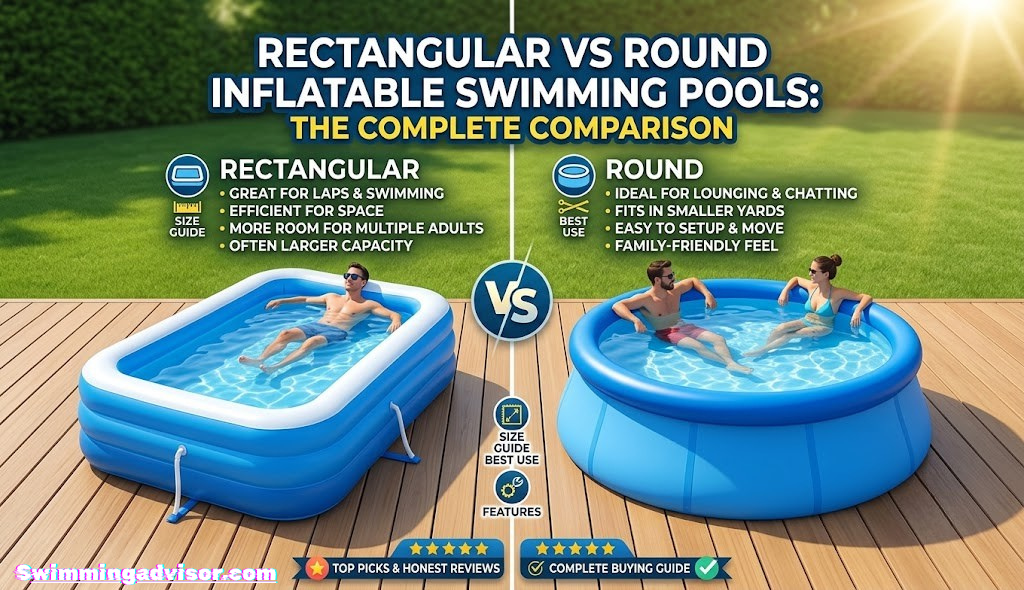
It seems like a simple question: rectangular or round? In practice, this single choice shapes nearly everything about your inflatable pool experience — how it fits in your backyard, how you and your family swim in it, how much work it takes to keep it clean, and even how much the water costs to heat. Most buyers pick a shape based on what looks good in a product photo or what fits their immediate budget, and only realize after filling it up and living with it for a few weeks that it was or wasn’t quite right for how they actually use a pool.
This guide cuts through the guesswork. We’ve compared rectangular and round inflatable swimming pools across every dimension that actually matters — yard geometry, swimming experience, maintenance burden, water volume, child safety, adult lap swimming, heating efficiency, and total cost of ownership. By the end, you’ll know exactly which shape fits your life, not just your yard.
If you’re still in the process of choosing a pool entirely, our comprehensive guide to the best inflatable swimming pools covers the full market across all shapes and sizes. This article goes deep on one specific decision within that: the shape itself.
At a Glance: Key Differences
| Factor | Rectangular | Round | Winner |
|---|---|---|---|
| Yard space required | More total area, fits corners & fences | Less area, needs clearance on all sides | Context-dependent |
| Swimming experience | Lap-friendly, directional flow | Splashing, social, non-directional | Rectangular for swimming |
| Setup complexity | Moderate — frame or ring must square up | Simple — inflate and fill | Round |
| Water volume (same sq. ft.) | More — fills the full footprint | Less — curved walls lose volume | Rectangular (more swim space) |
| Cleaning / vacuuming | Corners trap debris — harder to clean | No corners — easiest to vacuum | Round |
| Heating efficiency | Higher volume = slower/more costly to heat | Lower volume = heats faster, holds heat better | Round |
| Price (same capacity) | Slightly higher for frame-supported versions | Often lower, simpler construction | Round (slight edge) |
| Durability of shape | Frame pools maintain structure better | Ring-top pools rely on inflation alone | Rectangular frame pools |
| Kids (under 6) | Works, but deeper models need supervision | Ideal — uniform depth, safe splashing | Round |
| Adults & lap swimming | Far superior — straight wall-to-wall distance | No defined swim lanes, awkward turning | Rectangular |
Understanding Pool Shape Anatomy: Why Geometry Matters
Before diving into specific comparisons, it helps to understand why pool geometry has such far-reaching consequences. A swimming pool’s shape isn’t just an aesthetic choice — it fundamentally controls water circulation patterns, how debris settles, how people naturally move inside it, and how much structural reinforcement the liner needs to hold water without distortion.
A rectangular pool’s greatest structural advantage is that flat walls distribute outward water pressure evenly across a rigid frame. This is why most rectangular inflatable pools use a metal or PVC frame — without it, the long flat sides would bow outward under the water load. The corners, while structurally important, become the one consistent maintenance headache: they collect debris and are the hardest zones to vacuum effectively.
Round pools distribute water pressure in a fundamentally different way. The curved wall experiences equal pressure at every point on the circumference, which is why a simple inflated ring at the top is enough to maintain the pool’s shape without any frame. This is more structurally elegant in engineering terms — it’s the same principle that makes arches and domes so strong. The practical upside: simpler construction, easier setup, and no corners for debris to accumulate in.
Space & Yard Fit: Which Shape Works Where
The most common misconception is that round pools “take up less space.” In absolute square footage terms, that’s actually not true for the same diameter measurement. A 15-foot round pool has a usable footprint of about 177 square feet. A 15×10-foot rectangular pool has a footprint of 150 square feet — smaller. But the 15-foot round pool requires 15 feet of clearance in every direction from its center, which means nothing can be within 7.5 feet of it from any angle. A rectangular pool, by contrast, can sit flat against a fence, a deck, or a wall of the house on one or more sides.
This matters enormously in typical suburban backyards. If you have a narrow yard — say, 25 feet wide — a round pool with a 15-foot diameter may leave you with only 5 feet of clearance on each side, which is technically workable but feels cramped. A 15×10-foot rectangular pool pushed against one fence suddenly opens up a proper walkway and lounging area on the other side.
On the other hand, if your yard is roughly square and you’re positioning the pool in the middle, a round pool’s footprint is actually more compact in total area. It also means that level-ground preparation — covered in our guide on how to level ground for inflatable swimming pools — covers a smaller area for a round pool, which is less work.
🔷 Rectangular
- Fits flush against fences & walls
- Better for narrow or long yards
- Makes efficient use of rectangular plot shapes
- Leaves more contiguous open yard space
🔵 Round
- Compact in square yards
- Less area to level/prepare underneath
- Needs clearance gap on every side
- Better visual centerpiece in an open yard
Swimming Experience: How Shape Changes the Way You Move in the Water
This is where the two shapes diverge most significantly — and where most people discover they chose wrong. A pool’s shape dictates the natural directions you swim, turn, and float. It determines whether you can do a lap, play water games with children, or simply drift in peace without hitting a wall every few seconds.
Rectangular: Built for Actual Swimming
Any meaningful stroke — freestyle, breaststroke, backstroke — requires straight-line travel. A rectangular pool provides the only inflatable pool geometry that supports this. Even in a 12-foot rectangular pool, you can complete a genuine freestyle stroke for 3–4 full cycles before reaching the wall and turning. In a 16 or 18-foot model, you have room for a real swim workout. The straight walls also mean you push off clearly and turn efficiently — a wall that curves away from you at the moment of a flip turn kills the rhythm entirely.
For adults who use an inflatable pool for fitness rather than leisure, the rectangular shape isn’t a preference — it’s a requirement. You simply cannot do meaningful lap swimming in a round pool.
Round: Social, Not Directional
Round pools are designed around a different activity: communal floating and splashing. The curved walls encourage a gentle circular drift when people are in the water together. There’s no “wrong direction” to face — everyone has equal access to the center. For children’s water play, this is actually ideal. Kids create their own whirlpool by running in circles, and the even depth throughout the pool means no unexpected deep or shallow spots to navigate.
The round shape also means no one gets “cornered” — literally. In a rectangular pool, children sometimes drift to corners and need help getting back to open water. In a round pool, every point of the wall curves back toward the center naturally.
Setup & Installation: Which Shape Is Easier to Get in the Water
Round inflatable pools are among the simplest products to set up in the entire outdoor recreation category. The majority use an inflatable ring at the top of the sidewall — you inflate the ring, lay the liner flat in the grass, and as water fills the pool, it rises and pushes the liner up against the ring. No frame, no bolts, no alignment required. A family with a garden hose can have a round pool ready to swim in within 1–2 hours of opening the box, depending on pool size.
Rectangular pools come in two structural varieties, and setup complexity varies considerably between them. Ring-top rectangular pools follow essentially the same process as round ones — inflate the perimeter ring and fill. These are easier to set up but prone to wall bowing on the long sides without proper water balance. Frame-based rectangular pools require assembling a steel or PVC pole structure before the liner goes in. This is more involved — typically 30–60 minutes of frame assembly on top of the fill time — but results in a structurally superior pool that won’t warp or sag on the sides.
Regardless of shape, it’s worth reading our guide on what to put under inflatable swimming pools before setting up either type. The right ground pad protects the liner from punctures and makes the pool more comfortable to stand in.
Water Volume & Heating: The Hidden Cost Difference
Here’s a number most people don’t think about until after their first water bill arrives: the volume of water in your pool has direct ongoing costs attached to it. More water means more chemicals, more time to heat, more cost if you pay for water by the gallon, and more weight on your yard. Shape has a bigger impact on this than most buyers realize.
For pools with the same diameter measurement — say, a 15-foot round pool versus a 15×15-foot square pool — the round pool actually holds significantly less water. This is simple geometry: a circle inscribed in a square uses only about 78.5% of the square’s area. In practice, pool shapes are never exactly comparable like this, but the principle holds: a round pool holds meaningfully less water than a rectangular pool with similar outer dimensions.
What this means practically: a round pool heats up faster because it holds less water per unit of surface area exposed to sunlight. If you’re relying on solar heating — strategies covered in our guide on how to heat inflatable swimming pools naturally — the round pool will reach a comfortable temperature more quickly and maintain it longer with a cover in place.
For the same reason, a round pool requires fewer chemicals per gallon. Since you’re treating less total water, your chlorine and pH adjustment costs are lower throughout the season. For more on calculating your pool’s chemical needs, see our guide to inflatable pool chemicals. You can also get the right starting point from our article on how much water inflatable pools actually need.
Cleaning & Maintenance: The Shape You’ll Thank Yourself for Choosing
Ask anyone who has owned both shapes which is easier to maintain, and the answer is almost universally: round. The reason is so simple it’s almost obvious in retrospect — there are no corners.
Debris — leaves, insects, dirt, grass, sunscreen residue — doesn’t distribute evenly across a pool floor. It follows water circulation patterns and settles in the lowest points and the zones with least water movement. In a rectangular pool, those zones are the four corners. Every time you vacuum, those corners require special attention: a vacuum must approach from a specific angle, often requiring multiple passes to get full coverage. A crevice attachment helps, but the fundamental geometry works against efficient cleaning.
In a round pool, water circulation is naturally concentric. Debris tends to settle either in the very center (easiest vacuum point) or distribute evenly along the curved wall, which a vacuum’s suction head covers in one smooth arc. This can cut cleaning time by 20–30% compared to a similarly sized rectangular pool.
For anyone looking at pool vacuums, we’ve reviewed all the best options specifically designed for inflatable pools in our guide to the best vacuums for inflatable swimming pools. Whether round or rectangular, a dedicated pool vacuum is far more effective than a skimmer net alone.
Algae Prevention by Shape
Algae takes hold where water circulation is weakest and where sunlight hits the liner most directly. In rectangular pools, the long side walls can create stagnant zones if the pump or filtration system isn’t positioned correctly. Corners also accumulate organic debris that feeds algae blooms. Round pools’ inherent circulation means fewer dead zones — making algae management slightly easier by default. For the full seasonal strategy, see our guide on how to keep algae out of inflatable swimming pools.
Draining: Shape Matters Less Here
Whether round or rectangular, draining an inflatable pool follows the same principles. The shape doesn’t significantly affect drain speed when using a submersible pump or gravity-drain method. Our guide on how to drain inflatable swimming pools quickly covers the fastest methods applicable to both shapes.
Cover Fit
Round pools are dramatically easier to cover. Round pool covers fit snugly with a single adjustable drawstring — no corners to tuck, no corners to catch wind and lift. Rectangular pool covers come in standard sizes, but finding one that fits perfectly on an irregular rectangular frame can be frustrating. A well-fitting cover on either shape significantly reduces how often you need to clean the pool. See our best covers for inflatable swimming pools guide for shape-specific options.
Durability & Materials: Which Shape Holds Up Longer
Durability in an inflatable pool comes from three factors: the gauge and material of the vinyl liner, the structural support system (frame or inflation ring), and the stress points where failure typically starts. Shape influences all three in distinct ways.
Frame Rectangular Pools: Structural Integrity at a Cost
The best rectangular inflatable pools use a steel or strong PVC frame that takes the outward water pressure off the liner. The liner’s job is to hold water, not to hold its own shape — that’s the frame’s job. This means the liner experiences less ongoing stress and is less prone to seam failure over time. The tradeoff: the frame itself has more components that can bend, rust, or lose connection at joints, especially if stored improperly between seasons.
Ring-Top Round Pools: Simplicity Is Durability
Ring-top round pools have fewer moving parts and therefore fewer failure points. The inflated top ring is the single structural component — if it holds air, the pool maintains its shape regardless of how full it is. These pools are more susceptible to liner punctures from sharp objects on the ground, which is why proper ground preparation with a protective mat is especially important. See our recommendations for what to put under inflatable swimming pools to prevent this common failure mode.
When punctures do occur on either shape, the repair process is essentially the same. Our guide on how to repair holes in inflatable swimming pools covers everything from pinhole leaks to seam separation. Round pool liners are arguably easier to patch since the repair area isn’t near a structural corner or frame joint where tension concentrates.
Cost Comparison: What You’re Really Paying For
At equivalent water volume and quality tier, round and rectangular inflatable pools are priced similarly at the entry and mid-range levels. The cost differences appear at the extremes of the market and when you factor in ongoing operating costs rather than just the purchase price.
| Cost Factor | Rectangular | Round |
|---|---|---|
| Entry-level (small) | $40–$120 ring-top | $30–$90 ring-top |
| Mid-range (12–15 ft) | $150–$400 frame or ring | $120–$300 ring-top |
| Large / premium | $400–$900 frame pool | $250–$600 ring-top |
| Annual chemical cost | Higher (more volume) | Lower (less volume) |
| Heating cost | Higher (more volume) | Lower (heats faster) |
| Cover cost | $30–$80 (harder to fit) | $20–$60 (simpler drawstring) |
| Replacement liner | Higher (more material) | Lower (less material) |
The pattern is consistent: round pools have a lower initial purchase cost at equivalent size, and lower ongoing operating costs due to reduced water volume. Over a full season, the difference in chemical and heating costs can add up to $50–$150 depending on pool size, local utility rates, and climate. This doesn’t mean rectangular pools are a worse value — the swimming experience they provide may be worth the premium — but it’s worth factoring into the total cost comparison.
Kids, Families & Pets: Which Shape Is the Better Family Pool
For most families with children under 10, a round pool is the more practical daily-use choice, and the reasons stack up quickly.
Depth uniformity matters enormously for child safety. Round pools with a simple ring-top design tend to have perfectly even depth across the entire floor — there are no areas that are unintentionally deeper due to the liner pulling or bunching in a corner. When a 5-year-old is wading, an unexpected 4-inch depth variation at a corner can be the difference between comfortable wading and going under. Round pools eliminate this entirely.
Social dynamics inside the pool also favor round shapes for groups of children. Round pools encourage face-to-face play — children naturally face the center when they stand at the wall, creating a natural gathering dynamic. In a rectangular pool, children tend to spread along the long sides, which can make group water games harder to coordinate and makes supervision from outside the pool more difficult since children may be at opposite long ends.
For families considering whether their dog gets pool time too, see our guide on whether inflatable swimming pools are safe for dogs. Dogs that tend to pace or patrol a pool perimeter may actually benefit from the round shape, since they can continuously move in a circle without reaching a corner that forces a turn.
For pools purpose-built for kids, we’ve reviewed the best options in our best inflatable swimming pools for kids guide — most of which are round for exactly the reasons above. Pet-specific shallow pools are covered in our best foldable pet swimming pools roundup.
🔷 Rectangular is better for families who…
- Have older children (10+) who want to actually swim
- Have adults who want lap or fitness swimming
- Have a long, narrow yard that favors a rectangular shape
- Want a pool that looks more like an “in-ground” aesthetic
- Need to push the pool against a fence or wall
🔵 Round is better for families who…
- Have young children (under 8) who splash and play
- Want the easiest possible setup and takedown
- Prioritize minimal maintenance and cleaning time
- Have a square or open backyard layout
- Want lower ongoing water, chemical, and heating costs
Adults & Lap Swimming: When Rectangular Is the Only Answer
If swimming laps — even modest ones — is part of why you want an inflatable pool, a rectangular pool is non-negotiable. This isn’t a preference or a subtle advantage. A round pool simply cannot support the activity. Here’s why in concrete terms: a 15-foot diameter round pool gives you a maximum straight-line distance of 15 feet. A freestyle stroke at even a moderate pace covers that in 3–4 seconds. Turning in a curved pool without a flat wall means you lose the momentum of a proper flip turn. The experience is frustrating rather than refreshing, and most adults who try to lap swim in a round pool abandon it within a session or two.
A 15×9-foot rectangular pool provides a 15-foot straight wall-to-wall distance in one direction and a 9-foot distance in the other. You can complete a genuine swim workout — slow strokes, basic breathing technique, pushoff turns — in a pool this size. It’s not an Olympic setup, but it’s real swimming rather than the round-pool alternative of wading in place.
For adults who want a serious inflatable pool — something that functions as an actual swimming environment rather than a leisure soak — we’ve compiled the best options in our guides to the best inflatable swimming pools for adults and the extended adult pool picks. Virtually every recommendation in both guides is rectangular.
Category-by-Category Verdict
Based on everything above, here’s how the two shapes score across the dimensions most buyers care about:
Score: Round 7 — Rectangular 3. But don’t let that headline fool you. The three categories where rectangular wins — yard flexibility, lap swimming, and structural durability — may be the three most important factors for your specific situation. A buyer who wants to lap swim and has a narrow yard against a fence should still choose rectangular without hesitation.
Which Shape Is Right for You? The Decision Framework
Choose a Round Pool if you…
- Have children under 10 who primarily splash and play
- Want the simplest setup and takedown process
- Are on a tighter budget and want lower running costs
- Have a roughly square open backyard
- Want to minimize time spent on cleaning and maintenance
- Plan to cover the pool frequently and want a tight-fitting cover
- Live somewhere with cooler summers and want faster heating
- Have dogs who use the pool and might snag a corner
Choose a Rectangular Pool if you…
- Want to do any form of lap or stroke swimming
- Have older children or teens who want to actually swim
- Have a long, narrow yard or space next to a fence or wall
- Want the pool to look and feel closer to a “real” pool aesthetic
- Are willing to spend slightly more on a frame-supported structure
- Have the space and don’t mind the extra maintenance of corners
- Want to host more structured water activities or games
Frequently Asked Questions
Is a round or rectangular inflatable pool better for children?
For young children under 8, round pools are generally better. They offer uniform depth throughout with no unexpected variations at corners, encourage face-to-face group play, and are quicker to set up and easier to maintain. Older children and teenagers who want to actually swim strokes benefit more from a rectangular pool’s straight wall-to-wall distance.
Can you swim laps in a round inflatable pool?
Not effectively, no. Lap swimming requires a straight travel path and flat walls to push off from. A round pool has no flat walls and its largest straight-line distance is only its diameter. Even at 15 feet across, the curved wall makes proper flip turns impossible. If lap or stroke swimming is your goal, a rectangular pool is necessary.
Which shape is easier to set up — round or rectangular?
Round pools are significantly easier to set up, especially ring-top models. You inflate the ring, lay the liner flat, and fill with water — the rising water pressure inflates the pool itself. Frame-based rectangular pools require assembling the support structure before filling, which adds 30–90 minutes to the process depending on the frame complexity.
Do round or rectangular pools hold more water?
For the same outer diameter or length measurement, rectangular pools hold more water. A circle inscribed within a square occupies only about 78.5% of the square’s area. This means a rectangular pool uses its full footprint as swim area while a round pool of equal outer dimensions uses roughly three-quarters of the same space. The upside of less volume for round pools is faster heating and lower chemical costs.
Which shape is easier to clean and vacuum?
Round pools are easier to clean in every respect. There are no corners where debris accumulates, water circulation naturally moves particles toward the center or distributes them evenly along the curved wall, and a vacuum can follow the perimeter in one smooth arc rather than making repeated angled passes at corners. Owners consistently report 20–30% less cleaning time with round pools.
Are rectangular inflatable pools more durable than round ones?
Frame-based rectangular pools are generally the most durable type of inflatable pool because the steel or PVC frame bears the structural load rather than the liner seams. However, ring-top round pools have fewer total components to fail. Both types use similar vinyl liner materials at the same quality tier. The frame in rectangular models is the durability advantage — without it, rectangular ring-top pools are actually more prone to long-side wall bowing than round pools.
Which shape is more expensive?
At comparable quality levels, rectangular pools tend to cost more — especially once you get into frame-supported sizes over 12 feet. The frame components, additional liner material for straight walls, and more complex manufacturing all push the price up. Round pools of similar water volume are typically 15–30% less expensive to purchase, and carry lower ongoing costs for chemicals and heating due to their smaller water volume.
Can I fit a rectangular inflatable pool against a fence?
Yes, and this is one of the rectangular pool’s key advantages. Because the long sides are flat, a rectangular pool can sit directly alongside a fence, deck, or wall of the house with minimal clearance needed. A round pool requires the same clearance gap on all sides of its circumference, making it harder to tuck into corners of a yard without wasting usable space.
Which pool shape is better for heating with solar methods?
Round pools heat more efficiently with natural solar methods because they hold less water per unit of surface area exposed to the sun. The same solar cover or black liner absorbs similar amounts of solar energy, but that energy heats a smaller water volume — meaning faster temperature rise and better heat retention overnight. For full strategies, see our guide on how to heat inflatable pools naturally.
Are round inflatable pools easier to cover?
Considerably so. Round pool covers use a simple drawstring or elastic edge that cinches snugly to the pool circumference with no corners to tuck or gaps to manage. Rectangular pool covers must match the frame dimensions precisely, and even well-fitting covers can catch wind at corners and lift. A properly fitted cover on either shape dramatically reduces debris accumulation and evaporation, cutting cleaning frequency significantly.
Which shape is safer for dogs?
Round pools are slightly safer for dogs because the continuous curved wall gives dogs a perimeter they can follow without getting trapped in corners. Some dogs panic when they reach a right-angle corner in the water and can’t find a way out. The round pool’s continuous wall naturally guides them back to the entry/exit point. For full guidance, see our guide on whether inflatable pools are safe for dogs.
The Shape Decision, Made Simple
Round wins on almost every practical metric: easier setup, easier cleaning, faster heating, lower ongoing costs, and better suited to young families. Rectangular wins where it counts for swimmers: genuine stroke swimming, fitting into narrow yards against fences, and a pool that functions more like the real thing. Neither shape is wrong — but one of them is wrong for you specifically. Use what you’ve read here to match the geometry to your actual life: who uses the pool, how they use it, and what your yard actually looks like.
Ready to find the specific model that matches your choice? Browse our full curated picks:
Explore the Best Inflatable Swimming Pools →