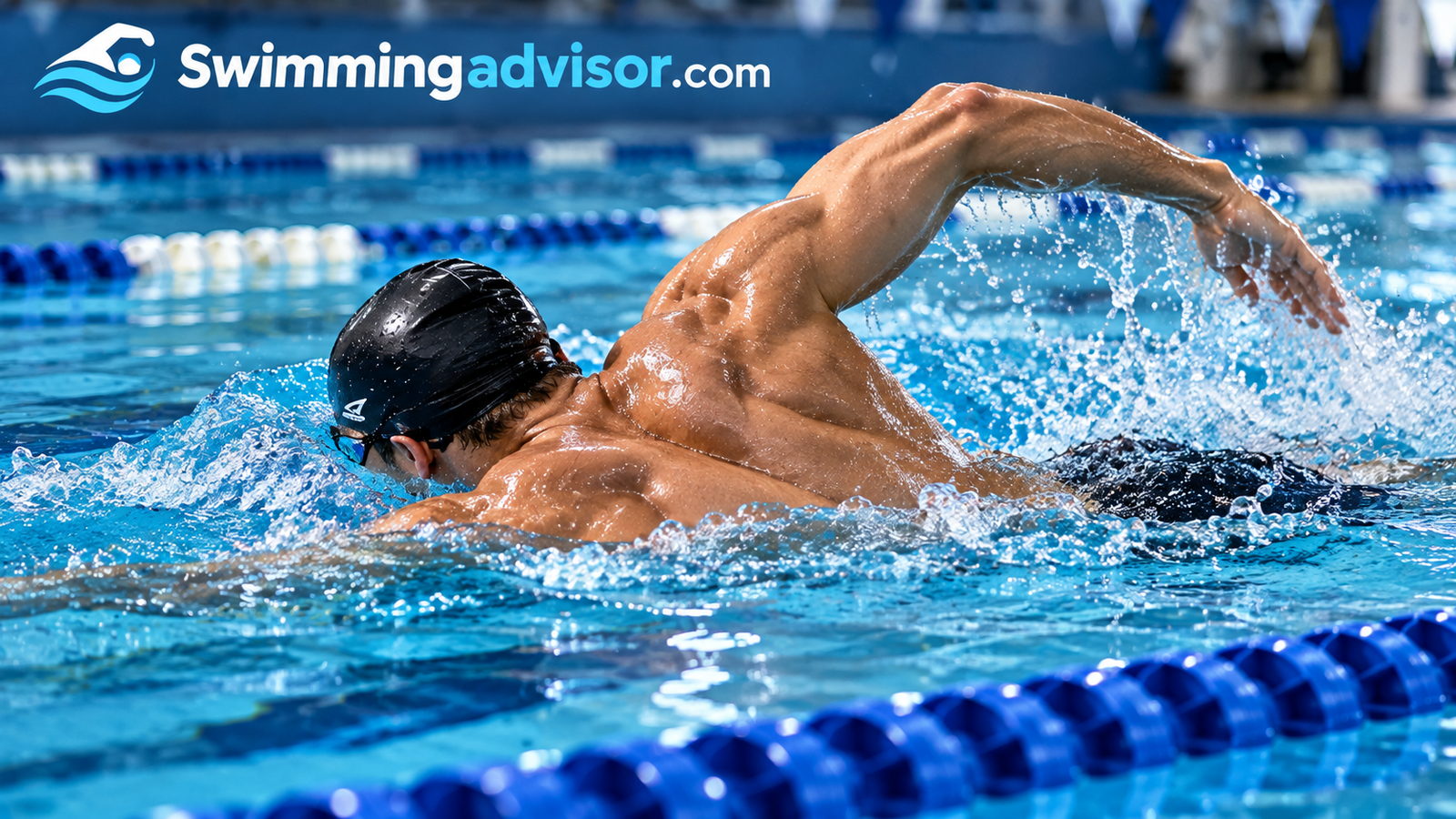
Does Swimming Build Muscle? What the Pool Really Does to Your Body
Short answer: yes, swimming builds muscle, though in a different way than the weight room. Here is exactly how much, where, and how to get more from every lap.
Does Swimming Build Muscle? The Quick Answer
Yes. Swimming builds lean muscle, especially in the shoulders, lats, core, and legs, and it builds muscular endurance very well. It will not usually match heavy lifting for maximum size or raw strength, but for beginners, for sprint-focused swimmers, and for anyone who adds resistance tools, the visible changes are real.
People ask this question for a reason. Walk past any pool deck and you will see swimmers with broad shoulders, tapered waists, and defined backs. Yet you will also meet plenty of people who swim laps for months and feel that their body has changed more in terms of stamina than size. Both observations are true, and understanding why is the key to getting the results you actually want.
Muscle growth, which scientists call hypertrophy, happens when a muscle is challenged enough to cause small amounts of stress and damage, and then given the nutrients and rest to rebuild slightly larger and stronger. Water provides that challenge in a unique way. It gives you resistance in every direction, with zero impact on your joints, and it scales with how hard you push. Swim gently and it feels like a relaxed stretch. Swim fast, or add paddles and a pull buoy, and it feels like a full resistance session.
In this guide, we will walk through what happens inside your muscles when you swim, which muscles get the most work, how each stroke shapes your physique differently, how swimming compares with strength training, and what you can do this week to turn ordinary laps into a muscle-building plan. If you are still deciding whether the pool deserves a place in your routine, our breakdown on whether swimming is a good workout covers the bigger picture too.
Ready to add resistance to your laps? Start with a solid pair of swim paddles.
Shop Swim Paddles on AmazonHow Water Resistance Builds Muscle
Water is roughly 800 times denser than air. That single fact explains most of what swimming does to your body. Every time you pull your arm through the water, you are pushing against a fluid that pushes back, and the harder or faster you move, the more it resists. Physicists describe drag as increasing with the square of speed, which means that moving twice as fast can demand about four times the force. In practical terms, easy laps feel easy, while sprints feel brutal.
Resistance in every direction
A dumbbell curl loads your biceps mainly while you lift against gravity. Water resistance is different because it acts against you in whatever direction you move. When you pull, the muscles on the back of the body work. When you recover your arm forward, you still work against the water. When you kick, your quadriceps, hamstrings, glutes, and calves all meet resistance on both the up and down movements. That is why a good swim can leave you feeling worked from your fingertips to your toes.
Muscle fibers involved
Your muscles contain slow-twitch fibers, which are built for long, steady efforts, and fast-twitch fibers, which produce short bursts of power and have the greatest growth potential. Long, steady swims mainly train the slow-twitch type, improving endurance and the ability of muscle to use oxygen. Short, fast, hard efforts recruit far more fast-twitch fibers. This distinction matters, because if your goal is size and definition, you will benefit from including sprint sets rather than swimming at one comfortable pace every session.
Low impact, high effort
Buoyancy supports most of your body weight, so your joints, tendons, and spine avoid the pounding they take from running or jumping. This is a real advantage for muscle building because it lets you train more often without the wear and tear that forces many lifters to take breaks. It is also why swimming is popular with people recovering from injury, older adults, and anyone carrying extra weight. You still work hard, but your joints stay happy.
Key idea: Muscle responds to challenge, not to the medium. Because water lets you increase challenge with speed, equipment, and technique, swimming can be a genuine muscle-building tool when it is programmed with intention.
Want to feel more resistance without changing your stroke? Try a pair of training fins.
Browse Swim Fins on AmazonWhich Muscles Does Swimming Work?
Few activities train as many muscle groups at the same time. While it is easy to say swimming is a full-body workout, it helps to see exactly what each area is doing so that you know where to expect changes.
| Muscle Group | What It Does in the Water | Growth Potential |
|---|---|---|
| Latissimus dorsi (lats) | Powers the pull phase of every stroke | High, especially with paddles |
| Shoulders (deltoids) | Lift and rotate the arm during recovery and entry | High |
| Triceps | Finish the push-back phase of the pull | Moderate to high |
| Chest (pectorals) | Assist the catch and the pull, especially in butterfly and breaststroke | Moderate |
| Rotator cuff and scapular muscles | Stabilize the shoulder joint | Moderate, mostly stability |
| Core (abs, obliques, lower back) | Keep the body long, straight, and rotating | Moderate |
| Glutes and hip flexors | Drive the kick from the hips | Moderate |
| Quadriceps and hamstrings | Power the flutter, dolphin, and breaststroke kicks | Moderate, higher in breaststroke |
| Calves and ankles | Point and flick the foot for propulsion | Low to moderate |
The upper back and shoulders lead the way
If you ask a swimmer where they feel it most, the answer is usually the lats and shoulders. The lats are the large wing-shaped muscles that run from your spine to your upper arms, and they create the wide V-shape that so many people associate with swimmers. Because every stroke depends on a powerful pull, these muscles get worked thousands of times in a single session, which is a big reason swimmers often develop noticeable back width.
The core is always switched on
In the water, there is no bench or machine to brace against. Your core has to hold your body in a streamlined line while your arms and legs move, and it also drives the body roll that makes freestyle and backstroke efficient. This constant stabilizing demand builds strong, functional abs and obliques, though you should not expect a six-pack from swimming alone, since visible abs depend heavily on body fat levels.
Legs get a quieter workout
Most recreational swimmers use their legs mainly for balance, so lower-body gains tend to be modest in casual lap swimming. Serious kick sets change this quickly. A dedicated session with a board, as explained in our guide on how to use a kickboard for swimming, targets the quads, hip flexors, glutes, and hamstrings with a burn many people find surprising.
Build stronger legs and hips with focused kick sets.
Shop Kickboards on AmazonMuscle Gains by Stroke: Freestyle, Backstroke, Breaststroke, and Butterfly
Not all strokes build the same physique. Each one loads the body in a slightly different way, so mixing them is one of the simplest ways to develop balanced muscle and avoid overuse problems.
| Stroke | Main Muscles Trained | Muscle-Building Intensity | Best For |
|---|---|---|---|
| Freestyle | Lats, shoulders, triceps, core, quads | Moderate to high | Overall conditioning and back width |
| Backstroke | Rear delts, lats, glutes, core, lower back | Moderate | Posture and balanced shoulder development |
| Breaststroke | Chest, inner thighs, quads, glutes, calves | Moderate | Leg strength and chest engagement |
| Butterfly | Shoulders, chest, lats, triceps, core, hips | Very high | Power, upper-body size, and core strength |
Freestyle
Freestyle is the workhorse stroke. It is efficient enough to swim for long distances and demanding enough at speed to challenge your upper body seriously. Because it rotates the body from side to side, it also trains the obliques and deep core muscles. If you can only choose one stroke for general muscle and fitness, freestyle is a strong pick.
Backstroke
Backstroke works many of the same muscles as freestyle, but with a greater emphasis on the rear shoulders and upper back. Since most people spend their days hunched forward, this stroke is a helpful counterbalance that opens the chest and strengthens the muscles responsible for good posture.
Breaststroke
Breaststroke has the most powerful kick of the four strokes. The squeezing motion of the legs recruits the inner thighs, quadriceps, and glutes far more than a flutter kick does. The arms sweep inward, which engages the chest. Many people find breaststroke gentler on the shoulders, which makes it useful for anyone managing shoulder discomfort.
Butterfly
Butterfly is the most physically demanding stroke by a wide margin. It requires both arms to pull and recover together while the body undulates through the water, which loads the shoulders, chest, lats, and core intensely. Even a few short butterfly sets can leave you sore the next day. If you can hold decent form, butterfly is arguably the closest thing the pool has to a heavy compound lift.
Tip: Rotate through all four strokes across your week. Balanced training builds a more even physique and spreads the load across different muscles and joints.
Because good technique lets you generate more force with less wasted effort, refining your form pays off for muscle building as well as efficiency. Our guide to how to improve swimming technique is a good companion to this article.
Protect your shoulders and ears while you train harder.
Find Training Goggles on AmazonSwimming vs Weight Training for Building Muscle
This is where honest expectations matter. Swimming can build muscle, but strength training remains the most efficient way to add maximum size and strength. Understanding the difference helps you choose the right tool, or combine both.
| Factor | Swimming | Weight Training |
|---|---|---|
| Primary adaptation | Muscular endurance, lean tone, cardio fitness | Size (hypertrophy) and maximal strength |
| Joint impact | Very low | Low to moderate depending on load |
| Muscles trained per session | Whole body at once | Depends on split |
| Progressive overload | Harder to measure, done through speed, distance, tools | Easy to measure, add weight or reps |
| Cardio benefit | Excellent | Limited unless circuit style |
| Best for beginners | Yes, very gentle entry | Yes, with proper coaching |
| Maximum muscle size potential | Moderate | High |
Where swimming wins
Swimming wins on joint friendliness, cardiovascular benefit, flexibility, and the sheer number of muscles it engages at once. It also wins on sustainability. Many people who quit lifting because of aches find they can swim for years without trouble, and consistency beats perfection in any fitness plan.
Where weights win
Weights win on precision and progressive overload. If you want to increase your biceps size or maximize leg strength, it is much easier to load those muscles heavily with a barbell than with water. Resistance in water is limited by how fast and how forcefully you can move through a fluid, which caps the maximum tension for most people.
The best answer is often both
A few pool sessions and two or three simple strength sessions each week create a very balanced routine. The weights supply the heavy tension that drives size, while the pool builds endurance, mobility, and recovery. Many athletes use swimming as an active recovery day between heavy lifting sessions because it promotes blood flow without stressing the joints.
Pros of Swimming for Muscle
- Works nearly every major muscle group
- Extremely gentle on joints
- Builds cardio and muscle together
- Great for beginners and older adults
- Improves flexibility and posture
Cons of Swimming for Muscle
- Harder to overload progressively
- Lower ceiling for maximum size
- Requires pool access and decent technique
- Legs often under-trained in casual swimmers
Pair your pool work with simple strength tools at home.
Shop Resistance Bands on AmazonThe Swimmer Body Explained: Myths and Reality
Say the words swimmer body and most people picture the same thing: wide shoulders, a narrow waist, long arms, and lean but defined muscle. That look is real, but it is not caused by swimming alone.
Genetics and selection play a big role
Elite swimmers are often tall, with long arms and large hands and feet that act like natural paddles. Swimming rewards those traits, so the sport naturally selects people who already have them. A person of average height who swims regularly will build muscle and lose fat, but will not turn into a different body type. It helps to remember that swimming shapes the body you have rather than replacing it.
Training volume matters
Competitive swimmers may train ten or more sessions each week, often adding dryland strength sessions. That volume, combined with sprint work and careful nutrition, produces the physiques you see in televised races. Recreational swimmers who swim two or three times a week will see smaller but still meaningful changes.
The long and lean muscle myth
You may have heard that swimming builds long, lean muscles while weights build bulky ones. Muscles cannot change their length in this way. What actually differs is the amount of muscle mass gained and the amount of body fat covering it. Swimming tends to promote a leaner, more toned look because it burns a lot of energy and produces moderate growth, not because it changes the shape of the muscle itself.
Does swimming make you bulky?
For most people, no. Building a large, bulky physique typically requires heavy resistance work, a calorie surplus, and a lot of protein. Swimming alone rarely does that, so if you are worried about getting too big, the pool is a safe way to firm up and gain strength without dramatic size changes.
Body composition also depends on how much energy you burn versus eat. If losing fat is part of your goal, our article on whether swimming helps you lose weight explains how to use the pool for fat loss while keeping the muscle you build.
Keep your swim gear organized so you never skip a session.
Shop Swim Bags on AmazonGear That Adds Resistance and Builds More Muscle
If you feel that your current swimming routine is not challenging your muscles enough, equipment is the easiest fix. The following tools change the load on your body in different ways, and each has a clear purpose.
Hand paddles
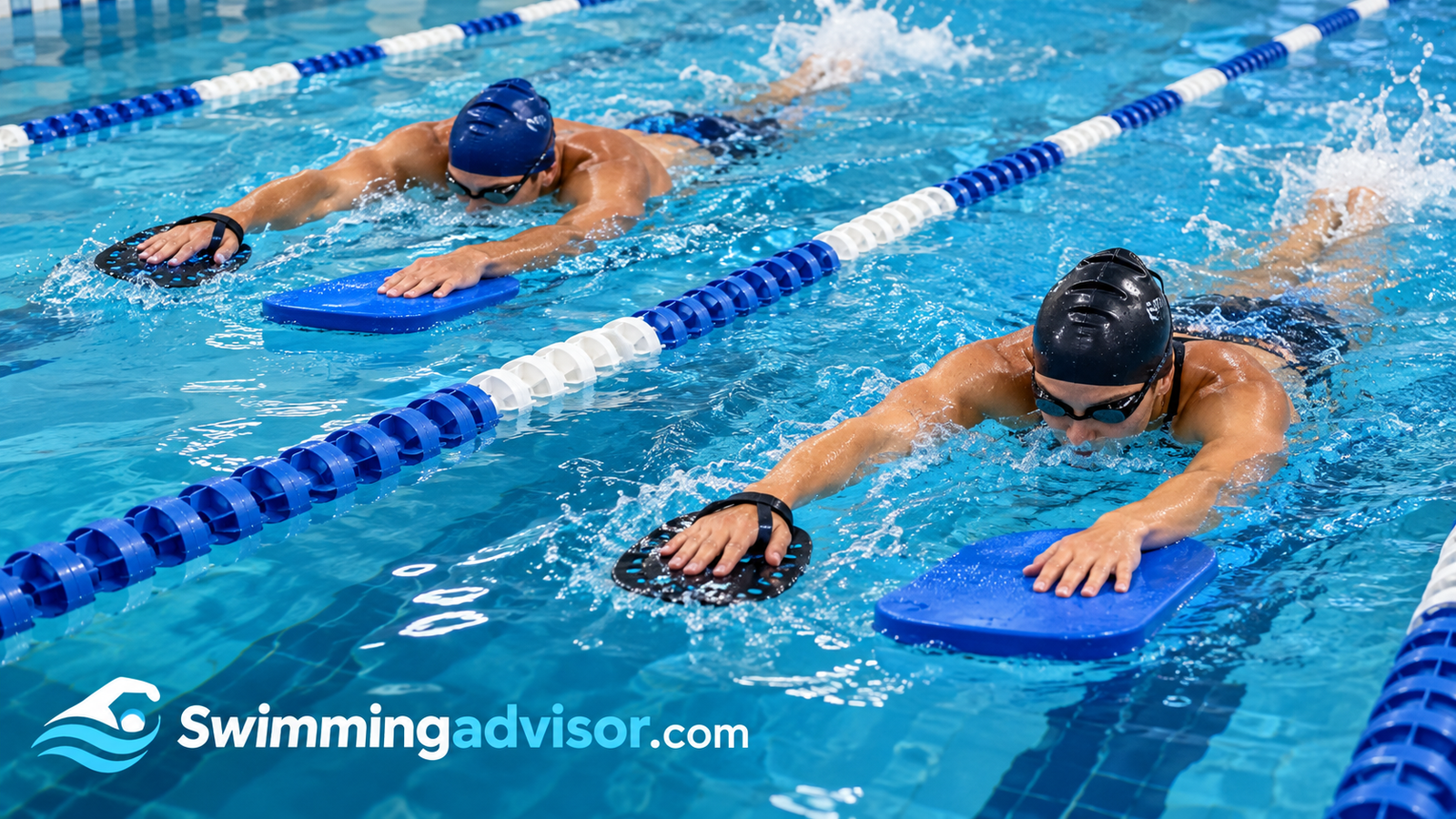
Paddles increase the surface area of your hand, so each stroke moves more water and demands more from your lats, shoulders, and triceps. They are the single most popular tool for adding upper-body resistance. Because they load the shoulders heavily, start with smaller sizes and short sets. You can read more in our guides on what swim paddles do and the benefits of hand paddles for swimming, and compare options in our roundup of the best swim paddles.
Kickboards
A kickboard isolates your legs so they do all the work. Longer kick sets, especially with fins, are an effective way to build lower-body endurance and firm the quads, glutes, and hip flexors. Browse our list of the best swimming kickboards to find one that suits your level.
Pull buoys
A pull buoy floats your legs so you can focus on your arms and core. Since your legs no longer help, your upper body works harder, which makes it a helpful partner to paddles for building pulling strength.
Swim belts and resistance tools
Some swimmers use tethered belts or drag belts to create a constant load, either by swimming against a fixed point in a small pool or by dragging a small parachute. Beginners or adults who want extra buoyancy may also use flotation belts while they build confidence. If that sounds useful, see our guides to the best swim belt for adults and this overview of a swim belt.
Fins
Fins increase the surface area of your feet, which lets you kick harder and faster and strengthens the legs and ankles. They also improve ankle flexibility, which is helpful for many adult swimmers.
Snorkels
A front-mounted snorkel lets you swim without turning your head to breathe. That allows you to keep your body line steady and put more focus on your pull and kick. Our list of the best swim snorkels can help you choose.
| Tool | Primary Muscles Loaded | Best Use |
|---|---|---|
| Hand paddles | Lats, shoulders, triceps | Pull sets for upper-body strength |
| Kickboard | Quads, glutes, hip flexors | Isolated leg training |
| Pull buoy | Lats, core, shoulders | Arm-only pulling |
| Fins | Legs, calves, ankles | Powerful kick sets |
| Drag or tether belt | Full body | Sprint resistance work |
| Front snorkel | Core, upper body | Technique and steady-line pulling |
Safety note: Paddles and other resistance tools raise the strain on your shoulders. Increase the load gradually and stop if you feel sharp pain rather than normal muscle fatigue.
A pull buoy plus paddles is a classic upper-body combination.
Shop Pull Buoys on AmazonMuscle-Building Swim Workouts You Can Start Now
Because muscle grows in response to challenge, your swim sessions should include some intensity and some variety. Here are three sample workouts, each designed with a different focus. Adjust distances to your fitness level, and rest as needed between sets.
Workout 1: Upper-body strength focus
| Part | Set | Notes |
|---|---|---|
| Warm-up | 300 easy freestyle, 100 backstroke | Loosen shoulders |
| Drill | 4 x 50 catch-up freestyle | Focus on a strong early catch |
| Main set | 6 x 100 pull with paddles and pull buoy | 20 to 30 seconds rest, strong pull |
| Power set | 8 x 25 fast freestyle | 30 seconds rest, max effort |
| Cool-down | 200 easy mixed strokes | Relax and stretch |
Workout 2: Leg and core focus
| Part | Set | Notes |
|---|---|---|
| Warm-up | 300 easy swim | Mix strokes |
| Kick set | 6 x 75 kick with board and fins | Kick from the hips |
| Vertical kick | 4 x 30 seconds | Deep water, arms crossed, hard effort |
| Core set | 8 x 25 streamline kick on side | Keep hips stacked |
| Cool-down | 200 easy backstroke | Loosen the legs |
Workout 3: Full-body sprint power
| Part | Set | Notes |
|---|---|---|
| Warm-up | 400 easy mixed | Build gradually |
| Speed build | 4 x 50 build to fast | Increase pace each length |
| Main set | 10 x 50 at hard effort | 45 seconds rest |
| Butterfly finisher | 4 x 25 butterfly or dolphin kick | Only if form stays clean |
| Cool-down | 300 easy | Slow and relaxed |
How often should you swim to build muscle?
Aim for three sessions per week as a starting point, with at least one day of rest between the hardest sessions. If you are new to swimming, build up slowly. Your shoulders in particular adapt more slowly than your lungs, so patience protects you from overuse problems. As your stamina grows, our article on how to increase swimming endurance can help you extend your sessions while your strength improves.
Progressive overload in the pool
Since you cannot simply add plates, you increase the load in other ways. Swim the same distance faster. Reduce your rest between repeats. Add distance to your hardest sets. Move from small paddles to larger ones. Add fins to kick sets. Track any of these over several weeks and you have a working system of progressive overload.
Make every set count with a waterproof timer or tracker.
Shop Swim Watches on AmazonNutrition and Recovery: Where Muscle Is Actually Built
Muscle is not built in the pool. It is built afterward, during recovery, when your body repairs and reinforces the tissue you challenged. Swimmers who ignore nutrition and sleep often plateau even with excellent training.
Protein
Protein provides the building blocks for muscle repair. Many sports nutrition guidelines suggest that active people aiming to build muscle consume somewhere in the range of 1.4 to 2.0 grams of protein per kilogram of body weight daily, spread across several meals. Good sources include eggs, fish, poultry, dairy, tofu, lentils, and beans. Individual needs vary, so speak with a doctor or registered dietitian if you have health conditions or specific dietary needs.
Carbohydrates
Swimming burns a surprising amount of energy, and carbohydrates refill the fuel your muscles use during hard sets. Without enough carbs, your intensity drops, and lower intensity means less growth stimulus. Whole grains, fruit, potatoes, and rice are dependable options before and after training.
Healthy fats and micronutrients
Fats support hormone production and joint health, and vitamins and minerals from vegetables and fruit support recovery and immune function. Include olive oil, nuts, seeds, and oily fish as part of a balanced diet.
Hydration
It may sound strange, but swimmers can become dehydrated because they do not notice sweating in the water. Drink water before, during, and after your session, especially in warm indoor pools.
Sleep and rest days
Most muscle repair happens during deep sleep. Seven to nine hours per night supports both recovery and performance. Rest days are just as important, because they let tendons and connective tissue adapt, which lowers the chance of shoulder problems.
Calories
To build muscle, you generally need enough energy to support growth. If you are eating far below what you burn, your body may struggle to add muscle even with plenty of training. If your priority is fat loss, a modest deficit combined with adequate protein helps preserve the muscle you have.
Need an easy way to hit your daily protein target?
Shop Protein Powder on AmazonCombining Pool Sessions with Dryland Strength Training
Competitive swimmers rarely rely on the pool alone. Dryland training, meaning strength work done outside the water, fills the gaps that swimming leaves. If your priority is building noticeable muscle, adding two short strength sessions each week can double your progress.
The best dryland exercises for swimmers
- Pull-ups and lat pulldowns: These mirror the pulling motion of the stroke and load the lats with real weight.
- Push-ups and bench press variations: They strengthen the chest and triceps, which support the finish of each pull.
- Squats and lunges: These build the quads and glutes that power turns, push-offs, and kicks.
- Romanian deadlifts: They strengthen the hamstrings, glutes, and lower back.
- Planks and side planks: They train the core to hold a streamlined position.
- Band pull-aparts and external rotations: They keep the rotator cuff strong and help protect the shoulders.
A simple weekly layout
| Day | Session |
|---|---|
| Monday | Swim: upper-body pull focus |
| Tuesday | Dryland strength: full body |
| Wednesday | Rest or light stretching |
| Thursday | Swim: kick and core focus |
| Friday | Dryland strength: full body |
| Saturday | Swim: sprint power or endurance |
| Sunday | Rest |
This layout gives you three pool sessions and two strength sessions, with two rest days. Adjust it to your schedule and energy. The point is that pool work and strength work reinforce each other, so you can grow muscle while also swimming faster and longer.
Shoulder health first: Swimmers put their shoulders through a huge number of repetitions. Include rotator cuff and upper-back exercises regularly to keep those joints resilient.
Set up a small home strength corner without a big gym membership.
Shop Dumbbells on AmazonSwimming for Different Goals and Different People
The way swimming affects your muscles depends on who you are and what you want. Here is how to adapt the pool to a few common situations.
For beginners
Beginners often see the fastest changes. If you are new to exercise, almost any challenge is enough to trigger muscle adaptation, so a few weeks of regular swimming can noticeably firm up the shoulders, back, and core. Start with easy laps, learn good form, and add intensity gradually. If your stamina limits you at first, use short intervals with rest in between.
For people who want to lose fat and keep muscle
Swimming burns significant calories while preserving lean tissue, which is appealing for people who want to slim down without losing strength. Combine regular swims with adequate protein and a moderate calorie deficit. The interval approach in the workouts above also keeps some fast-twitch fibers engaged.
For men
Men who want a bigger upper body should focus on paddles, pull buoy sets, butterfly, and sprint work, plus dryland pressing and pulling. Swimming builds a strong base, but heavy lifting will add the most size to the chest and arms.
For women
Women often use swimming to build strength, tone the arms and back, and improve posture, all with low joint stress. Women can add muscle just as effectively as men through progressive training, though typically at a smaller absolute scale because of hormonal differences. Many women also wonder about staying active during their cycle, and our guide on whether you can go swimming on your period answers common questions.
For older adults
As we age, we naturally lose muscle mass, and resistance activity helps slow that loss. Swimming and water exercise provide meaningful resistance with much less risk of falls or joint strain. Even gentle water workouts help maintain strength, balance, and mobility.
For open-water swimmers and triathletes
If you train in lakes or the ocean, you gain extra resistance from currents, chop, and wetsuit buoyancy. Tracking your sessions with a suitable device can make training more measurable, and our guide to the best open water swimming watch is a good place to begin.
Train smarter with a watch that counts laps and tracks effort.
Compare Swim Watches on AmazonCommon Mistakes and How to Track Your Muscle Progress
Many people swim regularly and still feel stuck. In most cases, one or more of the following mistakes is the reason.
Mistake 1: Swimming the same easy pace every time
Comfortable laps build fitness, but they offer little new challenge once you adapt. Add speed intervals, tools, and different strokes so your muscles keep getting a reason to grow.
Mistake 2: Skipping the legs and core
Many swimmers rely on their arms and neglect their kick. That leaves large muscles under-trained and reduces overall progress. Dedicate at least part of one session per week to kick and core work.
Mistake 3: Ignoring technique
Poor form wastes energy and can strain the shoulders. Efficient technique lets you swim harder and longer, which increases the total training effect.
Mistake 4: Undereating protein or calories
Without enough fuel and building blocks, your body cannot make much new muscle. Plan meals around training, especially after hard sessions.
Mistake 5: Not resting
Overtraining leads to fatigue, sore shoulders, and stalled progress. Rest days are part of the plan, not a lapse in commitment.
Mistake 6: Expecting overnight change
Visible muscle changes generally take several weeks of consistent training. Be patient and focus on habits rather than daily results.
How to know whether it is working
- Performance: Are you swimming the same distance faster, or with less rest?
- Strength: Can you do more push-ups, pull-ups, or hold longer planks than before?
- Measurements: Track shoulder, chest, and waist measurements every few weeks.
- Photos: Take progress photos in the same lighting and pose monthly.
- Clothing fit: Shirts may fit tighter through the shoulders and looser at the waist.
- Recovery: Notice how quickly you bounce back from sessions.
If you want cost-friendly help logging your sessions, take a look at our picks for a cheap swimming watch, or explore the wider range in our best swimming watches list. Garmin fans may also like the best Garmin swimming watch guide.
Track every lap and see your progress over time.
Shop Swim Trackers on AmazonConclusion: So, Does Swimming Build Muscle?
Yes, swimming builds muscle. It develops the lats, shoulders, triceps, core, and legs, and it does so while protecting your joints and boosting your heart health. It is especially effective for beginners, for people returning from injury, and for anyone who wants a lean, athletic, and functional body rather than maximum size.
To get the most muscle from your time in the water, remember the essentials. Swim with intensity some of the time instead of only cruising. Use paddles, fins, kickboards, and pull buoys to add resistance. Mix all four strokes. Support your training with enough protein, carbohydrates, water, and sleep. If maximum size matters to you, add two simple strength sessions each week and let the pool handle endurance, mobility, and recovery.
The best muscle-building plan is the one you will keep doing. For many people, that is the pool, because it feels good, it is easy on the body, and it delivers results you can see and feel. Grab your gear, pick a workout from this guide, and start your next session with a clear purpose.
Start building muscle in the pool with the right gear today.
Shop Swim Training Gear on AmazonFrequently Asked Questions
Does swimming build muscle or just tone?
Toning is simply muscle plus lower body fat. Swimming does build real muscle, especially in the upper back, shoulders, and core, and it also burns energy, which can make that muscle more visible.
How long does it take to see muscle from swimming?
Many people notice improved strength and firmness within four to eight weeks of regular swimming, with more visible changes over several months. Results depend on your starting point, intensity, nutrition, and consistency.
Which swimming stroke builds the most muscle?
Butterfly is the most demanding and builds the most upper-body and core strength, but it is hard to sustain. Freestyle offers the best mix of muscle work and practicality for most swimmers.
Can swimming replace the gym?
It can for general fitness, endurance, and moderate muscle tone. For maximum size or strength, weight training is more efficient, so many people combine the two.
Does swimming build abs?
Swimming strengthens the abdominal and oblique muscles because your core stabilizes your body in the water. Whether abs are visible depends largely on body fat percentage.
Does swimming make your shoulders bigger?
It can. The repeated pulling and recovery motions work the deltoids and surrounding muscles, and adding paddles or sprint sets increases that effect. Balanced training also helps keep shoulders healthy.
Does swimming build leg muscle?
Yes, but usually modestly in casual swimmers. Kick sets with a board or fins, and strokes like breaststroke, give the legs a much stronger workout.
Is swimming good for building muscle while losing weight?
It is a helpful option because it burns calories and challenges muscles without much joint stress. Pair it with enough protein and a moderate calorie deficit to protect your muscle mass while you lose fat.
How many days a week should I swim to build muscle?
Two to four sessions per week is a practical range for most people. Include at least one day of rest between harder sessions so your body can recover and adapt.
Do I need paddles or other equipment to build muscle?
You do not need them, but equipment makes it easier to add resistance and progress. Paddles, fins, kickboards, and pull buoys are the most common tools, and each can be used in short sets.
Will swimming make me bulky?
For most people, swimming leads to a leaner and more athletic look rather than a bulky one. Significant bulk usually requires heavy lifting and a calorie surplus.
Can beginners build muscle by swimming?
Absolutely. Beginners often respond quickly because their muscles are not yet used to the demands of swimming. Start gently, focus on technique, and increase intensity gradually.