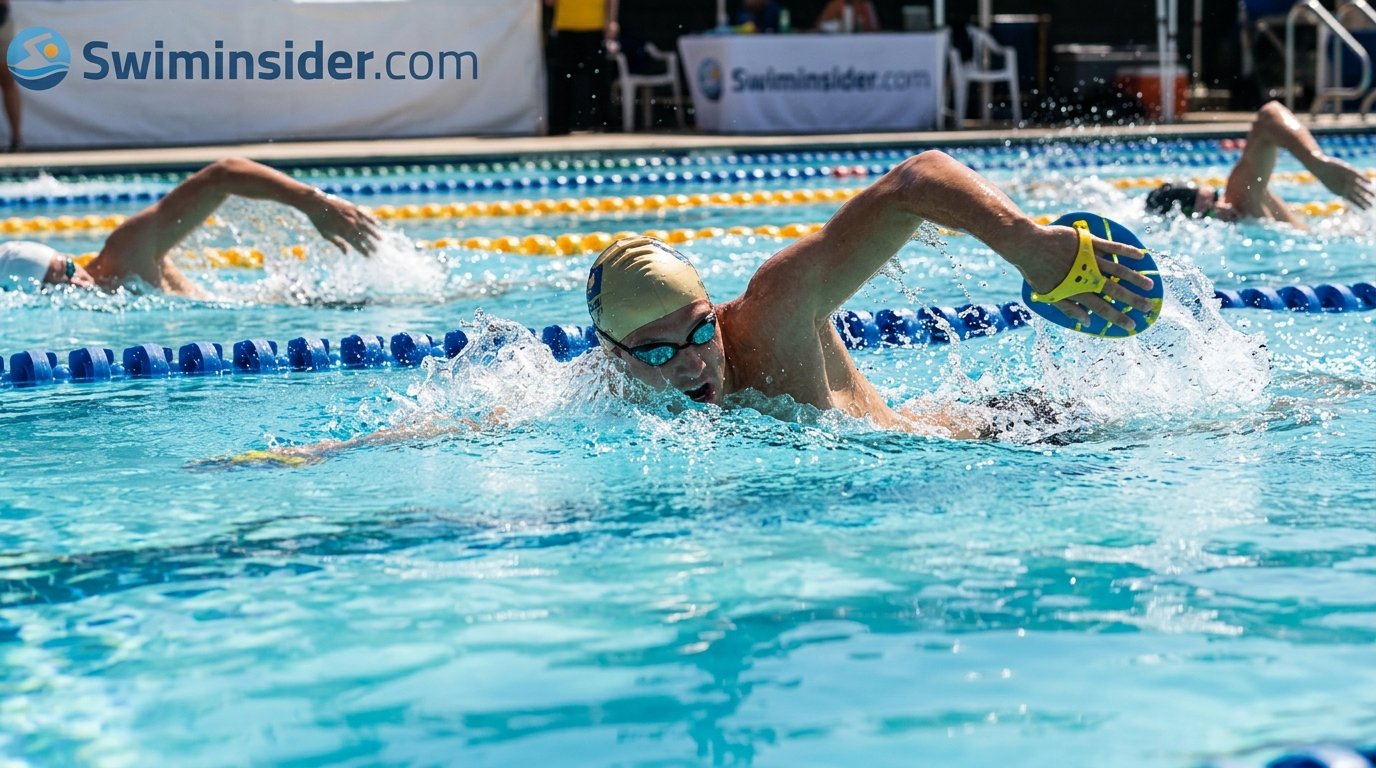
Benefits of Hand Paddles for Swimming: The Complete Guide to Faster, Stronger Strokes
How a simple piece of plastic strapped to your palms can rebuild your stroke, add real horsepower to your pull, and shave meaningful time off your swims.
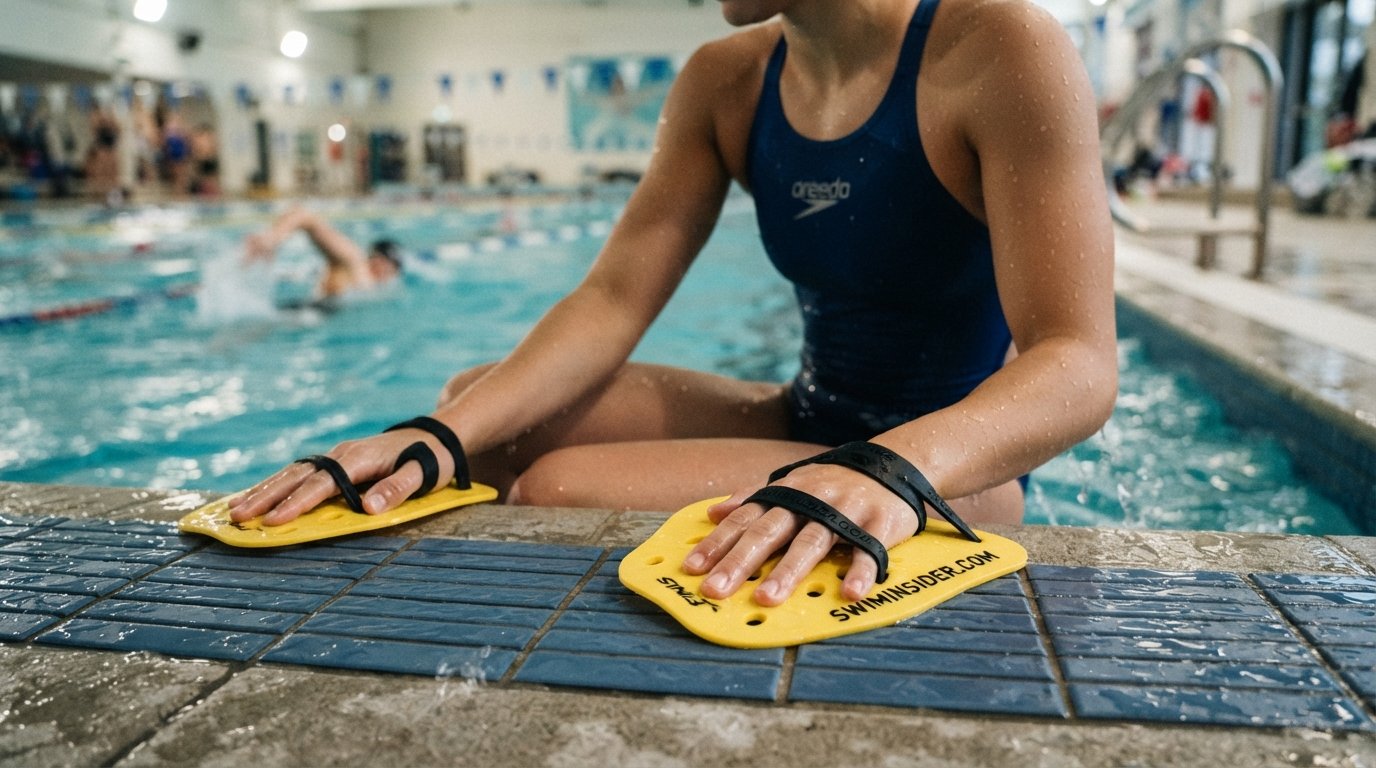
Walk onto any pool deck where serious swimmers train and you’ll spot them almost immediately: flat, colorful plates strapped across the palms of nearly every swimmer doing a pulling set. Hand paddles have been a fixture of competitive swim training for decades, and in recent years they’ve become just as popular with masters swimmers, triathletes, and anyone doing lap swimming for fitness. But what do they actually do, and are they worth adding to your own training bag?
This guide breaks down exactly what happens to your stroke, your muscles, and your technique when you swim with paddles. We’ll cover the biomechanics, the specific strength and conditioning benefits, the technique-correcting magic that makes coaches love them, the safety considerations that keep them from becoming a shoulder problem, and a practical framework for building paddles into your own training without wrecking your form. If you’ve ever wondered whether paddles are gimmick or genuine training tool, you’re about to get a complete answer.
We’ll also compare paddle styles, walk through sizing, and answer the questions swimmers ask most often before they clip a set onto their wrists for the first time. If you’re still deciding which paddles to buy, our guide to the best swim paddles is a good companion read, and if you’re curious about the mechanics before committing, check out what swim paddles actually do for a deeper technical breakdown.
What Are Swim Hand Paddles?
Swim hand paddles are rigid or semi-rigid plates, usually made of polypropylene, K-resin, or a similarly stiff plastic, that strap onto the palm and fingers to increase the surface area of your hand as it moves through the water. Most designs use two straps: one that wraps around the middle knuckles to hold the fingers in place, and a second, adjustable strap that wraps around the wrist for stability. Some finger-only paddles skip the wrist strap entirely and rely on a single loop around the middle finger.
The core idea is simple. Your open hand, on its own, has a relatively small surface area, somewhere in the range of 60 to 80 square inches depending on hand size. A paddle can add another 20 to 60 square inches to that number, depending on the model. More surface area pressing against the water means more resistance to pull against, which means your pulling muscles have to work harder to move the same distance. That single mechanical change is the root of almost every benefit this guide is about to cover.
Paddles aren’t a modern invention. Coaches have been strapping plastic to swimmers’ hands since at least the 1970s, and the tool has survived essentially unchanged in concept for fifty years because the underlying physics hasn’t changed either. What has evolved is the variety: today’s paddles range from tiny finger paddles the size of a large coin to full-hand designs with contoured, hydrodynamic shaping and multiple strap configurations for a customized fit.

Arena Elite Hand Paddle II
A widely used flat-design paddle with a large center hole for water feel, four sizes available, and smooth edges for pool safety.
Check Price on AmazonHow Hand Paddles Work: The Biomechanics
To understand why paddles change a swimmer’s stroke so dramatically, it helps to think about propulsion in swimming as a function of two variables: the surface area you’re pushing against the water, and the speed at which you move that surface through the water. Force scales with both, so increasing the surface area of your hand, while holding your stroke speed roughly constant, increases the propulsive force your pull generates. That’s the entire mechanical story in one sentence, but the downstream effects ripple through nearly every part of your stroke.
Increased Load on the Catch and Pull
The “catch” is the moment early in the stroke when your hand first grips the water and begins to accelerate it backward. With a paddle strapped on, that grip happens against a bigger surface, so your shoulder rotators, lats, and forearm flexors are recruited more forcefully from the very first inch of the pull. Swimmers frequently describe the sensation as “the water feels thicker,” which is a fairly accurate way to describe increased hydrodynamic drag on an enlarged surface.
Feedback Through Torque
Paddles also generate torque whenever your hand isn’t perfectly aligned with the direction of travel. If your wrist drops, your elbow collapses, or your hand enters the water crooked, the paddle catches uneven water pressure and twists, slips, or wobbles. Bare-handed, that same misalignment produces a much smaller, easier-to-ignore sensation. Strapped into a paddle, it becomes impossible to miss, which is exactly why paddles double as a technique-correction tool, not just a strength tool.
Altered Stroke Rate and Distance Per Stroke
Because each pull generates more propulsion, most swimmers naturally increase their distance per stroke while wearing paddles, covering more distance with each cycle of the arms. Some swimmers also slow their stroke rate slightly, since the increased resistance takes marginally longer to pull through. Coaches use this shift deliberately, prescribing paddle sets specifically to reinforce a longer, more powerful pull pattern that swimmers can then try to replicate, at a faster cadence, once the paddles come off.
Benefit 1: Upper Body Strength and Power
The most immediately obvious benefit of swimming with hand paddles is strength development in the muscles that drive the pull: the latissimus dorsi, posterior deltoids, triceps, and the smaller rotator cuff stabilizers that keep the shoulder joint controlled through a high-force movement. Because paddles increase resistance without adding external weight to lift, they let swimmers strength-train in the water using the exact movement pattern of their sport, something dry-land weightlifting can only approximate.
This is sport-specific strength training in its purest form. A lat pulldown in the gym builds general pulling strength, but it doesn’t replicate the exact angle, timing, or rotational demand of a freestyle catch. Paddle work does, because it’s the same catch, just under more resistance. Over weeks of consistent paddle sets, swimmers typically notice their unassisted stroke feels lighter and more powerful, a direct transfer effect from the overload training.
| Muscle Group | Role in the Pull | How Paddles Increase Demand |
|---|---|---|
| Latissimus Dorsi | Primary propulsive puller, drives the arm from catch to hip | Larger surface increases resistance through the entire pull phase |
| Posterior Deltoid | Stabilizes shoulder, assists in pull-through | Greater torque at catch demands more stabilization |
| Triceps Brachii | Extends elbow during the finish of the stroke | Increased load during push-off phase near the hip |
| Forearm Flexors | Maintain wrist and finger position against the paddle | Constant isometric grip demand throughout the stroke |
| Rotator Cuff (Supraspinatus, Infraspinatus) | Stabilize the shoulder joint under load | Higher force at catch increases stabilization workload |
It’s worth noting that this strength gain is progressive and dose-dependent. A swimmer who does one easy paddle set a week will see modest gains; a swimmer who structures paddle work as a deliberate strength block, gradually increasing volume and paddle size over a training cycle, will see much more dramatic transfer to their unassisted swimming speed.
Benefit 2: Sharper Stroke Technique
Ask any swim coach why they hand out paddles and strength is usually the second answer, not the first. The first answer is almost always technique. Because paddles amplify any inefficiency in hand position, they act as an immediate, physical feedback loop that’s far more honest than a coach’s verbal cue from the pool deck.
Early Vertical Forearm (EVF)
One of the most sought-after technical traits in freestyle and backstroke is achieving an early, high elbow catch, sometimes called Early Vertical Forearm. Swimmers who drop their elbow or press straight down instead of back will feel a paddle slip or twist almost instantly, since a dropped elbow angles the paddle away from directly opposing the direction of travel. That immediate feedback lets swimmers self-correct in real time, something that’s nearly impossible to feel with a bare hand.
Hand Entry and Alignment
A crossed-over hand entry, where the hand enters the water past the body’s centerline, creates a very obvious paddle wobble as the swimmer tries to pull. Many swimmers who “can’t feel” this flaw bare-handed suddenly understand exactly what their coach has been talking about the moment a paddle is strapped on.
Consistent Pull Path
Because a paddle only generates efficient propulsion when it travels along a smooth, consistent path, swimmers training with paddles are gently forced to iron out the S-curve or sculling irregularities that creep into a tired stroke. Over time, that consistency becomes muscle memory that carries over once the paddles are removed.

TYR Catalyst Stroke Training Paddles
Clear, see-through construction so you can watch your hand positioning in real time, with multiple gridded lacing options for a custom fit.
Check Price on AmazonBenefit 3: A Better Feel for the Water
Swim coaches talk constantly about “feel for the water,” a somewhat abstract concept that refers to a swimmer’s ability to sense water pressure against their hand and forearm and adjust their pull path to maximize propulsion. Paddles, somewhat counterintuitively, help build this sense rather than mask it, especially models with a perforated or gridded surface that lets water pass through in a way that mimics the pressure pattern of a well-executed catch.
Because the enlarged surface makes pressure changes more pronounced, subtle shifts in hand angle produce a noticeably different sensation. Swimmers who train regularly with paddles often report that when they remove the paddles, their bare-hand feel for the water becomes sharper too, since their nervous system has been calibrated to detect smaller and smaller changes in resistance.
This benefit compounds with experience. Beginner and intermediate swimmers get the most obvious feel-for-water gains from paddle work because they typically have the least developed sense of hand pitch and pressure to begin with. Advanced swimmers use paddles more for fine-tuning and maintaining a sense they’ve already built.
Benefit 4: Conditioning and Overload Training
Beyond pure strength and technique, hand paddles are a legitimate conditioning tool. Because they raise the resistance of every stroke, they also raise the cardiovascular and muscular demand of a given set, effectively letting a swimmer get a harder workout in the same distance and time. This makes paddles a useful tool for swimmers with limited pool time who still want a high-intensity stimulus.
Paddle sets are also a form of “overload training,” a principle borrowed from strength and conditioning where an athlete trains under conditions harder than competition in order to make competition feel easier by comparison. Sprinters, in particular, use large paddles combined with parachutes or drag socks to simulate race-pace resistance well beyond what open water or a normal pool provides, building a reserve of power that shows up as extra speed once the resistance is removed.
| Training Goal | Paddle Approach | Typical Volume |
|---|---|---|
| Technique refinement | Small to medium paddles, moderate pace, focus on form | 400–800m per session, broken into short reps |
| Strength building | Medium to large paddles, controlled tempo | 800–1500m per session, 2–3x weekly |
| Race-pace overload | Large paddles, sometimes combined with drag tools | Short, high-effort reps with full recovery |
| General conditioning | Small paddles mixed into normal sets | 20–30% of total session volume |
Benefit 5: Confidence, Speed Sensation, and Race Simulation
There’s a psychological benefit to paddle training that’s easy to overlook: swimming faster than you normally can, even briefly and with assistance, teaches your body and brain what higher speed actually feels like. Because paddles increase propulsion per stroke, a swimmer often moves through the water noticeably faster during paddle sets than during unassisted swimming, especially over short, high-effort repeats.
That sensation of speed is more than a confidence boost. Sports scientists refer to this as a form of “overspeed training,” a category of drills designed to let an athlete’s nervous system experience movement patterns at a velocity beyond their current unassisted capability. When the resistance tool is removed, the nervous system has already been exposed to a faster pattern, which can make replicating that speed unassisted feel more attainable.
For competitive swimmers preparing for a race, paddle-assisted speed work during a taper period is often used specifically for this reason: not to build new strength so close to competition, but to remind the body what race speed feels like.
Pros and Cons of Paddle Training
Like any training tool, hand paddles come with real trade-offs. They’re not a universal upgrade for every swimmer in every situation, and understanding the downsides is just as important as understanding the benefits.
Pros
- Builds sport-specific pulling strength in the water
- Provides instant, honest feedback on hand position and pull path
- Increases distance per stroke and reinforces a longer pull
- Adds conditioning intensity without adding pool time
- Improves feel for the water over repeated use
- Inexpensive compared to most other swim training equipment
Cons
- Can strain the shoulder joint if used with poor technique or excessive volume
- Not recommended for swimmers actively recovering from shoulder injuries
- Large paddles can reinforce a “muscling through” stroke instead of an efficient one if overused
- Learning curve for beginners who haven’t developed baseline stroke mechanics yet
- Improper strap fit can cause blistering or hand discomfort
Types of Hand Paddles Compared
Not all paddles are built the same, and the design differences aren’t cosmetic; they change how much resistance you feel, how forgiving the paddle is of technique flaws, and who the paddle is best suited for.
| Paddle Type | Surface Area | Best For | Feedback Sensitivity |
|---|---|---|---|
| Full-hand flat paddles | Large | Strength building, general training | Moderate |
| Contoured/curved paddles | Medium–Large | Comfort during longer sets | Moderate–High |
| Finger paddles | Small | Beginners, technique work, catch feel | Very High |
| Perforated/mesh paddles | Medium | Feel-for-water development | High |
| Strapless paddles | Small–Medium | Advanced technique isolation | Extremely High |
Finger paddles and strapless designs deserve special mention because they intentionally minimize the strap system that holds larger paddles in place. Without a firm strap, the paddle will fly off your hand entirely if your technique breaks down significantly, which paradoxically makes them a superb self-correcting technique tool for intermediate and advanced swimmers, though frustrating for beginners still developing basic catch mechanics.

Arena Elite Finger Paddle
A compact finger paddle that isolates the catch phase, ideal for swimmers refining early vertical forearm and hand entry.
Check Price on AmazonChoosing the Right Paddle Size
Sizing is where most first-time paddle buyers get it wrong, usually by going too big. A paddle that’s oversized for a swimmer’s current strength and technique level tends to amplify bad habits rather than correct them, and significantly raises the risk of shoulder strain.
General Sizing Guidelines
| Swimmer Level | Recommended Paddle Size | Notes |
|---|---|---|
| Beginner / returning swimmer | Extra small to small, or finger paddles | Prioritize technique feedback over resistance |
| Intermediate swimmer | Small to medium | Balance of strength work and form correction |
| Advanced / competitive swimmer | Medium to large | Higher resistance for strength and race-pace overload |
| Swimmers with shoulder sensitivity | Finger paddles or none | Consult a coach or physical therapist first |
A simple rule many coaches use: your hand should sit comfortably within the paddle’s outline without the paddle extending dramatically past your fingertips or wrist. If you find yourself unable to hold a consistent pull path even at moderate effort, size down before assuming the paddle style itself is the problem.
How to Use Hand Paddles Safely
The benefits described throughout this guide only materialize when paddles are introduced gradually and used with attention to technique. Jumping straight into long, high-volume paddle sets is the single most common cause of paddle-related shoulder soreness.
Start Small and Build Gradually
Begin with short paddle repeats, 25 to 50 meters at a time, mixed into an otherwise normal session. Pay attention to how your shoulders feel the following day, not just during the set itself, since overuse strain often shows up with a delay.
Prioritize Technique Over Speed
Resist the urge to race during early paddle sets. The goal at first is to feel where the paddle slips, twists, or catches cleanly, and to use that feedback to smooth out your pull path, not to hit a fast split.
Warm Up Without Paddles First
Give your shoulders a proper unassisted warm-up before adding resistance. Cold shoulder muscles asked to immediately handle amplified load are far more prone to strain.
Combine With Pull Buoys Thoughtfully
Many swimmers pair paddles with a pull buoy between the legs to isolate the upper body. This is effective but adds even more load to the shoulders since the legs contribute nothing to propulsion; total paddle-plus-buoy volume should generally be lower than paddle-only volume.
Listen to Joint Feedback, Not Just Muscle Fatigue
Muscle fatigue in the lats and triceps after a paddle set is normal and expected. Sharp, pinching, or lingering joint pain in the shoulder is not, and is a signal to stop, reduce paddle size, or take a break from paddle work entirely.
Common Mistakes to Avoid
Mistakes That Undermine Results
- Choosing paddles too large for current strength and technique level
- Doing high-volume paddle sets every single session without recovery
- Ignoring shoulder discomfort and pushing through pain
- Using paddles exclusively, without ever swimming unassisted to test transfer
- Loose strap fit that allows the paddle to shift mid-stroke
- Focusing on speed instead of pull-path quality during early sessions
Better Habits to Build Instead
- Size down and build up gradually over weeks, not days
- Rotate paddle sets with unassisted and fist-swimming sets
- Treat any sharp shoulder pain as a stop signal, not a toughness test
- Periodically remove paddles to test whether technique gains have transferred
- Adjust straps before every session, not just once when new
- Prioritize a clean, consistent pull path over chasing fast splits early on
Hand Paddles vs. Other Training Tools
Paddles are one tool among several in a swimmer’s equipment bag, and understanding how they differ from other common gear helps clarify when to reach for which tool.
| Tool | Primary Focus | Muscles/Skills Targeted | Pairs Well With Paddles? |
|---|---|---|---|
| Hand Paddles | Pull strength, catch feedback | Lats, deltoids, triceps, forearms | — |
| Pull Buoy | Upper-body isolation | Same as paddles, legs excluded | Yes, with reduced volume |
| Kickboard | Leg strength and technique | Quadriceps, hip flexors, ankles | Alternate use, not simultaneous |
| Swim Fins | Ankle flexibility, kick propulsion | Calves, ankles, hip drive | Yes, for full-stroke overload sets |
| Resistance Parachute | Whole-stroke overload | Full pulling and kicking chain | Often combined for sprint work |
| Snorkel | Head position and breathing rhythm | Neck alignment, body position | Yes, isolates stroke mechanics |
Swimmers building a home or travel training kit often look for compact, packable gear that works across pool and open-water settings; our guide to the best inflatable swimming pools is a useful read if you’re setting up a backyard training space where paddle drills can be practiced alongside other equipment.
Who Should (and Shouldn’t) Use Paddles
Good Candidates
Swimmers with reasonably solid baseline stroke mechanics who want to build strength, sharpen technique feedback, or add conditioning intensity are excellent candidates for regular paddle work. This includes club and masters swimmers, triathletes building pool speed, and fitness swimmers who’ve been in the water long enough to have a consistent stroke to refine.
Proceed With Caution
Complete beginners who haven’t yet built a consistent, coordinated stroke often benefit more from bare-hand drilling first, since paddles amplify whatever pattern is already present, including inefficient ones. Introducing very small finger paddles later, once basic mechanics are in place, tends to work better than starting with large full-hand paddles from day one.
Consider Skipping or Modifying
Swimmers with a history of shoulder impingement, rotator cuff issues, or recent shoulder surgery should talk to a physical therapist or coach before adding paddle resistance, since the increased torque at the catch is exactly the kind of load that can aggravate an already sensitive joint. If you do proceed, finger paddles or the smallest available size, combined with strict volume limits, is the more conservative starting point.
For swimmers monitoring pace and effort closely during paddle sets, a swimming watch can help track stroke rate and distance per length, which is useful data for confirming whether paddle work is actually producing the longer, more powerful stroke it’s meant to build.

Browse Swim Hand Paddles on Amazon
Compare current bestselling paddle styles, sizes, and brands to find the right fit for your training level.
Shop Hand PaddlesFrequently Asked Questions
Do hand paddles actually make you a faster swimmer?
Indirectly, yes. Paddles don’t make you faster while you’re wearing them in a way that transfers instantly, but the strength and technique improvements built through consistent paddle training tend to show up as real speed gains in unassisted swimming over several weeks.
How often should I use hand paddles in training?
Most coaches recommend two to three paddle sessions per week for swimmers building strength and technique, with at least one to two paddle-free sessions to let the shoulders recover and to test whether gains are transferring to unassisted swimming.
Are hand paddles bad for your shoulders?
Paddles themselves aren’t inherently harmful, but oversized paddles, excessive volume, or poor technique combined with paddle resistance can strain the shoulder joint. Starting small, progressing gradually, and stopping at the first sign of sharp joint pain keeps the risk low.
What size hand paddles should a beginner use?
Beginners generally do best with extra-small paddles or finger paddles, since smaller sizes provide technique feedback without adding enough resistance to reinforce poor mechanics or overload an untrained shoulder.
Can hand paddles help with freestyle technique specifically?
Yes, paddles are especially useful for freestyle because they make flaws like a dropped elbow, crossover entry, or inconsistent pull path immediately noticeable, giving swimmers direct feedback that’s hard to get from a bare-hand stroke.
Should I use hand paddles with a pull buoy?
Pairing paddles with a pull buoy is common and effective for isolating upper-body strength, but because it removes leg contribution entirely, the added load on the shoulders is higher, so total volume for buoy-plus-paddle sets should be kept lower than paddle-only volume.
Do hand paddles work for all swimming strokes?
Paddles are most commonly used for freestyle and backstroke, where the pull path is well suited to a flat plate, but many swimmers also use them for breaststroke pull work, and specialized paddle shapes exist for butterfly-specific training.
How long does it take to see results from paddle training?
Technique feedback is immediate, within a single session, since swimmers can feel pull-path errors right away. Strength gains and measurable speed improvements typically take three to six weeks of consistent, progressive paddle work to become noticeable.
Can triathletes benefit from swim hand paddles?
Triathletes often benefit significantly from paddle work since it builds pool-specific pulling strength and technique efficiency, both of which translate to less energy spent per stroke during the swim leg of a race, preserving more energy for the bike and run.
What’s the difference between finger paddles and full-hand paddles?
Finger paddles cover only the fingers and provide minimal added resistance but maximum technique feedback, making them ideal for catch-phase refinement. Full-hand paddles cover the entire palm, add substantially more resistance, and are better suited for strength-focused training.
Can I use hand paddles in open water swimming?
Paddles can be used in open water for training purposes, though most swimmers reserve them for pool sessions where pace, distance, and technique are easier to monitor and control, then apply the resulting strength and technique gains to open water swims.
Are expensive hand paddles worth it over budget options?
Higher-priced paddles often offer more durable straps, more refined hydrodynamic shaping, and more size options, which can matter for swimmers training frequently, but budget paddles are perfectly adequate for casual or fitness swimmers doing occasional paddle sets.
Final Thoughts: Are Hand Paddles Worth Adding to Your Training?
Hand paddles earn their spot in a swimmer’s gear bag for a straightforward reason: they solve two problems at once. They add resistance that builds real, sport-specific pulling strength, and they provide instant physical feedback that helps correct the small technical flaws that quietly slow every stroke down. Used thoughtfully, starting small, progressing gradually, and paying attention to how your shoulders respond, paddles can meaningfully improve both how hard you pull and how efficiently that pull moves you through the water.
Like any training tool, paddles reward consistency and good judgment far more than they reward going straight to the largest size available. Start conservative, track how your unassisted stroke changes over several weeks, and adjust size and volume as your strength and technique develop. Ready to try them for yourself? Compare current options and find a size that matches your training level below.
Shop Swim Hand Paddles on Amazon
Pingback: Does Swimming Help You Lose Weight? What Works
Pingback: Does Swimming Build Muscle? What the Pool Really Does