How to Keep Algae Out of Inflatable Swimming Pools
A complete, step-by-step system for crystal-clear water — using the right chemicals, cleaning habits, and prevention strategies that genuinely work.
Why Algae Grows in Inflatable Pools
Algae isn’t just unsightly — it’s a living organism, and like every living thing, it needs the right conditions to thrive. Understanding those conditions is the foundation of every effective prevention strategy.
Algae spores are present in the air around us at virtually all times. Every time someone climbs into your pool, blows leaves land in the water, or rain falls in, new spores arrive. In the right environment — warm temperatures, still water, elevated nutrients, and insufficient sanitiser — those spores multiply with stunning speed. A pool can shift from crystal-clear to visibly green within 24 hours during a heatwave.
The Four Triggers You Need to Eliminate
Sunlight: Algae photosynthesize, meaning they use UV light from the sun to grow. Inflatable pools are typically set up outdoors in full sun — perfect for swimmers, but a direct growth accelerant for algae. Every hour of unfiltered sunlight is free energy for the organisms you’re trying to kill.
Warm water: Most algae varieties grow fastest between 60°F and 80°F (15°C–27°C). Inflatable pools heat up quickly in summer, sitting squarely in algae’s preferred temperature range with far less thermal mass than an in-ground pool to moderate that heat.
Low or absent sanitiser: Chlorine is the primary defense against algae, but it depletes quickly — especially in a small, sun-exposed pool. If free chlorine drops below 1 ppm, algae can gain a foothold within hours. Inflatable pools often have minimal filtration systems that cycle water slowly, allowing dead spots where sanitiser concentration falls dangerously low.
Organic matter and nutrients: Sunscreen, body oils, sweat, grass clippings, insects, and rain all introduce phosphates and nitrates into your pool water. These are fertilizer for algae. The more organic load your water carries, the faster algae blooms when conditions are otherwise favorable.
Their small water volume means chemical concentrations shift dramatically with even small additions. A single swimmer introduces enough organic material to noticeably stress the sanitiser load. Couple this with limited filtration and full sun exposure, and you have an environment where attentiveness truly matters.
If you’re choosing a pool and want to make maintenance easier from the start, checking out the best inflatable swimming pools is worth your time — some models ship with better built-in filtration systems that reduce algae risk significantly.
Now that you understand the enemy, let’s walk through exactly how to defeat it — step by step.
Test the Water First — Every Single Time
Every effective pool maintenance routine begins with knowing what you’re working with. Testing your water before you add any chemical is non-negotiable. Flying blind with pool chemicals is how you end up with water that’s simultaneously over-chlorinated and still growing algae because the pH is wrong.
Purchase a reliable test kit or test strips rated for inflatable and above-ground pools. Three-in-one strips that check free chlorine, pH, and total alkalinity are the minimum. Better multi-parameter kits also test for cyanuric acid (chlorine stabiliser), calcium hardness, and phosphates — all of which influence algae growth in meaningful ways.
Your Target Parameters
| Parameter | Target Range | Why It Matters |
|---|---|---|
| Free Chlorine | 1–3 ppm | Primary algae and bacteria killer |
| pH | 7.2–7.6 | Controls chlorine effectiveness |
| Total Alkalinity | 80–120 ppm | Stabilises pH swings |
| Cyanuric Acid (CYA) | 30–50 ppm | Slows UV breakdown of chlorine |
| Phosphates | <200 ppb | Removes algae food source |
Test your water before adding chemicals, and re-test 4–6 hours after adding anything. Don’t rely on the colour of the water as a proxy for chemistry — algae can be brewing long before it’s visible.
Fig. 1 — Dip the test strip for one second, wait 15 seconds, then compare against the colour chart. Log your readings before dosing.
Chlorine readings fluctuate throughout the day as UV light burns it off. Test at the same time each day — morning is ideal — to get consistent, comparable data.

AquaChek 7-in-1 Pool & Spa Test Strips
Fast, accurate readings for chlorine, pH, alkalinity, stabiliser, and hardness in one dip. Highly rated for inflatable and above-ground pools.
View on Amazon →Chlorinate Properly — The Right Product, the Right Dose
Chlorine is your primary weapon against algae, but not all chlorine products are equal, and the delivery method matters enormously in a small inflatable pool. Use too little and algae blooms; use too much and you irritate skin and eyes, and create chemical imbalances that paradoxically make algae harder to kill.
Choosing the Right Chlorine Form
For inflatable pools, three chlorine forms are commonly used:
| Form | Best For | Notes |
|---|---|---|
| Trichlor tablets (3-inch) | Large inflatable pools with a floater or skimmer | Dissolves slowly; contains CYA stabiliser. Can be too strong for very small pools. |
| Dichlor granules | Small to medium inflatables | Dissolves fast; safer for vinyl; also contains some CYA. Add near a return jet. |
| Liquid chlorine (sodium hypochlorite) | All pool sizes | No stabiliser; best for shock treatment. Burns off faster in sunlight. |
| Non-chlorine shock (potassium monopersulfate) | Supplemental oxidiser | Breaks down organics; doesn’t replace chlorine but reduces demand. |
For most inflatable pools for adults, dichlor granules offer the best balance of convenience and control. They dissolve quickly, allow you to dose precisely, and are less likely to bleach or degrade the vinyl shell compared to undissolved tablet fragments sitting on the pool floor.
How to Dose Correctly
Read the manufacturer’s label — dosing varies between brands. As a general rule, 1 teaspoon of dichlor granules per 100 gallons of water raises free chlorine by approximately 1 ppm. Pre-dissolve the granules in a bucket of pool water before adding them to reduce contact time with the vinyl. Always add chemicals to water, never water to chemicals.
Fig. 2 — Dissolve granules in a bucket of pool water, then pour near the return jet. Run the pump for two hours before re-testing.
Wait at least two hours after adding chlorine before anyone enters the pool. Free chlorine above 3 ppm can cause skin irritation and eye redness. Test, confirm levels are in range, then swim.
Balance pH and Alkalinity — The Chemistry Foundation
Even if your chlorine levels are perfect on paper, the wrong pH will render that chlorine nearly useless. This is the most misunderstood aspect of pool chemistry, and it’s why some pool owners add chlorine repeatedly with little visible effect — the pH is working against them.
The pH–Chlorine Relationship
Chlorine’s killing power is directly tied to water pH. At pH 8.0, only about 3% of chlorine exists in its active form (hypochlorous acid). At pH 7.2, roughly 66% is active. In practical terms, fixing your pH from 8.0 to 7.2 can make your existing chlorine more than twenty times more effective — without adding a single drop more.
How to Adjust pH
pH too high (above 7.6): Add pH Decreaser (sodium bisulfate or muriatic acid). Add slowly in small increments — it’s easy to overshoot in a small pool.
pH too low (below 7.2): Add pH Increaser (sodium carbonate, also called soda ash). Again, dose in small amounts and re-test after 4 hours of circulation.
Don’t Neglect Total Alkalinity
Total alkalinity acts as a buffer that resists pH swings. If alkalinity is too low, pH will bounce wildly every time rain dilutes the water or swimmers splash in. Target 80–120 ppm. To raise it, use sodium bicarbonate (plain baking soda works). To lower it, use the same pH Decreaser mentioned above, added more aggressively near the surface of a still pool.
Fig. 3 — Chlorine effectiveness drops sharply as pH rises. Keeping pH in the 7.2–7.6 range maximises your sanitiser’s power.
Trying to correct pH when alkalinity is out of range leads to constant bouncing. Get alkalinity into the 80–120 ppm range first, then fine-tune pH. This order of operations saves you significant frustration.

Pool pH Up & pH Down Balancer Kit
Two-bottle kit for raising and lowering pH with pre-measured dosing instructions for above-ground and inflatable pools.
View on Amazon →Use an Algaecide as a Preventive Layer
Algaecides don’t replace chlorine — they work alongside it. Think of chlorine as the front-line soldier and algaecide as the backup force that handles what chlorine misses. Used preventatively, a weekly dose of algaecide can dramatically reduce the frequency and severity of algae blooms.
Types of Algaecide
Quaternary ammonium (Quat) algaecides: The most common and affordable. Effective at preventing green algae, though heavy doses can cause foaming. Use the lowest effective dose for inflatable pools to minimise foam.
Polyquat (polymer-based) algaecides: More effective, don’t foam, and work against green, mustard, and some black algae. More expensive, but worth it for pools that have previously struggled with algae.
Copper-based algaecides: Highly effective, but introduce copper ions into water. Excess copper stains vinyl pool walls — use cautiously and only at manufacturer-recommended doses. Not the best first choice for inflatable pools.
How to Apply
Add algaecide with the pump running, around the perimeter of the pool so it disperses evenly. Apply in the evening, after any chlorine dosing has mixed in and free chlorine has stabilised. High chlorine levels immediately after shock treatment can break down algaecide rapidly, so waiting 24 hours after shocking to add algaecide improves its longevity.
Fig. 4 — Pour algaecide around the perimeter of the pool (not in one spot) to ensure even distribution throughout the water.
✅ Algaecide Benefits
- Preventive — stops algae before it starts
- Works in dead spots chlorine misses
- Extends time between water changes
- Polyquat types are foam-free
❌ Watch Out For
- Quat types cause foam at high doses
- Copper versions stain vinyl walls
- Not a chlorine substitute
- Degrades faster at high chlorine levels

Polyquat Algaecide 60 — Non-Foaming Formula
Works against green, mustard, and black algae without foaming. Safe for all pool types including vinyl and inflatable shells.
View on Amazon →Shock the Pool Weekly — Kill What Routine Misses
Pool shocking means deliberately raising free chlorine to a very high level — typically 5–10 ppm — for a short period to destroy organic contaminants, combined chlorine (chloramines), and any early-stage algae that’s started forming but isn’t yet visible. It’s one of the single most effective tools in your algae-prevention arsenal.
Think of it as a deep-clean cycle. Your daily chlorine dosing maintains a defensive barrier, but organics accumulate over time. Body oils, sweat, sunscreen, and airborne debris continually “consume” chlorine and create chloramines — those are the compounds responsible for the eye irritation and that distinctive chlorine smell people often associate with over-chlorinated pools. Shocking destroys chloramines and resets the water chemistry.
When to Shock
- Routinely, every 5–7 days during active use
- After heavy use (a pool party or lots of swimmers)
- After heavy rain (which dilutes chemicals and introduces contaminants)
- At the first sign of cloudiness or a green tint
- After any animal has been in the pool — if you’re wondering about inflatable pools and dogs, extra shocking after four-legged swims is essential
How to Shock Correctly
Shock your pool in the evening or at night. UV light from the sun destroys unprotected chlorine rapidly, meaning daytime shocking wastes much of the product before it can work. Add shock in small amounts around the pool perimeter, never in one location. Run the pump or swirl the water for even distribution. Wait at least 8 hours before testing; wait until free chlorine drops back below 3 ppm before swimming.
Fig. 5 — Shock at 7 PM with the pump running. By morning, free chlorine returns to safe swimming levels with algae eliminated.
Calcium hypochlorite (cal-hypo) is the most common unstabilised shock — powerful and affordable. Dichlor granules function as a stabilised shock. For smaller inflatable pools, liquid chlorine (6% sodium hypochlorite, similar to pool-grade bleach) is convenient and leaves no residue.
Run Filtration and Circulate the Water
Still water is algae’s best friend. Without circulation, chemicals stratify, dead spots form, and algae colonises the stagnant zones before chlorine can reach them. Filtration and water movement are non-negotiable parts of any algae-prevention strategy.
Most inflatable pools ship with a small cartridge filter pump. Run it for a minimum of 6–8 hours per day during active season. If your pool lacks a pump, manually swirling the water with a pool brush or hand-cranked paddle helps, though it’s far less effective than mechanical filtration.
Filter Cartridge Maintenance
A clogged filter doesn’t just reduce circulation — it becomes a breeding ground for algae itself. Rinse your cartridge with a garden hose every 3–5 days during heavy use periods. Replace it when water flow noticeably drops even after cleaning. Most manufacturers recommend full cartridge replacement every 2 weeks during peak season.
Creating Circulation Without a Pump
If you have a smaller pool without a pump, look at the methods for cleaning inflatable pools without a pump — manual agitation combined with aggressive chemical maintenance can keep smaller pools algae-free without mechanical filtration.
Fig. 6 — Water drawn through the inlet is filtered and returned via the jet. Running the pump 6–8 hours daily ensures full pool turnover.
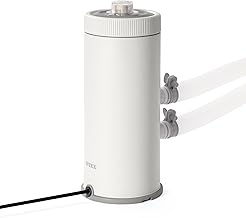
Intex Krystal Clear Cartridge Filter Pump
Compatible with most inflatable and above-ground pools up to 1,500 gallons. Easy cartridge replacement, quiet operation, and a built-in timer for hands-free circulation.
View on Amazon →Scrub the Walls and Floor — Remove the Biofilm
Algae doesn’t float freely in the water all the time. It attaches to surfaces — specifically the walls, floor, and any pool accessories like steps or toys. This surface growth is called a biofilm, and once it establishes itself, it becomes exponentially harder to kill. The biofilm’s outer layer can actually shield the algae underneath from sanitiser contact.
Brushing the interior surfaces of your pool two to three times per week dislodges algae before it can take root and sends the dislodged cells into the water where chlorine and filtration can neutralise them. It also prevents the staining and discolouration that algae causes on vinyl over time.
Choosing the Right Brush
Use a soft-bristle nylon brush designed for vinyl pools. Wire brushes or abrasive scrubbers will damage the inflatable shell’s surface, creating microscopic scratches that become perfect algae-attachment sites — the opposite of what you want. Pair the brush with a telescoping pole for reaching the floor without straining.
Don’t forget pool accessories. Floats, water toys, steps, and cup holders should be scrubbed and rinsed separately, because algae hides on any surface left wet between uses. For help keeping your pool’s bottom clean, check out our guide to the best vacuums for inflatable pools — a small hand vacuum makes floor cleaning genuinely easy.
Fig. 7 — Brush from top to bottom in overlapping strokes. Dislodged algae cells are then caught by the filter or neutralised by chlorine.
Brushing right before you add shock treatment maximises effectiveness. The physical dislodging opens up the biofilm, and the elevated chlorine then kills what the brush has exposed. This one-two combination is far more powerful than either approach alone.
Cover the Pool When Not in Use
A pool cover is one of the most underrated algae prevention tools available. When the pool is uncovered and not in use, sunlight streams in unimpeded, algae photosynthesize at full speed, and debris — leaves, insects, bird droppings, pollen — lands freely in the water, adding nutrients and contaminating the chemistry.
Covering the pool at night and whenever it’s not in use for extended periods dramatically reduces solar-driven algae growth and keeps organic load low. Studies on pool chemistry consistently show that covered pools require significantly less chemical treatment to maintain the same water quality as uncovered pools in comparable conditions.
What Kind of Cover to Use
For inflatable pools, a simple solar cover (also called a bubble cover or solar blanket) serves double duty: it blocks sunlight from reaching algae while also trapping heat — useful if you want warmer water for warming your pool naturally. Debris covers with elasticated edges that clip around the rim also work well and are easier to remove quickly.
The best covers for inflatable pools are purpose-made to fit the pool’s footprint tightly — a loose cover lets in light around the edges and doesn’t block debris effectively.
Fig. 8 — A pool cover blocks UV-driven algae growth and prevents debris from landing in the water, reducing chemical demand significantly.
Drain and Deep-Clean at Regular Intervals
No matter how diligently you maintain your pool chemistry, the water accumulates dissolved solids, phosphates, and chemical byproducts over time that make it progressively harder to keep clean. Every two weeks during active season — or immediately when water appears cloudy despite correct chemistry — a full drain and refill resets the baseline.
After draining, don’t simply refill. Take the opportunity to scrub every internal surface with a diluted bleach solution (1 part household bleach to 10 parts water), paying special attention to seams, corners, and the area around any drain or filter fittings where algae particularly likes to establish itself. Rinse thoroughly with fresh water before refilling.
Knowing how to drain inflatable swimming pools quickly saves significant time here — the right method can empty a medium pool in 20–30 minutes rather than waiting hours. Also, before you refill, it’s worth considering how much water your pool actually holds, so you can pre-calculate your chemical doses for the fresh fill.
Fig. 9 — The five-step deep clean cycle resets your water chemistry baseline and removes accumulated contaminants that feed algae growth.
Pool water with residual chlorine should not be drained directly into storm drains or near natural waterways. Let chlorine dissipate for 24–48 hours after your last chemical dose, or use a chlorine neutraliser before draining. Grass and gardens can handle diluted, neutralised pool water in most cases.
Types of Algae — What They Look Like and What They Mean
Not all algae are the same, and different types require different treatments. Identifying what you’re dealing with determines how aggressive your response needs to be.
| Algae Type | Appearance | Where It Grows | Difficulty | Best Treatment |
|---|---|---|---|---|
| Green Algae | Bright green haze in water or on walls | Everywhere in pool | Easy | Shock + algaecide + brush |
| Yellow / Mustard Algae | Yellow-brown powder on walls, especially shaded areas | Lower walls, seams, shaded spots | Moderate | Double shock + polyquat algaecide |
| Pink Slime | Pink or reddish film on fittings and return jets | Plumbing, filter, fittings | Moderate | Sanitiser + thorough scrubbing + filter clean |
| Black Algae | Dark spots with roots in vinyl | Walls, floor — deeply rooted | Difficult | Superchlorinate, aggressive brushing, copper algaecide |
Green Algae — The Most Common Offender
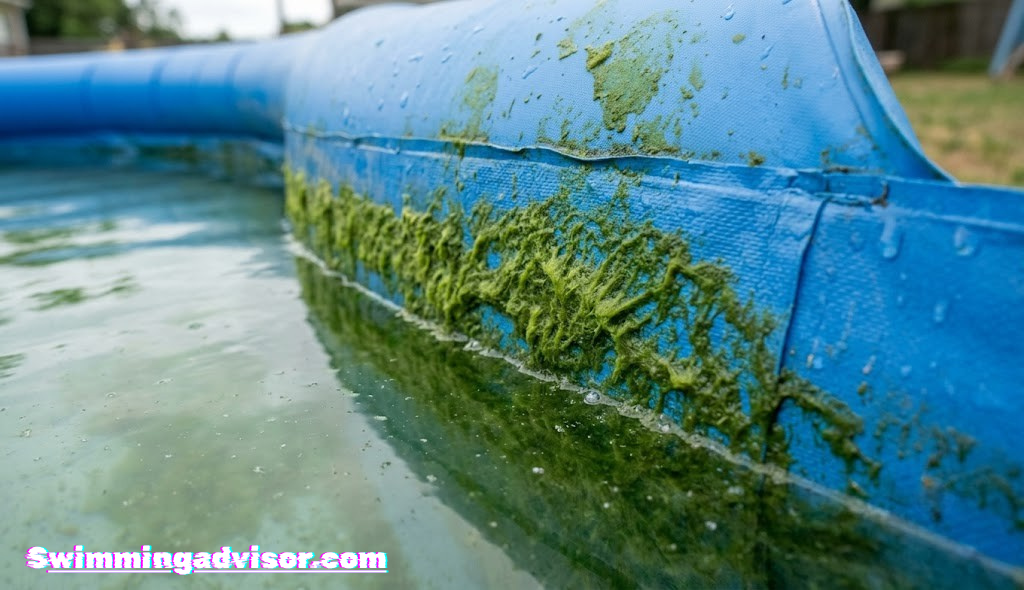
Green algae accounts for the vast majority of problems in inflatable pools. It’s fast-growing but also the most responsive to treatment. Catch it early — when water starts looking hazy rather than fully green — and a single shock treatment with brushing will typically clear it within 24 hours. Wait until the water is fully green and you’re looking at 2–3 days of elevated chemical treatment and extensive brushing.
Mustard Algae — Deceptively Stubborn
Mustard algae is chlorine-resistant due to a natural protective coating. It tends to cling to walls in a fine powder that brushes off easily but keeps returning. The key is a double or triple shock dose combined with a polyquat algaecide — standard shock levels aren’t sufficient. Also treat any accessories, toys, and the filter housing separately, as mustard algae contamination spreads easily.
Black Algae — Treat Aggressively and Early
Black algae is genuinely difficult and relatively rare in inflatable pools because its root system needs a porous surface to penetrate — and vinyl is quite smooth. However, worn or scratched vinyl can become vulnerable. If you spot black spots, treat them immediately with targeted superchlorination and physical brushing. Black algae that establishes deeply in a worn inflatable pool may indicate it’s time to replace the pool, as the roots can be nearly impossible to fully eradicate from degraded vinyl.
Chemical Dosing Quick Reference
One of the most practical things you can do for your pool is to create a consistent chemical routine and stick to it. Here’s a concise dosing guide calibrated for small-to-medium inflatable pools (250–1,000 gallons). Always follow specific product label directions — these figures are approximate starting points.
| Chemical | Purpose | Frequency | Approx. Dose per 500 gal | Notes |
|---|---|---|---|---|
| Dichlor Granules | Primary sanitiser | Every 2–3 days | 1–2 tsp | Pre-dissolve in bucket; test before dosing |
| Liquid Chlorine | Shock / booster | Weekly | 4–8 fl oz | Add near return jet at night |
| pH Decreaser | Lower pH | As needed | 1 tsp per 0.2 pH drop | Add slowly; retest after 4 hrs |
| pH Increaser | Raise pH | As needed | 1 tsp per 0.2 pH rise | Add near return jet with pump running |
| Baking Soda | Raise alkalinity | As needed | 1.5 tbsp per 10 ppm | Plain sodium bicarbonate works fine |
| Cyanuric Acid | Stabilise chlorine | Once per fill | 1–2 tsp | Dissolve completely before adding; test monthly |
| Polyquat Algaecide | Algae prevention | Weekly | 2–3 fl oz | Add 24h after shocking; pour around perimeter |
| Phosphate Remover | Remove algae food | Monthly | Per label | Turns water milky briefly — normal |
Each chemical goes in separately, with the pump running, and a minimum of 15–30 minutes between additions. Mixing pool chemicals can produce dangerous reactions, including chlorine gas. Add one at a time, always.
For a deeper dive into the full chemical picture, our complete guide on chemicals needed for inflatable swimming pools covers every product category with safety guidance and storage tips.

Complete Algae Prevention Bundle — Shock + Algaecide + Clarifier
Everything you need in one kit: fast-dissolving shock granules, no-foam polyquat algaecide, and a water clarifier to polish the water after treatment. Sized for small to medium inflatable pools.
View on Amazon →Frequently Asked Questions
For most inflatable pools in active use, adding chlorine every 2–3 days is a reasonable starting point. However, the correct frequency depends on your actual test results, not a fixed schedule. Test the water daily or every other day, and add chlorine whenever free chlorine drops below 1 ppm. Hot weather, heavy bather load, and rain all accelerate chlorine depletion and may require more frequent dosing. Using a cyanuric acid stabiliser slows UV breakdown and reduces the frequency needed.
Yes — baking soda (sodium bicarbonate) is chemically identical to most commercial alkalinity increaser products. It’s safe, food-grade, and readily available at a fraction of the cost. Use approximately 1.5 tablespoons per 500 gallons to raise total alkalinity by around 10 ppm. Always add it slowly with the pump running and retest after 4 hours of circulation before adding more.
This almost always comes down to pH being too high. When pH is above 7.8, chlorine loses most of its killing power — you can have 3 ppm of chlorine and still grow algae because it’s in the wrong chemical form. Test pH first and correct it to 7.2–7.6 before adding more chlorine. Other causes include a clogged filter reducing circulation, insufficient stabiliser allowing UV to destroy chlorine faster than you add it, or an extremely high phosphate level feeding the algae a supply that chlorine can’t fully offset.
Unscented household bleach (sodium hypochlorite, 6% or 8.25% concentration) works as a chlorine source for inflatable pools, particularly for small pools or as a shock treatment. It doesn’t contain stabiliser, which means chlorine depletes faster in sunlight, but for pools used on a rotating refill schedule, this isn’t a problem. Avoid scented bleaches or those with added “splash-less” thickeners, as these contain surfactants that can foam up your pool. Dose carefully — bleach is less concentrated than pool-grade liquid chlorine, so you’ll need more of it.
First, correct pH to the 7.2–7.4 range. Brush all pool surfaces vigorously to break up the biofilm. Shock the pool to 10 ppm of free chlorine using pool shock, run the filter continuously, and dose with a polyquat algaecide 24 hours after shocking. Test every 12 hours and maintain elevated chlorine until the water clears. For light infestations, clearing typically takes 24–48 hours. For heavy green water, you may need 2–3 days of treatment. If the water doesn’t clear within three days, a full drain and deep clean is faster and less frustrating than continuing to battle the existing water.
For very small pools used by young children and drained after each use, chemical-free maintenance is feasible — drain daily, scrub with a diluted white vinegar solution, and refill with fresh water each time. For any pool large enough that daily draining isn’t practical, some form of sanitiser is necessary to prevent algae and harmful bacteria. There are non-chlorine options such as bromine, mineral systems (silver/copper ionisation), and saltwater chlorinators, but these still produce active sanitiser — they’re just alternative delivery mechanisms rather than truly chemical-free solutions.
Under optimal conditions — warm water around 75°F (24°C), direct sunlight, and no chlorine — visible algae growth can appear within 24 to 48 hours. Algae cells double their population every few hours when conditions are right. In practical terms, an untreated inflatable pool left full in summer sun over a long weekend will almost certainly be visibly green by the time you return. This is why maintaining a minimum residual chlorine level at all times, even when the pool isn’t being actively used, is important.
Small-scale saltwater chlorine generators (SCGs) are available that are compatible with larger inflatable and soft-sided above-ground pools. They work by running low-voltage electricity through saltwater to generate chlorine on demand, providing continuous automatic sanitisation. The advantages include softer-feeling water and reduced need for manual chlorine dosing. The drawbacks are upfront cost and compatibility requirements — most work best in pools 1,500 gallons and up. For very small inflatables, a saltwater system is typically overkill relative to the cost.
The fastest reliable method: correct pH to 7.2, brush all surfaces, add a pool shock dose to achieve 10 ppm free chlorine, run the filter on maximum, and add a clarifier to help the filter capture dead algae cells. With all steps executed correctly, light-to-moderate algae blooms clear within 12–24 hours. If you have a pump-free pool or very limited filtration, draining, scrubbing with diluted bleach, and refilling is faster than attempting chemical treatment of heavily algae-laden water.
Recurring algae almost always means one of three things: the pH is consistently drifting too high (making chlorine ineffective), the filter isn’t running long enough to turn the water over fully, or there are phosphate levels driving algae nutrition that chlorine alone can’t overcome. Address pH first — if it keeps climbing, your total alkalinity may also be too high, causing it to buffer the pH upward. Then evaluate filtration hours and add a phosphate remover to eliminate the food source. Consistent weekly algaecide application after these root causes are corrected typically resolves the cycle.
Keeping Algae Out — A Summary That Sticks
Inflatable pools are wonderfully accessible — easy to set up, affordable, and endlessly enjoyable. The single barrier most owners run into is water maintenance, and specifically, the creeping green menace of algae. But as you’ve seen throughout this guide, it’s not complicated once you understand the underlying logic.
Test regularly so you know what you’re actually dealing with. Keep free chlorine between 1 and 3 ppm, pH between 7.2 and 7.6, and alkalinity between 80 and 120 ppm. Add a weekly algaecide dose as your second line of defence. Shock every 5–7 days and after any heavy use event. Run your filter at least 6 hours a day, brush the walls two to three times a week, and cover the pool whenever it’s not in use. Drain and deep-clean every two weeks.
That’s the whole system — nine steps, consistently applied. Follow them and algae won’t stand a chance. If you’re still shopping for the right pool, our guide to the best inflatable swimming pools can help you choose a model with filtration that makes maintenance genuinely easy. And if you have kids, see our picks for the best inflatable pools for kids — some come with design features that reduce algae risk from the start.
Clear water isn’t luck. It’s the result of a few consistent habits. Build those habits this season and you’ll spend all summer swimming rather than scrubbing.
Browse the Best Inflatable Pools →
Pingback: Does Swimming Help You Lose Weight? What Works
Pingback: Does Swimming Make You Taller? Science Says No