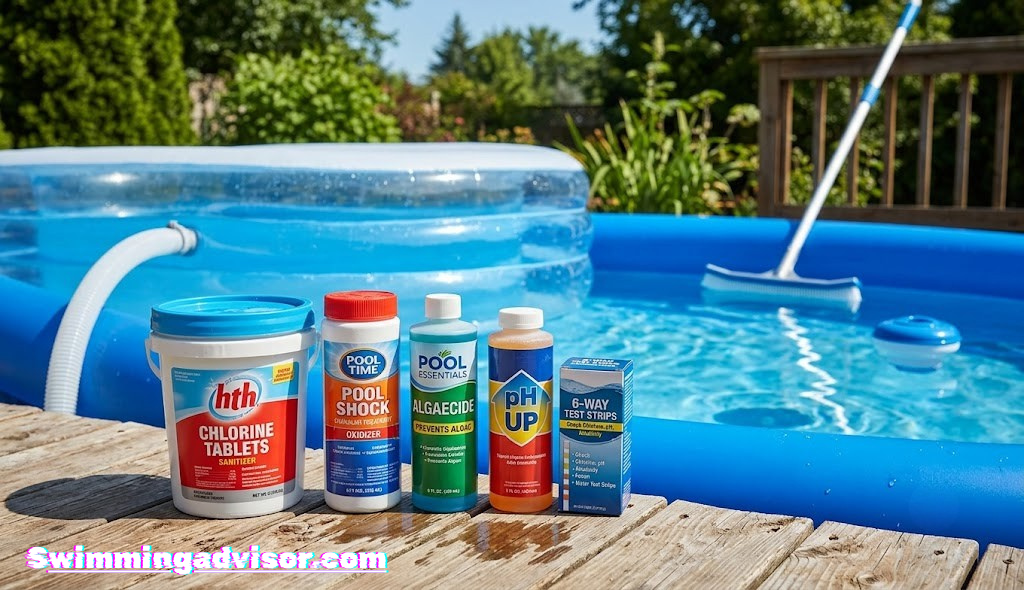
Chemicals Needed for Inflatable Swimming Pools
Every chemical your inflatable pool needs — chlorine, pH balancers, algaecides, shock treatments — with exact dosing charts, safety rules, and maintenance schedules for crystal-clear, healthy water.
The difference between sparkling, safe pool water and a green, bacteria-filled health hazard comes down to a handful of chemicals — correctly chosen, correctly dosed, and consistently maintained. This guide covers every chemical an inflatable pool owner needs to know: what each one does, how much to use, when to add it, and which products deliver the best results without breaking the bank or over-complicating your routine.
Why Pool Chemicals Are Non-Negotiable — Even for Small Inflatable Pools
There is a widespread belief that inflatable pools — particularly small kiddie pools — are too temporary or too modest to need chemical treatment. This is one of the most dangerous misconceptions in backyard pool ownership. Warm, standing water is one of the most hospitable environments for bacterial growth on earth. Within 24 hours of filling an untreated pool in summer temperatures, Pseudomonas aeruginosa (the bacteria responsible for swimmer’s ear and hot tub rash) can begin multiplying. Within 48 hours, E. coli — introduced by any swimmer, however briefly — can reach concentrations that would fail a public pool health inspection by orders of magnitude.
Algae presents a parallel problem. Green algae spores are present in virtually all tap water and the surrounding air. In a pool receiving direct sunlight, without any inhibitor, green algae can be visible as a slick surface film within 48–72 hours. Beyond being unsightly, algae creates a physical surface that harbors bacteria and makes pool walls dangerously slippery for children.
The good news is that maintaining safe inflatable pool water does not require expensive equipment, a chemistry degree, or hours of maintenance. For most medium-sized inflatable pools — the kind covered in our guide to the best inflatable swimming pools — a basic two-chemical routine (sanitizer plus pH control) keeps water safe all week for under a few dollars. This guide gives you everything you need to set up and sustain that routine with total confidence.
The 48-Hour Rule: Any inflatable pool water that has been sitting for more than 48 hours without sanitizer treatment in temperatures above 70°F (21°C) should be considered potentially unsafe for swimming. Drain and refill, or shock treat and re-test before allowing anyone in the water.
The volume of your pool determines almost everything about your chemical routine — how much you add, how often you test, and whether a simple daily-drain approach is practical. Our guide on how much water goes in inflatable swimming pools will help you calculate your exact pool volume if you are unsure, which is the essential first step before adding any chemical.
The 6 Core Chemicals Every Inflatable Pool Owner Needs to Know
Inflatable pool chemistry revolves around six chemical categories. Not every pool needs all six at all times, but understanding what each one does and how they interact is the foundation of effective, safe water treatment. Once you understand the role of each chemical, the maintenance routine becomes intuitive rather than intimidating.
Sanitizer
Kills bacteria & viruses. Chlorine or bromine. The foundation of every water treatment program.
pH Adjuster
Keeps water in the 7.2–7.6 sweet spot where sanitizers work best and swimmers are comfortable.
Shock Treatment
Oxidizes chloramines and resets water clarity. Used weekly or after heavy use.
Algaecide
Prevents and kills algae growth. Especially important in pools with direct sunlight exposure.
Clarifier
Clears hazy, cloudy water by binding small particles together so they can be filtered or settle.
Stabilizer (CYA)
Protects chlorine from UV degradation. Extends the effective life of each chlorine dose by up to 10×.
The most important concept in pool chemistry is that these chemicals do not work in isolation — they work as a system. Your sanitizer’s effectiveness is directly tied to your pH level. Your stabilizer determines how long each chlorine dose lasts before UV degrades it. Your algaecide fills the gaps that chlorine cannot reach in a pool without continuous filtration. Understanding these interdependencies allows you to troubleshoot problems intelligently rather than randomly adding chemicals until the water looks clear.
1. Sanitizer — The Most Important Chemical in Your Pool
Sanitizer is the single most critical element of inflatable pool water treatment. Without an active sanitizer, your pool is simply warm, standing water — an ideal breeding ground for the bacteria, viruses, and parasites that cause ear infections, gastrointestinal illness, and skin reactions. Chlorine is by far the most common and most cost-effective sanitizer for inflatable pools, though bromine is a viable alternative with specific advantages explored below.
Chlorine Tablets — The Easiest Maintenance Option
Slow-dissolving chlorine tablets (typically trichlor — trichloroisocyanuric acid) are the workhorse of inflatable pool maintenance. They come in 1-inch and 3-inch sizes; the 1-inch tablets are far more practical for inflatable pools, which are typically much smaller than full-size pools. Placed in a floating tablet dispenser — essentially a small plastic puck with holes that allows water to flow through and dissolve the tablet gradually — they release chlorine steadily over 5–7 days without any daily action from the pool owner.
The key advantage of tablets is set-and-forget convenience. Add one tablet per 1,000 gallons, place the dispenser in the water, and the pool maintains its chlorine level without daily attention. Test every other day to confirm the level stays in the 1–3 ppm range, and replace the tablet when it dissolves. Always pre-dissolve tablets in a small bucket of water before adding to the pool if you are not using a dispenser, and never place tablets directly on the pool floor — concentrated trichlor in direct contact with PVC can bleach and degrade the material.
Trichlor tablets have a naturally low pH (around 2.8–3.0), which means that continuous tablet use will slowly lower your pool’s pH over time. This is manageable with routine pH testing and the occasional addition of pH Up (sodium carbonate), but it is worth knowing as part of your routine.

Slow-dissolving trichlor tablets sized for inflatable and above-ground pools. Use with a floating dispenser for effortless maintenance. Ideal for pools up to 5,000 gallons.
Shop on Amazon →Granular Chlorine — For Fast-Acting Treatment
Granular chlorine — most often calcium hypochlorite (cal hypo, ~65% available chlorine) or sodium dichloro-s-triazinetrione (dichlor, ~56% available chlorine) — dissolves rapidly in water and raises chlorine levels within minutes rather than hours. This makes granular chlorine the preferred choice for two situations: shocking the pool when chlorine levels have dropped dangerously low, and making fast initial treatments when first filling the pool.
Calcium hypochlorite has one important note for inflatable pools: it raises water calcium hardness with each application. In a small pool where you are performing partial water changes regularly, this buildup is flushed out naturally. In a pool that rarely gets water changes, calcium hardness can climb over time and contribute to scale and cloudy water. Dichlor avoids this calcium issue and also includes its own built-in stabilizer (cyanuric acid), making it a slightly more versatile granular option for inflatable pool owners.
To use granular chlorine, always pre-dissolve the measured amount in a bucket of warm water before adding it to the pool. This prevents concentrated granules from settling on the pool floor and potentially bleaching or weakening the PVC material. Add the dissolved solution to the pool with the pump or agitation running if possible, and avoid swimming for at least 30 minutes after treatment. Test before allowing swimmers in.
Household Bleach — The Budget-Friendly Alternative
Regular, unscented household bleach (sodium hypochlorite at 6–8.25% concentration) is a genuinely effective and affordable chlorine source for inflatable pools, particularly small ones under 500 gallons where buying specialized pool chemicals feels excessive. The active ingredient — sodium hypochlorite — is the same compound used in liquid pool chlorine, just at a lower concentration.
Bleach Dosing Formula: Use approximately ¼ teaspoon (about 1.25 mL) of regular 6% household bleach per 10 gallons of pool water to achieve roughly 2 ppm free chlorine. For a 100-gallon pool, that’s approximately 2.5 teaspoons. Always use unscented, non-thickened bleach — scented or “ultra” formulas contain additives that are not safe for pool use.
The main drawback of household bleach is its shorter shelf life compared to pool-specific chlorine products — it degrades faster when exposed to light and heat, losing potency within a few months of manufacture. Always purchase fresh bleach and check the concentration on the label, as “regular” bleach has shifted from 5.25% to 6–8.25% in many brands. This affects dosing calculations. For pools regularly used by young children, our guide to the best inflatable swimming pools for kids includes notes on the minimum chemical requirements for safe children’s pool use.
Bromine — The Chlorine Alternative Worth Knowing
Bromine is the second major sanitizer option and is particularly popular in hot tubs and spas, though it works perfectly well in inflatable pools. Bromine has several advantages over chlorine: it is more stable in warm water (chlorine’s sanitizing power degrades significantly above 80°F), it does not produce the same skin and eye irritation at proper levels, and it does not create the sharp chlorine odour that some swimmers find unpleasant.
The primary disadvantages are cost (bromine is typically 2–3× more expensive than chlorine) and availability (most pool test strips are designed for chlorine; separate bromine test strips are needed). The target range for bromine in an inflatable pool is 3–5 ppm, slightly higher than chlorine’s 1–3 ppm range. For families whose members have chlorine sensitivity or skin reactions to chlorinated water, switching to bromine is worth the additional cost. For everyone else, chlorine remains the simpler and more economical choice.
2. pH Adjusters — The Factor That Controls Everything Else
pH is the logarithmic measure of how acidic or alkaline your pool water is, and it has a more profound impact on the success of your entire chemical program than most pool owners realize. At the wrong pH, even a perfectly dosed amount of chlorine can be almost completely ineffective. At the right pH, a modest chlorine dose keeps the water safely sanitized all week. This makes pH testing and adjustment arguably more important than getting the chlorine dose exactly right.
pH Up (Sodium Carbonate / Soda Ash)
When your pH test shows a reading below 7.2, add pH Up — sold under various brand names but chemically sodium carbonate (soda ash) or sodium bicarbonate (baking soda). Sodium carbonate is more potent and raises pH faster; sodium bicarbonate (pure baking soda) raises pH more gently and also raises total alkalinity, making it the better choice for pools where both pH and alkalinity are low. Add pH Up in small increments, stir or circulate the water, and re-test after 30 minutes before adding more. Over-correction is easy and then requires pH Down to fix.
pH Down (Sodium Bisulfate / Muriatic Acid)
When pH climbs above 7.8 — which often happens after heavy rain adds alkaline tap water, or after the natural off-gassing of CO₂ from filled pools — pH Down brings it back into range. Sodium bisulfate (dry acid) is the safer and more practical option for home pool owners; muriatic acid (hydrochloric acid) is more powerful but requires serious safety precautions including gloves, eye protection, and careful dilution. For inflatable pools, sodium bisulfate is the only pH Down product you should be using. Always add pH adjusters to the pool water — never add water to the chemical.

Everything needed to test and correct pH in an inflatable pool. Includes test strips or liquid test kit, soda ash pH increaser, and sodium bisulfate pH decreaser for the perfect chemical balance.
Shop on Amazon →3. Shock Treatment — The Weekly Reset Your Pool Needs
Shock treatment is perhaps the most misunderstood element of pool chemistry among inflatable pool owners. Many people believe they only need to shock a pool when something goes wrong — water turns green, smells bad, or becomes visibly cloudy. In reality, shocking once per week is part of proper maintenance, not a crisis response. Here is why.
As chlorine sanitizes pool water, it combines with nitrogen-containing compounds (from sweat, urine, sunscreen, and body oils) to form chloramines — combined chlorine compounds. Chloramines are far less effective at sanitizing than free chlorine, and they are the primary cause of the “chlorine smell” and eye irritation that most people wrongly attribute to too much chlorine. The irony is that a strong chlorine smell usually indicates not enough effective free chlorine — you are smelling the chloramines, not the active sanitizer.
A shock treatment — adding a large dose (typically 10× the normal level) of calcium hypochlorite or a non-chlorine oxidizer — breaks apart these chloramine compounds in a process called superchlorination or breakpoint chlorination, releasing the bound chlorine back into its active form and restoring the water’s sanitizing power. After shocking, wait for chlorine levels to drop back below 5 ppm before allowing swimming — typically 8–24 hours depending on the dose and UV exposure. Always shock in the evening to maximize the treatment’s effectiveness before UV degrades it overnight.
Non-Chlorine Shock: Potassium monopersulfate (MPS) is a non-chlorine shock option that oxidizes chloramines without adding chlorine. Its main advantage is a much shorter wait time — as little as 15 minutes before swimming is safe again. It is slightly less effective at breaking down heavy contamination but excellent for weekly maintenance shocking where the pool is used daily.
When to Shock Your Inflatable Pool
- Weekly, regardless of appearance. Even clear water accumulates chloramines through regular use.
- After heavy swimmer loads — pool parties, multiple children swimming all day.
- After heavy rainfall, which dilutes chlorine and introduces organic material.
- After any animal swims in the pool — dogs introduce high amounts of organic load. See our guide on whether inflatable pools are safe for dogs for more guidance on managing shared pet and human pool use.
- When the water first turns green or cloudy — a double or triple shock dose is the correct first response.
- When opening the pool at the start of the season after winter storage.

Fast-dissolving pool shock for inflatable and above-ground pools. Eliminates chloramines, restores water clarity, and reactivates your sanitizer program in hours. Single-use packets available for small pools.
Shop on Amazon →4. Algaecide — Preventing the Problem Before It Starts
Algae treatment follows a simple principle that most inflatable pool owners learn the hard way: prevention costs a tablespoon of algaecide per week; cure costs a triple shock dose, multiple water changes, and a thorough scrubbing. Algae spores are present in the air, in tap water, and on swimwear, meaning every pool is in a constant battle against algae whether the owner knows it or not. The question is whether your chemistry is winning that battle quietly in the background, or whether algae wins visibly in 48 hours.
Types of Algaecide and Which to Choose
| Type | Active Ingredient | Best For | Notes |
|---|---|---|---|
| Polyquat Algaecide | Polyquaternary ammonium | Regular weekly prevention | Non-foaming, compatible with all sanitizers, best all-rounder |
| Quat Algaecide | Quaternary ammonium | Budget prevention | Can foam at high doses; less effective for heavy algae problems |
| Copper-Based Algaecide | Copper sulfate | Green & black algae treatment | Very effective but can stain PVC surfaces blue-green at excess doses |
| Sodium Bromide | Sodium bromide | Algae already present | Must be activated with shock; extremely effective once activated |
For inflatable pool owners, polyquat algaecide is the clear recommendation. It is non-foaming (critical in pools without filtration systems where foam has nowhere to go), compatible with chlorine and bromine sanitizers, and effective against all three major algae types — green, black, and mustard. Copper-based alternatives risk staining the interior of your inflatable pool if overdosed, which is difficult to reverse. A weekly dose of polyquat algaecide, added on the same day as your shock treatment, gives your pool a complete defence cycle once per week.
If your pool has already developed visible algae, see our complete guide on how to keep algae out of inflatable swimming pools, which covers the step-by-step remediation process from diagnosis through treatment and prevention. Simultaneously, our guide on how to clean inflatable pools without a pump explains how to physically remove algae and debris from the pool surfaces and floor without specialized filtration equipment.
5. Water Clarifier — Clearing the Haze Quickly
Pool water clarifier is a coagulant — it works by attracting the tiny suspended particles responsible for cloudy, hazy water (fine dust, sunscreen residue, microscopic organic matter, dead algae cells) and binding them together into larger clumps that either settle to the pool floor where they can be vacuumed, or are large enough to be captured by a filter if your pool has one.
Clarifier is not a substitute for proper sanitization and pH control — it addresses the symptom (cloudy appearance) rather than the cause (chemical imbalance or organic contamination). When you encounter cloudy water, always test and correct chlorine and pH first. If the water remains hazy after chemical correction and allowing 4–6 hours for the treatment to work, then add clarifier to address the residual suspended particles.
For inflatable pools without filtration, add clarifier and allow 12–24 hours for particles to settle. Then use a pool vacuum or carefully drain and refill the pool to remove the settled debris without disturbing it back into suspension. Our guide on best vacuums for inflatable swimming pools covers the specific handheld vacuum models best suited to this process.
6. Cyanuric Acid (Stabilizer) — Protecting Your Chlorine Investment
Cyanuric acid (CYA), also called pool stabilizer or pool conditioner, is a chemical that forms a protective bond with chlorine molecules, shielding them from degradation by ultraviolet radiation. Without stabilizer, chlorine in direct sunlight can be fully depleted within 2 hours on a sunny day. With stabilizer at the correct level, the same chlorine dose can last 8–12× longer under identical sun exposure conditions. For an inflatable pool that sits in direct sun all day, this is not a minor difference — it is the difference between maintaining effective sanitizer levels between treatments and having effectively zero protection by noon.
The practical shortcut: if you are using dichlor granular chlorine as your primary sanitizer, it already contains cyanuric acid as a co-ingredient, so CYA levels build automatically with each treatment. If you are using trichlor tablets, they also contain CYA. In both cases, monitor CYA levels with a test kit and avoid letting it climb above 80 ppm — once it is too high, the only solution is partial draining and dilution with fresh water. If you are using calcium hypochlorite (cal hypo) or liquid bleach as your sanitizer, these contain no stabilizer, so you will need to add CYA separately to gain UV protection.
Testing Your Water — The Habit That Keeps Everything on Track
Every chemical recommendation in this guide is contingent on accurate testing. Adding chemicals without testing first is like adjusting a recipe without tasting it — you might get lucky, but more often you will overcorrect and create a new problem. Testing is quick (under two minutes with test strips), inexpensive (a 100-strip kit typically costs under $15), and is the single most effective thing you can do to maintain water quality.
Types of Pool Test Kits
| Test Type | Accuracy | Tests For | Best For | Cost |
|---|---|---|---|---|
| Test Strips | Moderate (±0.3 ppm) | CL, pH, alkalinity, CYA, hardness | Routine daily checks — fast & easy | $10–$20 / 100 strips |
| Liquid Drop Kit (DPD) | High (±0.1 ppm) | Free CL, total CL, pH, alkalinity | Precise troubleshooting & verification | $15–$35 |
| Digital Tester | Very High | CL, pH, ORP | Pool owners wanting precision readings | $40–$120 |
For most inflatable pool owners, a good set of 7-in-1 test strips (testing free chlorine, pH, total alkalinity, total hardness, cyanuric acid, and sometimes bromine) is all that is needed for a complete picture of water health. Test at least every two days during active use and within 30–60 minutes after adding any chemical to verify the result. Always collect the water sample from elbow depth in the middle of the pool — not from the surface, which can have localized chemical concentrations, and not from near the inlet or chemical dispenser.

Fast, accurate test strips measuring free chlorine, pH, alkalinity, hardness, and cyanuric acid simultaneously. Results in 15 seconds. Essential for any inflatable pool chemical program.
Shop on Amazon →Dosing Charts by Pool Size — How Much of Each Chemical to Add
The most common chemical mistake inflatable pool owners make is guessing at dosage. Pool chemistry products are designed for full-size pools holding thousands of gallons; an inflatable pool might hold 500 gallons, which means a “standard dose” on the packaging can be 4–6× too much. Always calculate your pool volume first (see our how much water goes in inflatable pools guide for the formulas), then use the charts below as your baseline.
Weekly Maintenance Dosing by Pool Volume
| Pool Volume | Chlorine Tablets (weekly) | Granular Chlorine Initial | Shock (weekly) | Algaecide (weekly) | pH Adj. (if needed) |
|---|---|---|---|---|---|
| 50–100 gal (kiddie / toddler) | ½ × 1″ tablet | ¼ tsp granular | 1 tsp cal hypo | 1 tsp polyquat | ¼ tsp increments |
| 100–300 gal (small family) | 1 × 1″ tablet | ½–1 tsp granular | 1 tbsp cal hypo | 2–3 tsp polyquat | ½ tsp increments |
| 300–600 gal (medium inflatable) | 2–3 × 1″ tablets | 2–3 tsp granular | 2–3 tbsp cal hypo | 1–2 tbsp polyquat | 1 tsp increments |
| 600–1,000 gal (large inflatable) | 3–4 × 1″ tablets | 1 tbsp granular | ¼ cup cal hypo | 2–3 tbsp polyquat | 1–2 tsp increments |
| 1,000–2,500 gal (large family) | 1–2 × 3″ tablets | 2–3 tbsp granular | ½–1 cup cal hypo | ¼ cup polyquat | 1 tbsp increments |
Critical Safety Rule: These are starting point estimates only. Always test your water first, calculate the adjustment needed from your current level to the target, then add in small increments and retest. Never add the maximum possible dose in one go — it is always easier to add more than to remove excess chemical from the water.
The 3-Tier Weekly Maintenance Schedule
One of the biggest frustrations pool owners face is feeling like pool chemistry requires constant attention. In reality, a well-structured maintenance routine for an inflatable pool takes about 10 minutes per week plus daily 90-second test checks. The schedule below organizes every task into a simple three-tier system that keeps the water safe, clear, and consistently maintained without becoming a second job.
Tier 1: Daily (90 seconds)
Test free chlorine and pH with a test strip. If chlorine is below 1 ppm, add a small chlorine boost and re-test in 30 minutes. If pH is outside the 7.2–7.6 range, add the appropriate adjuster in small increments. Check the floating tablet dispenser and replace the tablet if it has dissolved below the size of a marble. Visually scan for any discoloration or debris. This entire process takes 90 seconds and prevents every major water quality problem before it starts.
Tier 2: Every Other Day (5 minutes)
Skim any leaves, bugs, or surface debris with a net. Run a full test strip — checking chlorine, pH, alkalinity, and CYA — rather than just the quick daily spot checks. Inspect the pool’s inflation pressure and look for any seam areas that appear stressed or losing shape. Check that the floating dispenser is positioned centrally and not stuck in a corner where water flow is minimal. Note any changes in water color or clarity for trending purposes.
Tier 3: Weekly (15–20 minutes, Saturday evening recommended)
Saturday evening is the optimal shock night for most families — pools typically see the heaviest use over the weekend, and shocking in the evening allows the full night for treatment to work before Sunday swimming. Add your weekly shock dose, followed by your algaecide dose 30–60 minutes after the shock. (Never add algaecide and shock simultaneously in the pool — the shock can deactivate some algaecide formulas.) Check and replace the chlorine tablet. If you have been using the pool daily all week, this is also a good time to do a more thorough water test including CYA if you have a full test kit. For pools needing drainage guidance, see our guide on how to drain inflatable swimming pools quickly.
Chemical Rules for Small & Kiddie Pools — Where the Rules Change
The chemical guidance above applies primarily to medium and large inflatable pools — those holding 100 gallons or more and used by school-age children and adults. For very small kiddie pools and toddler splash pools (under 100 gallons, used by children under 5), the equation changes significantly, and in many cases the safest approach is no chemicals at all.
Young children — particularly those under 3 — are more sensitive to chemical exposure in multiple ways. They have a higher skin surface area to body weight ratio, meaning they absorb proportionally more of any chemical that contacts their skin. They are more likely to accidentally ingest pool water. Their immune systems are still developing, making any contamination more consequential in both directions (from pathogens if the water is untreated, and from excess chemical exposure if overdosed).
For pools under 100 gallons used by toddlers, the recommended approach is simple: drain after each use, rinse and refill with fresh water before the next session. No chemicals required, no testing required, no safety concerns. This is practical because small pools hold so little water that daily drainage is minimally wasteful, and refilling takes just a few minutes. The small pools and foldable kiddie pools featured in our guide to the best inflatable swimming pools for kids are specifically sized to make this daily-drain approach convenient.
For 100–300 Gallon Pools with Young Children: If daily draining is impractical, use a minimal chlorine treatment — ½ of a 1-inch tablet via floating dispenser, and test to confirm the level is between 1–2 ppm before children swim. A more conservative 1–2 ppm target (rather than up to 3 ppm) gives an additional safety buffer for young swimmers.
One additional concern with small pools and children: water temperature. In summer heat, a small, direct-sun pool can reach temperatures of 90°F or above within an hour or two of filling. At these temperatures, bacterial growth accelerates dramatically, shortening the safe “no chemical” window significantly. On hot days, position the pool in partial shade, or add a very small amount of chlorine and test to 1 ppm before children swim, even if you plan to drain and refill later.

Everything in one box: chlorine tablets, shock packets, algaecide, pH Up, pH Down, and test strips sized for small to medium above-ground and inflatable pools. No guesswork, no separate purchases.
Shop on Amazon →Pool Chemical Do’s and Don’ts — The Rules That Prevent Costly Mistakes
Pool chemical errors are some of the most common and most preventable mistakes in inflatable pool ownership. Each of the “don’ts” below represents a real mistake that real pool owners make regularly — often with consequences ranging from ruined pool surfaces to unsafe water to genuine chemical hazards.
✅ DO
- Always test before adding any chemical
- Pre-dissolve granular chemicals in a bucket of water first
- Add chemicals to water, never water to chemicals
- Run or stir water after adding any chemical
- Wear gloves and eye protection when handling concentrated chemicals
- Store chemicals in their original, labeled containers
- Check pH before chlorinating — pH controls how effective chlorine is
- Add shock in the evening to maximize overnight treatment
- Wait 30–60 minutes (or per label) after any addition before re-testing
- Keep a simple log of what you add and when
- Add algaecide 30+ minutes after shock, never simultaneously
- Use a floating tablet dispenser — never let tablets rest on the pool floor
❌ DON’T
- Mix different chemicals in the same bucket or container
- Add multiple chemicals to the pool at the same time
- Assume the water is safe because it looks clear
- Use scented bleach or “ultra” thickened bleach
- Let chlorine tablets rest directly on the pool floor or liner
- Allow swimmers in until CL is confirmed below 5 ppm
- Ignore pH because “the water looks fine”
- Store chemicals in direct sunlight or next to a heat source
- Mix different chemical brands in the same dispenser
- Use any chemical after its expiration or storage date
- Over-dose trying to speed up results — always go slowly
- Leave chemical containers open between uses
Chemical Storage & Safety — Protecting Your Family and Home
Pool chemicals are effective precisely because they are chemically reactive — and that reactivity demands respect in storage and handling. The safety rules in this section are not suggestions; they are non-negotiables that protect your family, your home, and anyone who handles the chemicals.
Storage Non-Negotiables
- Original containers only. Never transfer pool chemicals to unlabeled or repurposed containers. Original packaging includes critical safety information and is designed to minimize accidental exposure.
- Cool, dry, and ventilated. A shed, garage with ventilation, or dedicated chemical storage box works well. Avoid anywhere that gets hot in summer (above 90°F accelerates chemical breakdown) or humid (moisture causes granular chemicals to cake and can initiate dangerous reactions in some products).
- Away from fuel, paint, and flammables. Pool oxidizers — shock treatments and some algaecides — can accelerate fires dramatically when in contact with organic materials, oils, or petroleum products. Store pool chemicals well away from any flammable storage.
- Out of reach of children and pets. This should be obvious, but pool chemicals are among the most common causes of household chemical poisoning injuries in children. A locked cabinet or high shelf is appropriate for any home with children.
- Never mix in storage. Chlorine and acid products stored close together can release chlorine gas through container walls and seals. Keep different chemical categories physically separated, ideally in different storage areas.
For broader inflatable pool maintenance context — including how chemical care ties into the overall cleaning routine, cover use, and water replacement schedule — our related guides cover each piece of the puzzle: best covers for inflatable pools (reducing contamination load), cleaning without a pump, and proper pool setup (preventing contaminated runoff from entering your pool).
If you are also managing a pool used by both adults and children, our guides to the best inflatable pools for adults and the best overall inflatable pool recommendations for adults cover larger pools that require proportionally higher but still manageable chemical doses. For larger-capacity models, the rectangular vs. round pool comparison affects water volume calculations and therefore dosing significantly — a key consideration when planning your chemical program.
Frequently Asked Questions
These are the questions pool owners ask most often about inflatable pool chemistry. Each answer is structured for both quick scanning and the depth needed to actually apply the information.
What chemicals do I need for an inflatable swimming pool?
How much chlorine do I put in an inflatable pool?
Can I use bleach instead of chlorine in an inflatable pool?
What is the correct pH level for an inflatable pool?
Do I need to shock an inflatable pool?
How often should I test the water in my inflatable pool?
Is it safe to swim in an inflatable pool with chlorine?
Can I use pool chemicals in a small kiddie pool?
What happens if I don’t put chemicals in my inflatable pool?
What is the difference between chlorine tablets and granular chlorine?
Do inflatable pools need algaecide?
How do I store pool chemicals safely?
Conclusion: Clean Water Is Simple When You Know the System
Inflatable pool chemistry is not complicated — it only feels that way before you understand the role each chemical plays. Once you internalize the logic (sanitizer kills pathogens; pH controls how well the sanitizer works; shock resets the system weekly; algaecide fills the gaps; stabilizer protects your chlorine investment from the sun), the routine becomes second nature. Test every day — 90 seconds. Adjust as needed. Shock every Saturday evening. Add algaecide after the shock. Done.
The most important takeaways: always test before adding anything, always add chemicals in small increments, and never assume that clear-looking water is safe water. The pathogens that cause ear infections, stomach illness, and skin rashes are entirely invisible — only your test strip can tell you whether your chlorine is actually doing its job.
For everything beyond the water itself — from setting up your pool correctly to keeping it in great shape across seasons — our full library of inflatable pool guides covers every topic in the same depth as this chemistry guide. The best inflatable swimming pools master guide is the natural starting point if you are still choosing a pool. Once you have one, our guides on what to put under inflatable pools, pool covers, and draining quickly at season’s end will keep it protected and performing all summer.
Ready for Crystal-Clear Pool Water All Season?
Browse all of our expert inflatable pool guides — from chemical care and maintenance to pool selection and seasonal setup — at SwimmingAdvisor, the most comprehensive resource for inflatable pool owners.
Explore All Pool Guides →